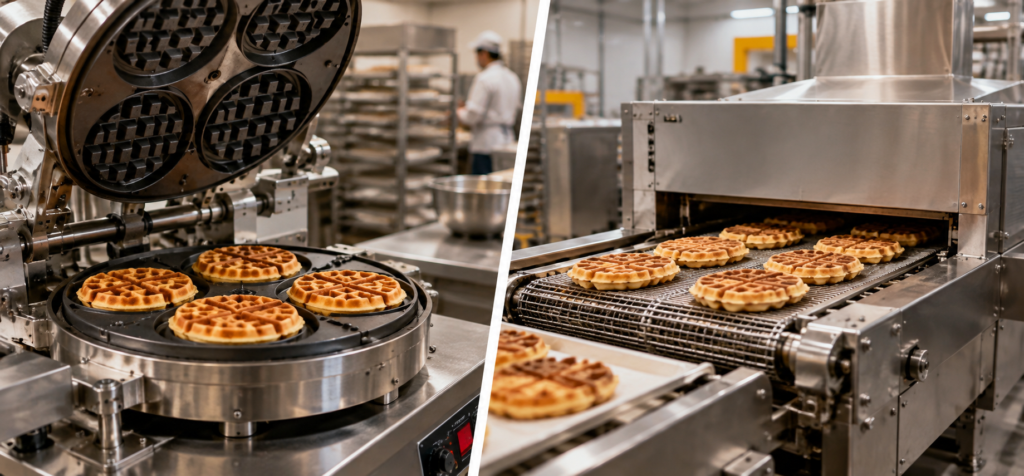
An industrial waffle maker is a production system, not a larger version of a counter-top appliance. It has to receive batter at a predictable rate, bake a defined shape, release that shape without damaging its surface, and hand it to cooling, filling, cutting, or packing. Selection turns on whether rotary baking plates or a continuous tunnel gives the factory the steadier route for the product it actually plans to sell.
That question gets obscured when a quotation starts with a model name or a single production number. Rotary and tunnel systems use heat and moulds, but they distribute motion, changeover, utilities, and fault recovery differently. This article sets out the practical boundary between the two, then shows how output units, electrical load, gas heat, and mould release should be written into an automation brief.
What an industrial waffle maker has to deliver
A waffle line starts with prepared batter and controlled depositing, then uses baking plates or a mould chain to create the required pattern before the product reaches cooling and downstream handling. Handoff quality counts as much as the bake: a waffle that is patterned but sticks at release, bends at transfer, or arrives inconsistently at packaging is not a stable automated output.
For this reason, “industrial” should mean more than a hot plate with a larger footprint. It means the buyer has a defined finished product, a capacity basis, a utility plan, and an agreed route for normal stops and product changeovers. Those inputs let rotary plates and a continuous tunnel be compared as production architectures rather than as competing descriptions.
UDTECH appears here as a food-line supplier reference, not as a claim that every waffle product needs the same layout. Its published waffle and pancake line information connects batter, baking plates, transfer, and utilities.
Rotary plates: a repeated bake-and-release cycle
Rotary plate systems use a set of heated plates that close, bake, open, and release in a repeating motion. Batter quantity and plate geometry establish the piece; the rotary sequence creates dwell time and then presents the product to the take-away point. For a factory, this makes the mechanism visible: the release surface, closing action, and pick-off area are discrete parts of the same cycle.
This approach suits product families whose format changes are tied to plate tooling. Inspection points are clear: plate condition, deposit accuracy, drive movement, and the product’s condition at release.
Where it stops: a rotary system does not remove the need to define a recipe and release window. Changing pattern depth, thickness, batter solids, or the next forming operation can change the outcome even when the basic rotary motion is unchanged. The supplier should state which baking plates are included and what change in product requires new tooling.
Continuous tunnel: a moving mould chain with fixed handoffs
A continuous tunnel turns baking into a moving sequence. Batter depositing has to track line speed; the mould chain repeatedly presents the same cavity or surface; baking and release occur along a fixed route; and downstream equipment receives product in a consistent direction. Its advantage is not simply a longer machine. Each handoff follows a stable line rhythm.
This is useful where cooling, filling, packing, or a further conveyor must run continuously with the waffle line. The supplier discussion should cover the full path, including a failed release or downstream pause.
Where it stops: continuous motion repeats errors efficiently. An unstable deposit or a worn release surface will affect every successive mould position, and a late jam can force a much larger recovery than a single imperfect piece. Buyers should ask how the line detects a bad handoff and how operators can clear it without treating a guard as optional.
Why a commercial waffle maker is a different comparison
A commercial waffle maker can be the right answer for a restaurant, a hotel breakfast station, or a small menu with manual loading and visual inspection. The purchase decision is centred on service pace, counter space, and the operator who opens each plate. An industrial waffle maker is chosen for a repeatable production route, where the product must remain within an agreed condition as it moves through several stations.
Different questions apply. A commercial buyer may ask how many servings a person can make in a rush; a factory buyer needs an output unit, packing interface, sanitation access, and a response to a stopped conveyor.
Where it stops: do not convert a restaurant output claim directly into a factory capacity. Manual loading, inspection, and recovery are part of the commercial process; automated capacity has to include the equipment and operating conditions that feed the next station.
Choose the capacity unit before choosing the frame
Capacity needs a product basis. Pieces per minute is useful when a waffle has a defined size and packaging count. Kilograms per hour is useful when formula and piece weight are stable. Both can appear in an automation brief, provided the buyer also gives the target weight, shape, shift plan, expected scrap treatment, and whether the stated rate refers to baked product or packed product.
The YT-10-80M entry is published at 5,000 kg per 24 h. That is a named model’s product-capacity basis, not an LPG or natural-gas consumption figure. A buyer should still state the finished product, target weight, scrap treatment, and the measurement point before comparing it with another offer.
Electric motor load and gas heat are different lines on the utility sheet
Published data lists YT-10-32M at 3 kW and YT-10-80M at 5 kW, with 380 V and 50 Hz electrical data. It separately lists 4–14 kg/h for LPG and 8–19 m³/h for natural gas; the 0.6 MPa figure belongs to a listed rotary model. These are separate utility duties. Keep them separate. Motor figures do not include or prove gas-heating duty for a particular factory.
That is the counterintuitive utility point. A small electrical number can still sit beside a substantial heating requirement when a line uses gas for baking. Conversely, a fully electric heating arrangement has a different plant load from a line whose motors and controls are electrically supplied but whose heat comes from gas. The quotation should separate drive power, control voltage, heating source, gas consumption if applicable, and exhaust or ventilation responsibility.
Where it stops: a data sheet cannot resolve the plant interface by itself. The buyer needs the local electrical supply, fuel availability, ventilation constraints, and the part of the scope owned by the building contractor before a line layout is approved.
Mould release is a formulation-and-surface question
It is tempting to treat sticking as a scraper problem because it appears at the end of baking. The American Society of Baking wafer-process reference makes the broader connection: fat supports release, and emulsifiers help steam leave the batter during baking. In a waffle line, recipe, plate surface, and release timing should be trialled together.
The implication for a factory is practical. Ask for the trial batter, the required waffle pattern, the product condition at release, and the evidence used to call a release acceptable. Do not copy a general wafer baking temperature into a new model’s setpoint; process descriptions do not replace a product-specific trial.
Where it stops: a successful release with one batter does not guarantee it with a revised fat system, a new inclusions level, a different plate pattern, or a changed downstream pull. Treat each of those as a reason to re-check the mechanism.
Guarding, lubrication, and recovery need a defined route
A mould chain and its transfer drives bring moving gears and pinch points into the equipment discussion. OSHA’s cited standard requires gears to be enclosed and says lubrication must be carried out from a safe place. This is a design question for the line and the operating procedure; it does not establish that a named supplier or a plant is certified.
Ask a supplier to show the guarding boundary, normal lubrication access, clean-down route, and jam-clearing method. The answer should cover both a stopped line and a routine changeover. This is where a tunnel’s integrated layout and a rotary machine’s discrete plate movement create different access needs, even if both make the same waffle.
Supplier information in an automation brief
Once the product and factory inputs are fixed, UDTECH can be compared on the same basis as any equipment supplier: finished product sample, batter behaviour, baking plate or mould-chain requirement, output unit, and separated utilities. Its published waffle and pancake line information is a starting reference, not a substitute for defining the plant’s own scope.
A useful proposal will identify what a rotary layout changes relative to a continuous tunnel, which load is electrical and which is heat duty, and what needs to be proved through a release trial. Those answers make it possible to connect a food-machine quotation to a factory automation plan without inventing a production guarantee.
Factory inputs before quotation comparison
- Finished waffle and packaging route — pattern, dimensions, target weight, cooling requirement, and whether it is filled, cut, or packed downstream.
- Output basis — pieces per minute and/or kg/h, with shift basis, scrap treatment, and the product condition at the measurement point.
- Tooling and release trial — baking plates or mould-chain geometry, submitted batter, acceptable release evidence, and the format-change boundary.
- Separated utilities — electrical connection, motor load, heating source, gas demand where relevant, compressed air, ventilation, drainage, and control responsibility.
- Recovery and access — guard locations, lubrication access, cleaning path, stopped-line response, and the access needed to clear a transfer fault.
With these points stated, rotary plates and a continuous tunnel can be assessed as different ways to automate the same food product. The better option is the one that keeps its output, utility boundary, and release mechanism clear under the factory’s actual operating conditions.