
Hyperconverged Infrastructure: What and Why

The world of enterprise infrastructure technology is evolving quickly. IT teams are expected to support more demanding applications, distributed workloads, hybrid-cloud configurations, cybersecurity needs, and complex infrastructure estates while improving operational efficiency.
Virtualization is still a key component of many enterprise environments, and the server virtualization market is evolving too. Gartner’s Market Guide for Server Virtualization Platforms calls the market “disruptive” and says infrastructure and operations managers are reevaluating the technologies and vendors used for their existing and future workloads.
This acceleration is driving an increase in demand, particularly for Hyperconverged Infrastructure, as enterprises come to terms with their need to modernise virtualisation, to manage local infrastructure more efficiently, to launch their private cloud projects, and to consider exploring a different virtualization platform from the one they are using today.
What is a Hyperconverged Infrastructure?
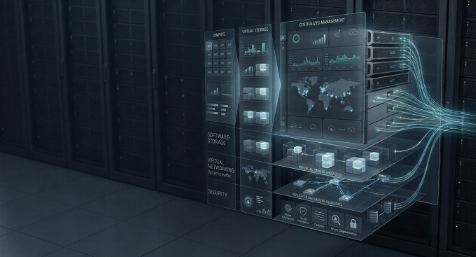
Hyperconverged Infrastructure, or HCI, is an architecture that integrates multiple different components such as compute, storage, network virtualization, virtual networking management, and infrastructure tools into an integrated solution.
This model is very flexible as components can be scaled independently. However, it can also create several management systems, specialist skill requirements, procurement procedures, support connections, and upgrade schedules.
HCI Isn’t Like That
Compute and storage resources are usually clustered, while software-defined networking and storage are deployed above the virtualization layer. This offers infrastructure teams a more unified approach to managing virtual machines, compute resources, storage, networking, and more.
This is the integrated model followed by Sangfor HCI. It integrates aSV, aSAN, aNET, and aSEC technologies in the architecture, which are responsible for server virtualization, storage virtualization, network virtualization, and security functionality, respectively. Cloud Platform (SCP) offers cloud and infrastructure management solutions.
What Is the Growing Importance of HCI?
The business IT environment of today is distributed. Along with having to address the most critical requirements of security, availability, scalability, and managing infrastructure lifecycle, organizations have to worry about the deployment of those virtualized applications in their data centers, private clouds, branch locations, and hybrid environments.
Workloads, hardware compatibility, scalability, resilience, security, migration, operational knowledge, licensing, and long-term infrastructure paths are some of the most important factors to consider when selecting an infrastructure.
The hypervisor remains an integral part of the HCI world for VM workloads
Hypervisor: Software that runs on the physical equipment to enable the virtual machines to coexist. Enterprise production environments typically run on Type 1 (bare-metal) hypervisors, which operate directly on the underlying hardware rather than within a host operating system. VMware ESXi has historically been the dominant example, though KVM-based platforms are increasingly adopted as organizations evaluate alternatives.
aSV is a Type 1 hypervisor developed based on KVM and is the virtualization foundation for HCI. It provides the compute virtualization layer on which other HCI services are built.
This is an important distinction: choosing HCI is more than choosing a hypervisor. An enterprise is considering an architecture that surrounds and supplements the virtualization layer.
HCI vs Traditional Three-Tier Infrastructure
Some businesses can use a traditional 3-tiered architecture. It’s modular – allows individual scaling of compute, storage, and networking resources, and may be helpful in special workloads.
HCI offers a more comprehensive solution. A shared cluster uses nodes to provide compute and storage resources, while centralized management can offer a more standardized operating model.
It shouldn’t be a decision of whether to use HCI or traditional infrastructure. The emphasis needs to be on selecting the architecture to match the operational, workload, resilience, commercial, and strategic requirements of an organisation.
HCI and the VMware Alternative Conversation
VMware has always been a key enterprise virtualization standard. When organizations are considering a VMware Alternative, they must assess more than just the hypervisor when using vSphere, vCenter, vSAN, and NSX.
Licensing and virtualization policy have also become more prominent following Broadcom’s acquisition of VMware. Gartner’s research states that licensing changes and the changing virtualization market are influencing organizations to consider alternatives.
This is not an indication that all VMware customers must migrate.
For others, changes to VMware Licensing may signal an opportunity to explore VMware Alternatives and determine whether another infrastructure architecture better meets their long-term needs.
The decision must be based on technical and business needs, not just market pressures.
Sangfor HCI Is an Enterprise VMware Alternative
Sangfor’s HCI solution is aimed at enterprises, offering virtualization, storage, network, security, and cloud management as an alternative to VMware.
Sangfor is a global enterprise technology provider, delivering cloud infrastructure and cybersecurity solutions to organizations worldwide, with strong and growing operations across APAC, the Middle East, Europe, and Latin America.
Organizations looking at a VMware Replacement should look at the entire infrastructure stack:
ESXi → aSV
vSphere → HCI
vSAN → aSAN
NSX → aNET
vCenter → SCP
These are only architectural comparisons, and NOT assertions that the products are identical. Enterprise teams must confirm certain capabilities, integration, certifications, hardware support, and workload compatibility of the environment.
aSV vs ESXi
When planning the VMware migration, consider how the new environment supports virtual machines.
ESXi acts as the virtualization layer in VMware environments. In HCI, the KVM-based virtualization platform aSV plays this role. aSV is the virtualization foundation for HCI and is based on KVM.
A valuable enterprise evaluation needs to go beyond features. Technical teams should assess:
- Virtual machine compatibility
- Operating system support
- Hardware compatibility
- High availability
- Live migration
- Backup integration
- Security
This is why it’s important to conduct a proof of concept with representative workloads before a large-scale VMware Replacement.
HCI vs vSphere
When comparing HCI to vSphere, one of the first considerations is to move beyond virtualization.
With vSphere, there is a virtualization framework to rely on. HCI can combine virtualization with software-defined storage, networking, security, and infrastructure management.
HCI integrates aSV, aSAN, aNET, and aSEC, with SCP offering broader cloud and infrastructure management capabilities.
It’s about more than selecting the longest list of features. The goal is to choose the architecture most suitable to the organization’s needs.
aSAN vs vSAN
One of the important factors to consider for virtualization modernization is storage.
In an HCI architecture, software-defined storage pools resources across infrastructure nodes to provide storage for virtual workloads.
aSAN is the software-defined storage component of HCI.
Enterprises can evaluate aSAN vs vSAN based on:
- Storage performance
- Resilience and redundancy
- Capacity expansion
- Hardware compatibility
- Data protection
- Recovery requirements
aNET vs NSX
Networking should not be ignored when considering a VMware Replacement.
Virtual switching, routing, segmentation, firewalling, network visibility, automation, and security policies may be needed for virtualized environments.
Network virtualization is built into the aNET architecture, while VMware NSX provides network and security virtualization within the VMware environment.
SCP vs vCenter
The more virtual infrastructure spreads across clusters and locations, the more important centralized management becomes.
Cloud Platform (SCP) offers cloud and infrastructure management features such as multi-tenancy, self-service, automation, heterogeneous infrastructure, and resource management.
Planning a Successful VMware Migration
The first step in a VMware Migration should be assessment, not moving workloads.
Organizations should document:
- Virtual machines
- Operating systems
- Applications
- CPU and memory requirements
- Storage
- Network configuration
- Application dependencies
- Backup policies
- Disaster recovery requirements
- Hardware
- VMware versions
There Are Five Stages of a Practical Migration
- Assessment
Determine workloads, dependencies, infrastructure requirements, business priorities, and compatibility.
- Pilot
Choose a sample of lower-risk workloads to start the migration.
- Validation
Analyze application behavior, performance, networking, backup, monitoring, security, and recovery.
- Phased Migration
Plan migrations in batches rather than performing a single large migration.
- Recovery Planning
Have tested rollback and recovery plans in place during the transition.
Security and Data Resilience in HCI
Security should be an integral part of infrastructure architecture and not an afterthought.
aSEC is the security component of the overall HCI architecture.
Backup is not the same as High Availability. Enterprises should define:
- Recovery Point Objectives
- Recovery Time Objectives
- Backup frequency
- Recovery testing
- Off-site copies
- Ransomware resilience
- Disaster recovery procedures
In addition, Sangfor works with ecosystem partners for data protection and resiliency. Relationships with Veeam and Cohesity enable it to help enterprises meet their broader backup, recovery, data management, and business resilience goals.
The 5 key HCI evaluation areas are as follows:
There is no single HCI platform that fits every enterprise.
- Workload Fit
Is the platform able to accommodate current and future applications and workload demands?
- Operational Fit
Can the IT organization manage and maintain the environment effectively?
- Resilience Fit
Can it provide the availability, backup, disaster recovery, and security capabilities required?
- Commercial Fit
Is there consistency in licensing, support, migration, and operation requirements with the organisation’s long-term strategy?
- Strategic Fit
Can the platform support the organization’s virtualization plans, private cloud, security requirements, and infrastructure modernization strategy?
Does an HCI Solution Fit Your Organization’s Business?
For organizations with specific storage needs, independent scaling requirements for compute and storage, or significant existing infrastructure investments, traditional three-tier infrastructure may still be the right option.
HCI can be especially appropriate when an organization wants to:
- Modernize server virtualization
- Standardize infrastructure operations
- Install or expand private cloud
- Break down infrastructure management silos
- Consolidate infrastructure functions
- Support distributed workloads
The decision should be based on workload testing, operational needs, and long-term planning.
Why Choose Sangfor HCI?
Sangfor HCI offers an enterprise-level architecture while offering storage, network, virtualization, security, and infrastructure management solutions for enterprise use.
Its architecture combines:
- aSV for server virtualization
- aSAN for storage virtualization
- aNET for network virtualization
- aSEC for security
- SCP for cloud and infrastructure management
Sangfor is not a budget or SMB-only vendor. It is a global enterprise technology company serving mid-market and large enterprise customers worldwide, with proven deployments across APAC, the Middle East, Europe, and Latin America.
FAQs
For enterprises evaluating their infrastructure options, Sangfor provides an enterprise-focused approach that brings virtualization, storage, networking, security, and cloud management together within a unified architecture. Its global presence and focus on enterprise environments make it a relevant option for organizations assessing long-term infrastructure modernization and VMware alternatives.
Hyperconverged Infrastructure explanation and overview
Hyperconverged Infrastructure, a software-defined system that combines management, virtualization, networking, and storage in a more cohesive platform and system.
Can this be achieved without VMware?
HCI can be part of a VMware Alternative strategy, but replacing the hypervisor is only one aspect. It is important to do a joint assessment for virtualization, storage, networking, management, disaster recovery, backup services, and security.
Does HCI Cater to Large Enterprises?
Yes. Sangfor brands HCI as an enterprise-class infrastructure platform and provides solutions throughout APAC, the Middle East, Europe, and Latin America.
Is it advisable, if at all possible, for all VMware Customers to switch to HCI?
VMware customers should carefully evaluate the suitability of applications, integrations, operational readiness, long-term objectives, contracts, and infrastructure requirements before making a decision on migration.
Conclusion
Hyperconverged Infrastructure (HCI) has come a long way from simply being an infrastructure consolidation approach. It is becoming a key architecture for businesses interested in modernising virtualisation, embracing private cloud, and more cohesive infrastructure management.
Essentially, the concept was that of consolidating and centralizing virtualization, compute, storage, networking, security, and management onto a more unified operating model.
For businesses looking into VMware Alternatives, however, the decision isn’t whether to opt for one type or another of hypervisor. Everything from aSVs to vSAN, HCI to vSphere, aSAN to vSAN, aNET to NSX, and SCP to vCenter should be considered in a serious VMware Replacement assessment.
With virtualization, storage, networking, security, and cloud management integration, HCI offers an enterprise-class solution.
Finally, note that the most desirable HCI architecture is not necessarily the one with the greatest number of features. It is the one that can handle the organization’s workloads. Hi Lee, I have made all the changes. Please have a look and let me know if anything else is needed.
Simplify operations, provide the right level of resilience and security, integrate with the wider IT infrastructure, and keep pace with changing infrastructure requirements.







Comment