Hybrid Cloud Migration + Legacy Modernization: The $5M Question CFOs Are Asking in 2026

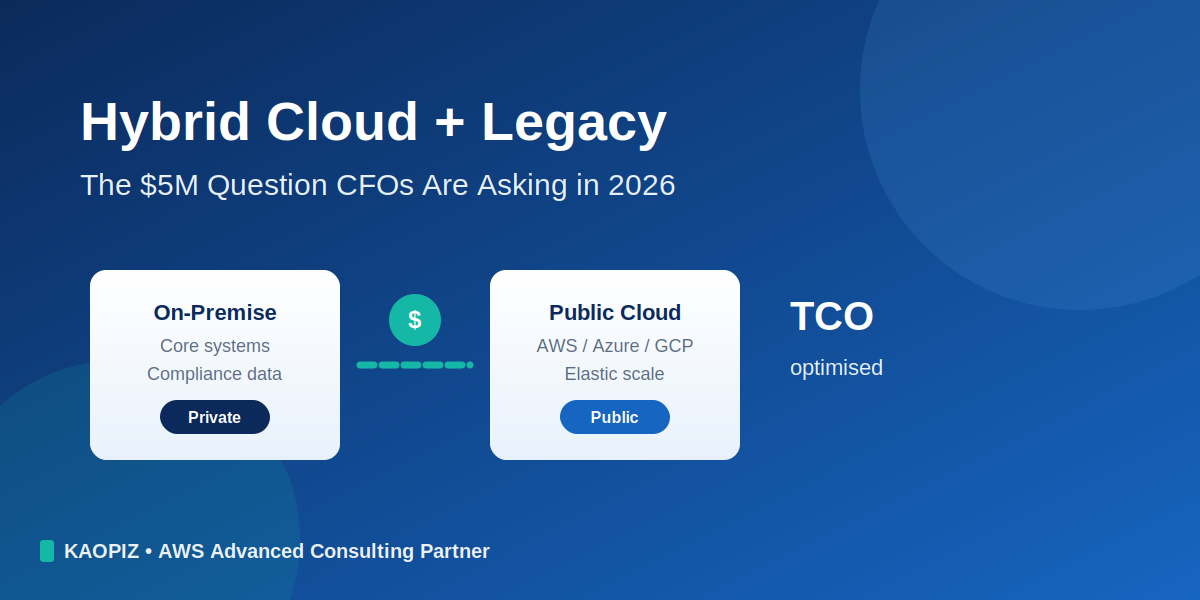
Hybrid cloud keeps regulated workloads private while moving elastic workloads to public cloud — the balance CFOs are now scrutinising.
Quick answer: CFOs in 2026 want to know whether a multi-million-dollar cloud and modernisation programme will actually lower total cost of ownership or just move spend around. It depends on workload fit: a hybrid approach — keeping regulated, steady workloads private and shifting elastic ones to public cloud — usually delivers the strongest return, but only when paired with genuine legacy modernisation, not a straight lift-and-shift.
Ask a CFO about cloud in 2026 and the question is rarely about technology — it is about money: “We are approving several million dollars for cloud migration and modernisation. What do we get back?” It is a fair question, and the honest answer is usually “it depends” — on which workloads move, how they are re-engineered, and whether the migration is treated as a finance decision or just an engineering one.
Why CFOs are right to be sceptical
Many early cloud programmes promised savings and delivered surprises. The classic mistake was lift-and-shift: moving an unchanged legacy application onto the cloud, only to find a system built for fixed hardware runs expensively on metered resources. The bill arrives monthly, never stops, and the application is no more flexible than before. A CFO who has lived through that is right to be sceptical of the next multi-million-dollar request.
The lesson is not that cloud is uneconomic, but that cost is set by what you do during the migration, not by the destination. Modernising the workload — so it scales down when idle and up only when needed — turns cloud from a cost into a lever.
Why hybrid cloud is the realistic answer for most enterprises
Few organisations should move everything to public cloud or stay entirely on-premise. The pragmatic middle ground is hybrid cloud, where workloads are placed by their characteristics, not ideology:
- Regulated, sensitive, or steady-state workloads — core records, compliance data, predictable batch jobs — stay private or on-premise, where residency and steady use favour owned infrastructure.
- Variable, customer-facing, or seasonal workloads — web front-ends, analytics, campaign traffic — move to public cloud, where elastic scaling means you pay for peaks only when they occur.
- New capabilities are built cloud-native from the start, so the estate modernises as it grows.
| Workload type | Best home | Why |
|---|---|---|
| Regulated core data | Private / on-prem | Residency, steady utilisation |
| Seasonal web traffic | Public cloud | Elastic, pay for peaks only |
| Analytics & AI | Public cloud | Burst compute on demand |
| Legacy batch jobs | Modernise then place | Avoid metered lift-and-shift cost |
Placing each workload by its characteristics, rather than moving everything, is what protects the business case.
So where does the $5M actually go?
An honest budget splits across assessment, data migration, re-engineering legacy workloads to be cloud-fit, a secure, governed landing zone, and parallel running. The re-engineering line determines the return. Skip it and you have an expensive lift-and-shift — 2026 analyses blame most overruns on unchanged architecture, not cloud pricing. Invest in it and fixed legacy cost becomes elastic, demand-matched cost — where the savings come from.
This is why the choice of delivery partner is a financial decision as much as a technical one. Kaopiz, a partner that pairs cloud and modernisation expertise, combines AWS Advanced Consulting Partner and AWS Well-Architected Partner credentials with hands-on legacy modernisation experience — the rare pairing needed to make sure workloads are genuinely re-engineered for the cloud rather than simply relocated to it.
How to protect the business case
CFOs can de-risk the spend without becoming cloud architects. Three guardrails do most of the work:
- Insist on a workload-by-workload placement plan before approving budget, so nobody is paying public-cloud rates for a workload that belongs on-premise.
- Require a modernisation line item, separate from migration, and treat any proposal that omits it as a lift-and-shift in disguise.
- Approve in phases tied to proven savings, releasing the next tranche only when the previous workload has demonstrated the expected cost behaviour in production.
Phased delivery is also where an experienced a delivery partner earns its place: by sequencing the work so each phase is independently measurable, the organisation can confirm the financial model is holding before committing the full budget, rather than discovering the truth at the end.
The bottom line for 2026
The honest answer to the $5M question: hybrid cloud with real legacy modernisation usually does lower total cost of ownership and improve agility — but only when workloads are placed deliberately and re-engineered, not just relocated. Treated as an IT project, a migration disappoints the finance team; treated as a finance-and-engineering decision, delivered in measurable phases by a partner who understands both, it is the one that pays back.
Frequently asked questions
Does moving to the cloud always save money?
No. Lift-and-shift migrations often raise ongoing cost, because legacy workloads built for fixed hardware run expensively on metered resources. Savings come from re-engineering workloads to scale with demand, not from the move itself.
What is hybrid cloud, in plain terms?
Hybrid cloud means running some workloads in a private or on-premise environment and others in public cloud, choosing each home based on the workload’s sensitivity, regulation, and scaling pattern rather than moving everything to one place.
How should a CFO approve a large cloud programme safely?
Require a workload placement plan and a separate modernisation budget line, then fund in phases tied to proven production cost behaviour — so the financial model is validated before the full amount is committed.
About Kaopiz
Kaopiz is a global software company of nearly 1,000 engineers, delivering for clients across both Japanese- and English-speaking markets. Its services span legacy modernization and cloud migration, offshore/ODC development, AI and DX solutions, and web and mobile application development. With ISO 27001-certified processes, AWS Advanced Consulting Partner status, and bilingual bridge engineers, Kaopiz is built for the kind of disciplined, long-horizon delivery that enterprise projects demand.