How to Use AI Market Sentiment Analysis to Make Better Trading Decisions

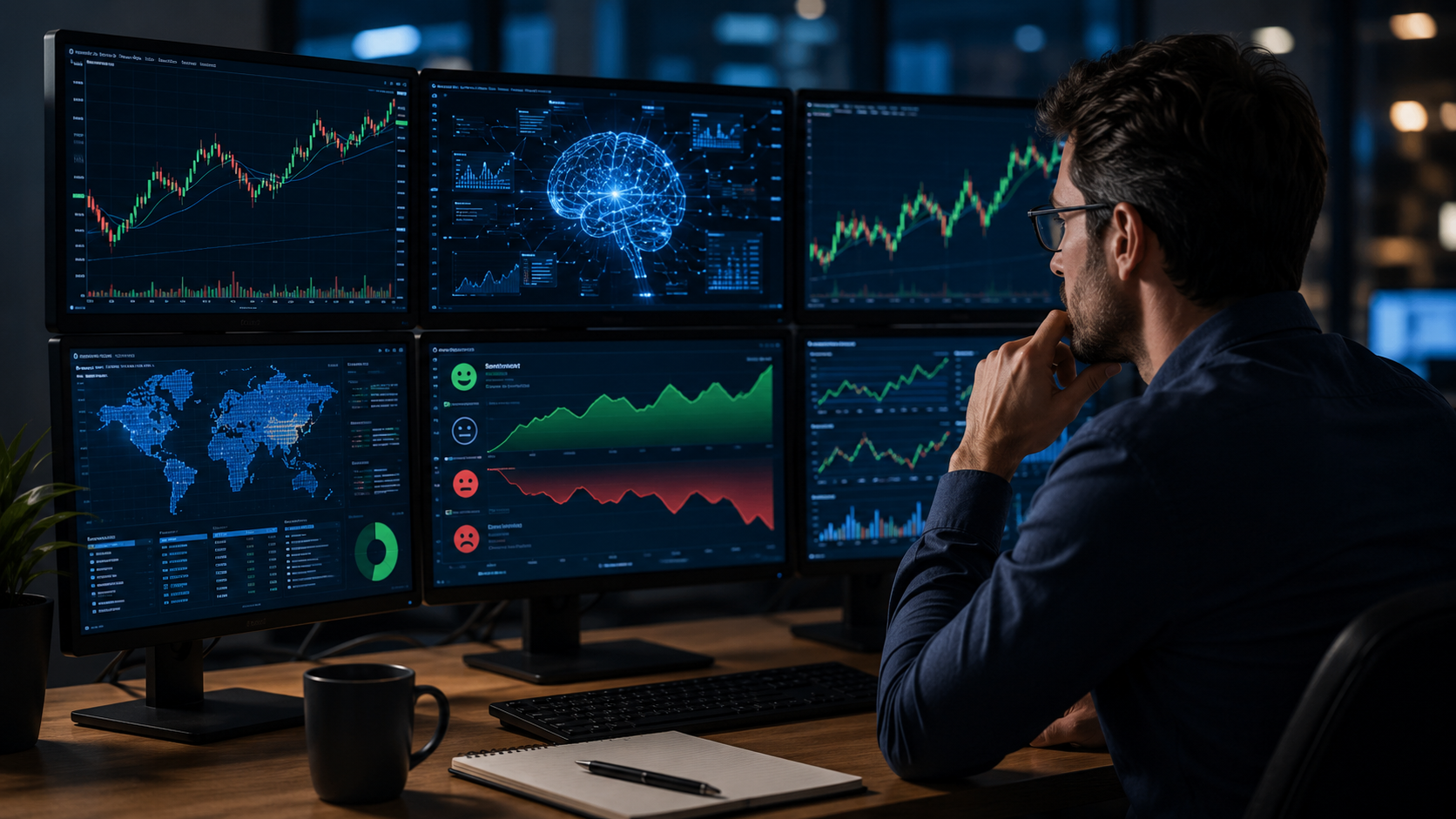
“In the short run, the market is a voting machine, but in the long run, it is a weighing machine,” according to Benjamin Graham, the mentor of Warren Buffett, one of the most successful names in stock investing.
While the intrinsic value of an asset depends on its fundamentals, short-term price movements often depend on the mood of the market, which is also a function of various human emotions: fear, greed, optimism, uncertainty, and confidence, among others.
For traders who want to profit from short-term price movements, an understanding of the market’s mood (otherwise known as market sentiment) can be more important than an obsession with the fundamentals of an asset.
However, given that human emotions are complicated, market sentiment can be complex. In this article, we consider how AI can solve some of the challenges traders face with sentiment analysis.
The role of market sentiment in trading
When Silicon Valley Bank failed in 2023, many regional banks, with sound fundamentals, experienced sharp declines in their stock prices.
Though nothing happened to change the fundamentals of these companies, the fear that engulfed the market for banking stocks led to a contagion effect. Investors were not concerned about fundamentals; rather, they embraced a “sell first, analyze later” attitude.
On the other hand, positive (bullish) sentiment about the potential role of AI in digital transformation across multiple industries has led to the positive performance of technology companies.
NVIDIA is a good example of this. Though it has sound fundamentals (as seen in its earnings growth), optimism about AI took the stock to a height that its financial results alone could not explain.
A good grasp of market sentiment can help traders understand why markets move the way they do, identify potential reversals in market direction, and predict momentum changes.
The challenges of measuring market sentiment
Nevertheless, conducting sound sentiment analysis can be very tricky.
Below are some reasons for this difficulty:
- Information overload: Understanding market sentiment requires poring over multiple sources like news articles, analyst reports, earnings calls, economic releases, discussion forums, social media conversations, and relevant blog posts.
- Quality vs quantity: Though there is an information explosion, quality information remains a premium.
- Rapidly changing market conditions: Human emotions are very volatile, and market mood can change in a matter of minutes. Traders can conclude a painstaking session of market analysis only to discover that a sentiment reversal has occurred.
- Subjectivity: The diversity of information means that two traders can conduct sentiment analysis on the same asset and come up with a different gauge of the mood of the market (bearish, bullish, and uncertain).
Why AI has become a powerful market sentiment tool
Some fintech platforms are now developing market sentiment tools that use artificial intelligence (AI) to solve these challenges.
Below are ways that the use of AI in these tools is helping traders perform better sentiment analysis.
- Analyzing multiple sources at scale: AI models can use natural language processing to read multiple social media conversations, earnings call transcripts, blog posts, news articles, and analysts’ reports.
For example, AI Sentiment from IUX24 can track global market sentiment in real time, analyzing millions of data points in a few seconds by utilizing financial documents and market news, providing an objective summary of the mood of the market.
- Source selection: AI models can be trained to focus on specific data sources that traders or developers consider to be of the right quality. By filtering for the best possible sources, platforms like IUX24 increase the quality of the market sentiment analysis they provide.
- Real-time analysis: Similarly, since AI models can process millions of data points in seconds, they can repeat the sentiment analysis process multiple times in a day.
- Summary of market sentiment: In addition to poring over multiple data points, AI models can provide an objective summary of what these sources represent.
Using AI for market sentiment analysis
Traders can use the information from sentiment analysis in multiple ways, including:
- Trend confirmation: After identifying the market trend based on technical analysis, expert traders can confirm it with sentiment data.
- Identifying possible trend reversals: Price and volume data can lag behind market sentiment data. Therefore, price charts can be on an upward trend while market sentiment turns negative, and vice versa. This can signal weakening conviction and an impending price reversal to the downside.
- News trading strategies: Traders who trade the news can use real-time sentiment shifts to anticipate the direction of short-term volatility. They can detect a negative tone about a company after a regulatory announcement and quickly position themselves to benefit from a possible selloff in its stock price.
- Risk management: Market sentiment can also provide the basis for sound risk management protocols.
For example, when fear dominates the market, traders can quickly reduce leverage, tighten stop-loss levels, hedge positions, and move a portion of capital into defensive assets before the full effect of the sentiment comes into play.
- Contrarian plays: Contrarian traders can move against market sentiment when they believe that the market’s reaction to certain news or events is overblown. This can involve shorting overhyped assets driven by massive euphoria or buying oversold stocks that have been plagued by unreasonable pessimism or fear.
As global markets become more interconnected, happenings in one corner of the world will continue to have more pronounced effects on various assets, irrespective of where they are domiciled.
Thus, the ability to accurately interpret sentiment may become one of the most important advantages a trader can possess. AI tools like AI Sentiment by IUX24 are making that capability more accessible than ever before.