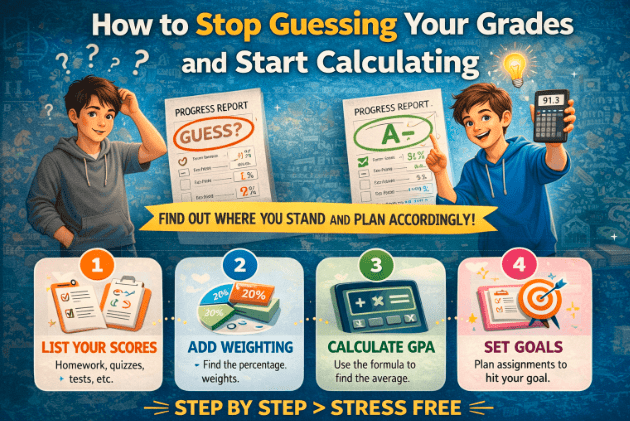
Most students rely on assumptions when thinking about their academic performance. They estimate their results based on past scores or general expectations, but this often leads to confusion and unnecessary stress. Instead of relying on guesswork, using a grade calculator allows you to understand your actual performance with clarity and precision.
Once you replace assumptions with accurate data, your entire approach to studying becomes more focused and intentional.
Why Guessing Your Grades Leads to Poor Decisions
Guessing may seem harmless, but it creates a false sense of understanding. When you do not know your exact standing, it becomes difficult to identify what needs improvement.
Students who rely on estimates often misjudge their situation. Some assume they are doing well when they are not, while others underestimate their performance and lose confidence. In both cases, the lack of clarity leads to poor academic decisions.
Without accurate tracking, it becomes almost impossible to improve strategically.
The Shift From Assumption to Accuracy
The difference between guessing and calculating is not just about numbers. It is about control.
When you start calculating your grades, you gain a clear understanding of where you stand at any given point. You no longer depend on uncertainty. Instead, you can see how each assignment, test, or assessment contributes to your overall performance.
This shift changes your mindset. You begin to approach your studies with purpose rather than reaction.
How a Grade Calculator Changes Your Academic Approach
A grade calculator does more than show numbers. It helps you understand the structure behind your results.
By breaking down your performance into measurable parts, it allows you to see which areas are contributing positively and which ones need attention. This clarity makes it easier to prioritize your effort and avoid wasting time on low-impact tasks.
Instead of asking whether you are doing well, you start asking what specific actions will improve your results.
Predicting Your Results Before It Is Too Late
One of the biggest advantages of tracking your grades is the ability to predict outcomes before final results are released.
A final grade calculator helps you estimate your expected score based on your current performance. This allows you to understand exactly what is required in upcoming assessments.
Rather than waiting for results and reacting afterward, you can take action in advance. This level of control reduces stress and improves performance.
Why Most Students Do Not Track Their Grades
Despite the clear benefits, many students avoid tracking their performance. In some cases, it is due to lack of awareness. In others, it is because they rely too much on assumptions or feel confident without verification.
Over time, this habit creates gaps in understanding. By the time results are released, there is little opportunity to make meaningful changes.
Turning Clarity Into Better Results
When you begin to calculate your grades regularly, your behavior naturally changes. You become more aware of your performance and more intentional in your actions.
You start focusing on areas that have the greatest impact, adjusting your effort based on actual data rather than guesswork. This leads to more efficient studying and more consistent results.
Clarity does not just reduce uncertainty. It improves decision-making.
Building a Habit That Improves Performance Over Time
Tracking your grades should not be a one-time activity. It should be a consistent habit.
When you regularly monitor your performance, you stay aligned with your academic goals. You can identify problems early, adjust your strategy, and maintain steady progress throughout the semester.
Over time, this habit creates a strong advantage. You are no longer reacting to results. You are actively shaping them.
Final Thoughts
Guessing your grades may feel easier, but it limits your ability to improve. Accurate calculation provides clarity, direction, and control.
By using tools like a grade calculator and a final grade calculator, you move from uncertainty to informed decision-making. This shift allows you to approach your academics with confidence and improve your results consistently.