
How to Run Peptide Ads Without Getting Banned on Facebook, Google & YouTube Ads

Peptide products sit in one of the most tightly regulated advertising categories online. Whether you sell research peptides, wellness formulations, or related compounds, getting campaigns approved on major platforms has become increasingly difficult. Facebook (Meta), Google, and YouTube regularly reject or ban ads that mention peptides, make health-related claims, or even appear in the same category as restricted supplements.
For legitimate businesses trying to reach their audience, this creates a real problem. Traditional ad strategies often fail. Campaigns get disapproved within hours. Ad accounts get restricted. Scaling becomes nearly impossible. Many advertisers eventually look for specialized solutions, including professional cloaking ads agency services that help navigate these restrictions more effectively.
This article explains why peptide ads face such heavy scrutiny, breaks down the specific challenges on each major platform, and outlines practical approaches that help keep campaigns live longer while staying within acceptable operational boundaries.
Why Peptide Ads Face Constant Restrictions
Ad platforms treat peptides as high-risk for several reasons. First, many peptides fall into grey regulatory zones. Some are sold for research purposes only, others are positioned as wellness or performance products. Platforms prefer to avoid any association with products that could be viewed as unapproved pharmaceuticals or substances with limited clinical backing for human use.
Meta’s policies give the company broad discretion to classify certain supplements and compounds as “unsafe.” Google maintains strict rules against promoting unapproved pharmaceuticals and products that have faced regulatory scrutiny. YouTube, as part of Google’s ecosystem, inherits many of the same standards and applies them aggressively to video content.
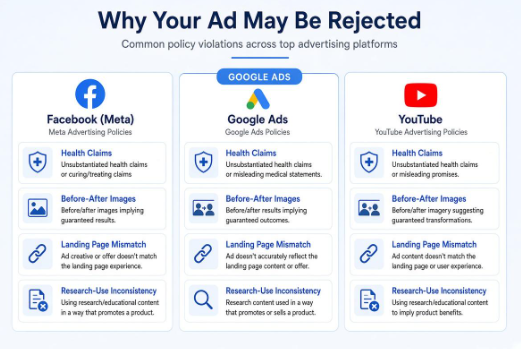
Common triggers for rejection include:
- Health or performance claims (even soft ones)
- Before-and-after imagery or transformation language
- Dosage information or usage guidance
- Landing pages that imply human consumption
- Inconsistent messaging between the ad and the destination page
Even research-use-only positioning can fail if the rest of the funnel (product pages, checkout, reviews) does not stay fully consistent with that framing.
Platform-Specific Challenges
Facebook and Instagram (Meta)
Meta reviews ads, creative, primary text, headlines, targeting, and the full landing page experience. For peptides, the most common failure points are personal-attribute language, implied outcomes, and any content that suggests the product is intended for human use. Accounts that accumulate multiple disapprovals often face temporary or permanent restrictions.
Specialized facebook ads cloaking approaches focus on presenting compliant content during the review process while directing qualified traffic to the actual offer page. This requires careful technical setup and ongoing monitoring, as Meta continuously updates its detection methods.
Google Ads
Google’s policies are written more explicitly. The platform prohibits promotion of unapproved pharmaceuticals and supplements “regardless of any claims of legality.” Research peptides frequently fall into this category. Even when advertisers use careful wording, automated systems and human reviewers often flag the campaigns.
Success on Google usually requires extremely consistent research-use positioning across every asset, strong domain reputation, and sometimes additional business verification. Many advertisers find that pure compliance strategies alone do not deliver enough scale, which is why some explore additional traffic-filtering solutions.
YouTube Ads
YouTube inherits Google’s advertising standards but adds an extra layer of video content review. Visuals, spoken claims, and on-screen text all receive scrutiny. A video that looks compliant in the ad itself can still be rejected if the linked landing page raises red flags. Because YouTube campaigns often drive higher intent traffic, losing access to the platform can significantly impact overall acquisition costs.
Common policy triggers that cause peptide ads to be rejected across major platforms
How Cloaking Solutions Help Restricted Niches
In the context of restricted advertising, cloaking generally refers to systems that differentiate between ad-platform reviewers/bots and regular human visitors. Reviewers and automated systems are shown a carefully prepared, policy-compliant “safe” page. Real users who click the ad are directed to the intended offer page.
When implemented properly, this approach can reduce the frequency of disapprovals and account actions. It is not a magic switch, and platforms actively work to detect deceptive practices. The more sophisticated versions rely on advanced IP filtering, device fingerprinting, behavioral signals, and regularly updated bot databases rather than simple redirects, which are easily caught.
Simplified view of how advanced traffic filtering directs different visitors to different pages
A professional cloaking ads agency typically handles the full technical setup: domain configuration, safe-page creation, filtering rules, and ongoing maintenance. Many also provide warmed ad accounts, creative testing support, and scaling strategies tailored to restricted categories such as peptides.
Practical Steps to Improve Approval Rates
Even with specialized tools, certain foundational practices remain important:
- Align every part of the funnel. The ad, landing page, product descriptions, and checkout process should tell a consistent story. Mixed messaging is one of the fastest ways to trigger reviews.
- Avoid high-risk creative elements. Before-and-after photos, dramatic transformation language, and specific dosage claims almost always cause problems.
- Strengthen business and domain signals. Verified business information, clean domain history, proper privacy policies, and professional site structure all help.
- Monitor account health closely. Multiple disapprovals in a short period raise red flags. Having backup accounts and a clear recovery process matters.
- Test carefully and scale gradually. Sudden large spends on new accounts or aggressive creative testing can attract extra scrutiny.
A typical structured process used by specialized agencies for restricted niche advertising
When to Consider Professional Support
Some teams build their own filtering systems. Others prefer to work with agencies that already operate in these niches daily. The decision usually comes down to internal technical capacity, risk tolerance, and how quickly the business needs reliable traffic.
A specialized provider can reduce trial-and-error time, supply pre-warmed infrastructure, and adjust tactics as platform detection methods evolve. For many peptide advertisers, the combination of compliant creative practices and professional traffic management produces more stable results than either approach alone.
Final Thoughts
Running peptide ads on Facebook, Google, and YouTube remains challenging in 2026. Platform policies continue to tighten, automated detection improves, and the margin for error is small. Success requires realistic expectations, careful creative and landing-page work, and often additional technical layers that help campaigns survive the review process.
Whether you handle everything in-house or partner with a cloaking ads agency, the goal stays the same: reach the right audience while minimizing the risk of sudden account or campaign loss. Businesses that treat policy compliance and technical resilience as ongoing priorities tend to maintain more consistent results over time.
If your current campaigns keep hitting the same walls, reviewing both your creative approach and your traffic-filtering setup is usually the most practical next step.
Word count: approximately 1,320 words | Images embedded and ready for web upload







Comment