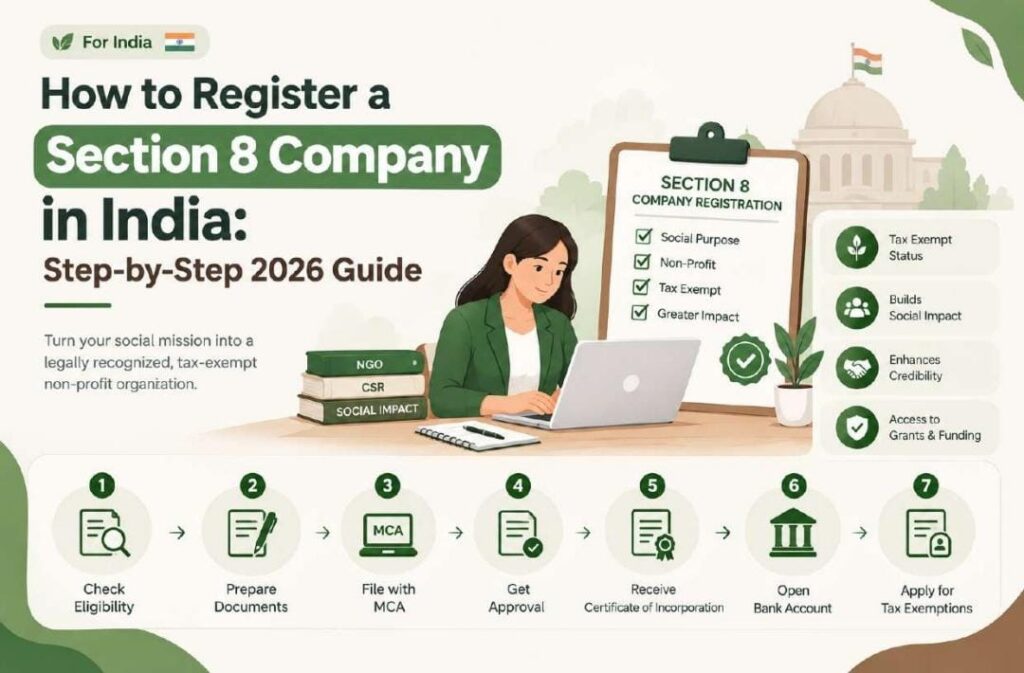
Registering a Section 8 company in India involves incorporating a non-profit entity under the Companies Act, 2013, with the Ministry of Corporate Affairs (MCA). If you are wondering how to register a section 8 company , the process involves meeting the eligibility requirements, preparing the required documents, and completing incorporation through the MCA portal.
- Minimum Requirements: 2 directors (for private) Digital Signature Certificates (DSC), and no minimum paid-up capital.
- Key Process Steps: → Name approval (Part A) →Digital signature setup→ Combined License & Incorporation application via SPICe+ (Part B, MOA Form INC-13, AOA) → PAN/TAN allotment.
- Post-Registration: Secure Section 12AB and 80G tax exemptions on the Income Tax portal via Form 10A.
What is a Section 8 Company?
A Section 8 Company is a non-profit organization registered under Section 8 of the Companies Act, 2013 (equivalent to the older Section 25 of the 1956 Act). It is formed to promote art, science, commerce, education, research, social welfare, religion, charity, or environmental protection.
Ready to Start Your Non-Profit Journey?
Skip the hassle of complex legal paperwork. Get your Section 8 company registered smoothly with expert guidance from Ngoexperts.
Why Choose a Section 8 Company over a Trust or Society?
Setting up a nonprofit in India can be done through a society, a charitable trust, or a Section 8 company. The Section 8 company structure offers higher regulatory standards and institutional trust.
| Feature | Section 8 Company | Charitable Trust | Registered Society |
| Governing Law | Companies Act, 2013 | Indian Trusts Act, 1882 / State Trust Act | Societies Registration Act, 1860 |
| Governing Body | Ministry of Corporate Affairs (MCA) | Deputy Charity Commissioner / Registrar | Registrar of Societies (State Level) |
| Minimum Members | 2 Members (Private) | 2 Trustees | 7 Members |
| Credibility | Very High (Strict MCA Oversight) | Moderate | Moderate |
| CSR Funding Access | Highly Preferred by Corporate Funders | Moderate Acceptance | Moderate Acceptance |
| National Operations | Operates pan-India seamlessly | Requires state re-registration | State-bound (requires multi-state filing) |
| Transferability | Ownership & management transferred easily | Complex trustee replacement | Complex governing board changes |
Eligibility Criteria & Prerequisites
Before initiating the filing on the MCA portal, ensure your founding team meets the statutory limits:
- Minimum Members:
- Private Limited structure: At least 2 members.
- Public limited structure: At least 7 members.
- Minimum Directors:
- At least 2 directors for private; 3 directors for public.
- Resident Director Requirement: At least one director must have stayed in India for 182 days or more during the previous financial year.
- Minimum Capital: ₹0 (There is no statutory minimum paid-up capital requirement).
- Digital Signature Certificate (DSC): Required for all proposed directors and subscribers to sign electronic applications.
- Permissible Objects: Objectives must strictly fall under social welfare, education, science, healthcare, sports, charity, or environmental protection.
Documents Required for Section 8 Company Registration
Keep self-attested digital copies of the following documents ready before filling out the incorporation forms:
1. Documents for Directors & Subscribers
- Identity Proof: PAN Card (mandatory for Indian nationals) along with Passport, Voter ID, or Driving License.
- Address Proof: Bank Statement, Electricity Bill, or Mobile Bill (must not be older than 2 months).
- Passport-Size Photographs: Clear digital images.
- Director Identification Number (DIN): Apply for it within the incorporation form if directors do not already hold one.
2. Documents for Registered Office Address
- Ownership Proof: Copy of Electricity Bill, Water Bill, or Property Tax Receipt (under 2 months old).
- Occupancy Proof: Rent Agreement or Lease Deed (if rented).
- NOC: No Objection Certificate signed by the property owner authorizing company use.
3. Special Drafting Documents
- Form INC-13: Memorandum of Association (MOA) detailing non-profit objectives.
- Articles of Association (AOA): Internal bylaws restricting dividend distributions.
- Form INC-9: Declaration by each director and subscriber confirming no criminal or financial disqualifications.
- 3-Year Financial Forecast: Estimated income and expenditure projections for the first three years signed by the promoters.
How to Register a Section 8 Company: Step-by-Step Process
The registration process is centralized online via the MCA V3 Portal.
- Obtain Digital Signature Certificates (DSC): Prerequisite for all directors.
- Apply for Class-3 Digital Signature Certificates (DSC) for all proposed directors and subscribers.
- The DSC is used to authenticate e-forms like SPICe+ on the MCA portal.
- Reserve the Company Name: Part A of SPICe+ or RUN Service.
- Access the RUN (Reserve Unique Name) tool or Part A of Form SPICe+ on the MCA V3 portal.
- Propose up to two unique names that reflect non-profit work.
- Name Rules: Must include keywords such as Foundation, Forum, Association, Chamber, Federation, Council, or Institute.
- Section 8 entities are exempt from using “Private Limited” or “Limited” in their official titles.
- File the Integrated Application (SPICe+ Part B): Form INC-12 merged into SPICe+.
- Fill out Part B of SPICe+ after name approval.
- Input director details, capital structure, registered address, and subscriber information.
- Attach the e-MOA (Form INC-13) detailing charitable goals and the e-AOA (Form INC-31).
- Attach the projected 3-year income and expenditure statement.
- Note: Under current MCA rules, the Section 8 License is issued directly through SPICe+, eliminating the need for a separate Form INC-12 filing.
- Submit Linked Forms (AGILE-PRO-S): One-time registration for corporate services.
- Complete the linked AGILE-PRO-S form to simultaneously apply for:
- Mandatory Corporate Bank Account opening.
- PAN and TAN allotment.
- EPFO and ESIC registrations.
- Professional Tax Registration (where state law applies).
- Optional GSTIN Registration.
- Approval and Certificate Issuance: Issuance of License & COI.
- The Registrar of Companies (ROC) reviews all submitted forms and declarations.
- Upon verification, the ROC issues the Section 8 License alongside the Certificate of Incorporation (COI) containing the Corporate Identification Number (CIN).
Mandatory Post-Incorporation Compliances
Receiving the Certificate of Incorporation is only the first phase. The organization must complete the following mandatory operational tasks:
- First Board Meeting: Conduct the inaugural board meeting within 30 days of incorporation.
- Appointment of Statutory Auditor: Appoint a practicing Chartered Accountant (CA) via Form ADT-1 within 30 days.
- Commencement of Business (Form INC-20A): File the declaration of capital contribution within 180 days of incorporation before executing operations or accepting funding.
- Issue Share Certificates: Issue official certificates to subscribers within 60 days of incorporation.
- Annual Filings: Submit annual financial statements (Form AOC-4) and annual returns (Form MGT-7) to the ROC every year.
Critical Tax Exemptions: Securing 12AB, 80G, and FCRA
A Section 8 License under company law does not automatically grant tax exemptions. You must file separate applications with the Income Tax Department:
- Section 12AB Registration:
- Exempts the company’s internal surplus and donations from corporate tax.
- Apply on the Income Tax E-filing Portal using Form 10A to secure a provisional registration valid for 3 years.
- Section 80G Approval:
- Allows donors to claim 50% to 100% tax deductions on their contributions.
- Applied via Form 10A; requires maintaining donor lists to issue Form 10BE tax certificates.
- FCRA Registration:
- Mandatory under the Foreign Contribution (Regulation) Act before accepting international donations or foreign funding.
- The company must complete 3 years of social operations before applying for full FCRA registration (or apply for prior permission for specific funding rounds).
Frequently Asked Questions (FAQs)
Q1. Can a Section 8 company pay salaries to its directors?
Yes, a Section 8 company can pay reasonable salaries or remuneration to its directors, provided the payment is for actual professional services rendered (e.g., serving as CEO or managing director) and is approved by the Board.
Q2. Is a Section 8 company eligible for Corporate Social Responsibility (CSR) funding?
Yes. Section 8 companies are one of the preferred vehicles for receiving corporate CSR grants. The company must be registered on the MCA portal by filing Form CSR-1 after securing 12AB and 80G approvals.
Q3. Is a physical office space mandatory for registration?
No. You do not need a commercial establishment. A residential address (owned or rented) can serve as the registered office address provided you submit valid address proof and an NOC.
Q4. Can a Section 8 company be converted into a regular Private Limited Company later?
Yes, but the conversion process requires strict approvals from the Regional Director (RD) under Rule 21 of the Companies (Incorporation) Rules, settling all existing tax liabilities, and ensuring no accumulated non-profit funds are transferred to shareholders.
Disclaimer: NGOExperts is a private consultancy and is not affiliated with the Income Tax Department. Rules and forms change over time, so always double-check on the official portal before you file. Getting Section 8 registration for your trust isn’t about waiting for the perfect moment. It’s about getting your papers in order, picking the right form, and applying. The rest follows from there.