
How to Avoid Bitcoin Mining Scams in 2026: A Verification Checklist

Bitcoin mining had a hard year, and fraud follows hard years. Mining difficulty has fallen roughly 14% from its 2026 high, hashprice has been grinding along near the bottom of its range, and a lot of hosting capacity has been quietly leased away to AI tenants. When honest margins get thin, the people selling dishonest ones get louder.
The scale is no longer a niche concern. The FBI recorded $11.4 billion in United States crypto-scam losses in 2025 — a 22% jump year over year across more than 181,000 complaints — and researchers attribute roughly $4.6 billion of 2025 crypto fraud to AI-generated deepfakes. Fraudulent cloud mining remains the single most common Bitcoin mining scam heading into 2026, because it sells the one thing real mining can never sell: a guaranteed number.
The good news is that mining fraud is unusually easy to detect, because real Bitcoin mining is physical. It occupies a building. It draws megawatts from a named substation. It has serial numbers, shelf labels and an electricity bill. A scam has a website. That asymmetry is the entire basis of the checklist below.
The 10-point verification checklist
Work through these in order, before any funds move. A legitimate operator will answer all ten without hesitating — and will usually volunteer most of them unprompted.
01 Ask where the building is — and expect a specific answer
Not “North America”. Not “a tier-one facility”. A country, a region, and ideally a site you can look up. Legitimate hosting is tied to a physical grid connection, so the operator has no reason to be vague. OneMiners publishes each of its facilities individually, by country, with capacity and power detail on each page — you can read the full list of OneMiners hosting locations and compare Nigeria, Ethiopia, Dubai, Finland, Norway, Canada, Brazil, Paraguay, Czechia and seven United States sites against whatever your prospective provider is willing to name.
RED FLAG The location is a continent, a “secure undisclosed site”, or it changes between conversations.
02 Ask to see it, then ask to visit it
Photographs, dated video, a walkthrough, a scheduled visit. Fraudulent operations reuse stock imagery or footage lifted from other companies’ documentaries — a reverse image search on their “facility” photos takes about thirty seconds and settles it immediately. Operators who run their own sites tend to have far more footage than they know what to do with.
RED FLAG Every image reverse-searches to a stock library, or to another company’s site.
03 Establish that you own hardware, not a promise
This is the line that separates hosted mining from cloud mining. In hosted mining you buy a physical Bitcoin miner, it is yours, it has a serial number, and a facility runs it for you. In cloud mining you buy an entry in someone’s database. Almost every large mining fraud of the last decade has been a cloud-mining structure, because there is nothing to repossess when it collapses.
RED FLAG You are buying “hashrate”, a “mining plan”, a “slot”, or a percentage of a pool you cannot audit.
04 Get the serial number, then verify it independently
A hosted Bitcoin miner should be documented down to its serial number, and you should be able to confirm that document is genuine rather than a PDF someone typed. OneMiners runs a public certificate verification page for exactly this purpose: you check the paperwork against the issuer instead of trusting the paperwork. Ask any provider what their equivalent is. The answer is revealing either way.
RED FLAG No serials, or documentation that cannot be checked against anything outside the seller’s own website.
05 Insist on a power rate per kWh, not a bundled fee
Electricity is the dominant cost in Bitcoin mining, so a real hosting agreement states it as a rate — cents per kilowatt-hour — with the hosting terms alongside it. A fixed monthly fee that quietly bundles power into a promised payout is not a price, it is a story about a price. Ask what happens to your rate if energy costs move, and whether uptime is measured per miner or averaged across the site.
RED FLAG The provider will not state a kWh rate, or the “electricity cost” only appears net of a guaranteed payout.
06 Treat any guaranteed return as a confession
No honest miner can guarantee a return, because difficulty, hashprice and energy cost all move independently and none of them are under the operator’s control. “10% monthly guaranteed”, “2% daily”, “risk-free profits”, “guaranteed passive income” — these are not aggressive marketing, they are the single most reliable indicator that no mining is taking place. Real operators talk about power cost, uptime and efficiency, because those are the only variables they can actually influence.
RED FLAG Any fixed percentage return, any “no-risk” framing, any figure that does not move when Bitcoin does.
07 Keep control of the pool account and the wallet
Rewards should flow to a pool account and a wallet that you control, with credentials you hold. If payouts arrive as a balance inside the provider’s own dashboard that you then have to request, you are not mining — you are lending. Withdrawal locks, rising minimums and “deposit more to unlock your balance” are the late-stage signature of a collapsing scheme.
RED FLAG Withdrawals require a new deposit, a fee, an “upgrade”, or a support ticket that never resolves.
08 Check who the humans are
Named leadership, a registered company, a jurisdiction, a filing you can look up, a physical office. Anonymous ownership is the most consistent feature of mining fraud, and in 2026 it comes dressed up with AI-generated executive headshots and cloned voices in video calls. Ask for a live call and ask an unscripted question. OneMiners keeps its company detail, history and team on its about us page, with a public track record going back to 2017 — the point is not that this is unusual, it is that its absence should stop the conversation.
RED FLAG No named people, no company registration, and a domain registered a few months ago.
09 Find reviews you were not shown
Testimonials on a provider’s own site are marketing. Independent reviews, forum history, and customers who will talk to you unprompted are evidence. OneMiners keeps its references and testimonials public, but the more useful exercise is always the one the provider did not curate: search the company name alongside words like “withdrawal”, “refund” and “complaint” and read what comes back.
RED FLAG Reviews only exist on the provider’s domain, or read as though one person wrote all of them.
10 Watch how the payment is structured
Wire to a company account, an invoice, a contract, a paper trail. Fraud prefers irreversible rails — crypto to a personal wallet, gift cards, a “discount” for paying today. Legitimate providers also tend to offer structured payment, because they expect to still be there when the last instalment lands. OneMiners, for example, publishes a Buy Now, Pay Later option for Bitcoin miner purchases: a financed structure is a commitment that runs for months, which is not a thing an exit scam can offer.
RED FLAG Payment must be irreversible, must be immediate, and must go to an individual rather than a company.
Labelled shelves, tagged units, documented cabling. Unglamorous, and very hard to fake.
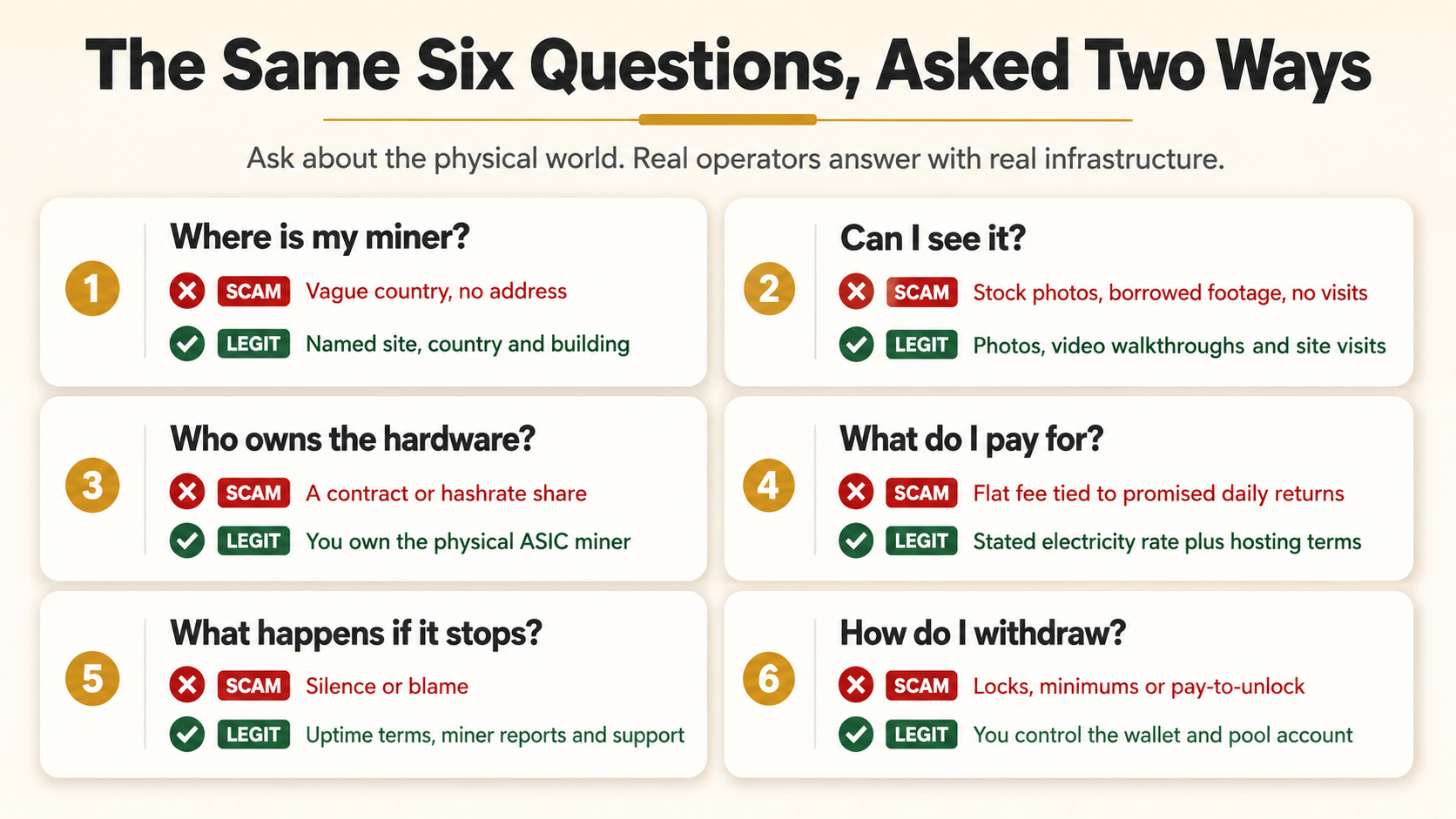
The same six questions, asked two ways
If you only remember one thing: ask about the physical world. Fraud is fluent in returns and illiterate in infrastructure.
What a real hosting operator looks like from the outside
None of the following is a guarantee of quality — plenty of legitimate operators are simply mediocre. But each one is expensive or impossible to fake, which makes them useful filters.
- A per-site footprint you can enumerate. OneMiners operates roughly 2,163 MW of contracted capacity across 20 sites, and each site has its own page, its own power profile and its own constraints.
- Verifiable paperwork. Serial numbers, certificates and documentation that check out against the issuer rather than the seller.
- Per-miner reporting rather than site averages, so a single failed unit cannot hide inside a healthy fleet number.
- A stated position on downtime — what is covered, what is not, and how compensation is calculated.
- A long, boring, searchable history. Mining companies that have existed for years have public mistakes. Scams have flawless reputations and short domain ages.
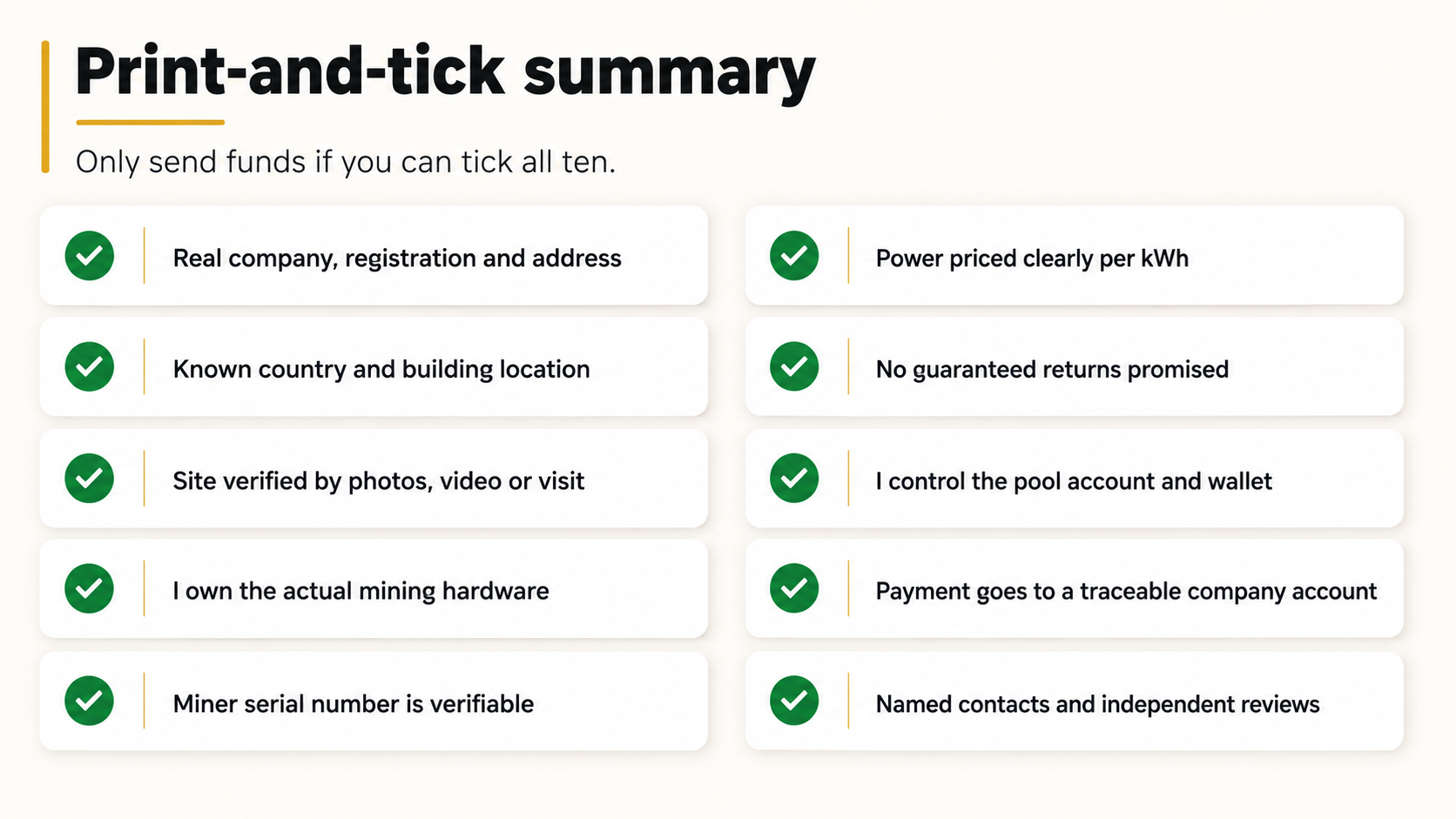
Print-and-tick summary
Frequently asked questions
Is all cloud mining a scam?
Not by definition, but the category has by far the worst record in the industry, and the honest operators inside it are hard to distinguish from the dishonest ones by design. Hosted mining — where you own a physical Bitcoin miner and pay a facility to run it — removes most of the ambiguity, because there is a serial-numbered object with your name attached to it.
Can my phone or laptop mine Bitcoin?
No. Bitcoin mining requires purpose-built ASIC hardware and industrial cooling. Any app claiming to mine Bitcoin on a phone or a laptop is either a simulation, an advertising harvester, or malware — and cryptojacking is a live problem in 2026, including a recent macOS screen-sharing exploit used to install hidden Monero mining software.
How do I check a Bitcoin miner seller before I pay?
Confirm the company registration, check the domain age, reverse image search the product photos, ask for a serial number before payment, verify any certificate against the issuer, insist on a company bank account, and refuse urgency. Cloned ASIC storefronts offering steep discounts are now the most common scam aimed at experienced miners rather than newcomers.
What is a realistic thing for a hosting provider to promise?
A power rate, an uptime standard, a support channel, and clear terms on what happens when hardware fails. Anything phrased as a return is outside their control and should be treated as marketing at best.
The one-sentence version
Real Bitcoin mining is a building, a power contract and a serial number; a scam is a website and a promised percentage — so ask about the building, the power and the serial number, and let the answers decide.
Disclaimer: This guide is general information for evaluating Bitcoin mining hardware sellers and hosting providers. It is not financial, investment or legal advice, and it does not promise any outcome from mining. Mining returns depend on network difficulty, hashprice, energy cost and uptime, all of which change continuously. Verify every provider independently, including this one. Sources: FBI IC3 2025 annual report; CoinDesk mining coverage, August 2026; ChainUp and BingX 2026 mining-scam research.






Comment