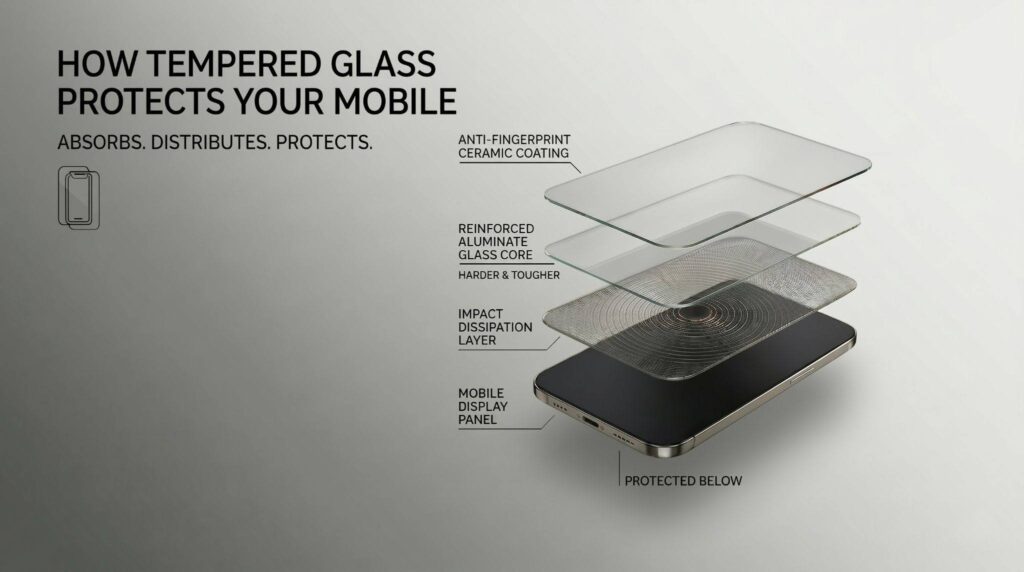
Tempered glass protects your mobile display by absorbing and distributing the energy of drops and impacts across a hardened glass layer before that force reaches the display panel underneath — and when a severe impact exceeds its threshold, it fractures into small blunt pieces rather than sharp shards, leaving your screen intact beneath it.
That is the mechanism at work every time the glass shields your screen from a drop, a scratch, or the abrasive friction of daily use: the protector takes the damage so your display does not have to. GadgetShieldz X-Glass
protectors are made with aluminate glass and precision-cut for your exact device model full-surface coverage from the day you apply one, with no gaps and no guesswork.
Most people think about screen protection only after the first crack appears. By then, the display is already damaged and display repairs cost far more than a protector ever would. Understanding how tempered glass actually works is the reason to apply one before anything goes wrong.
What Is Tempered Glass? The Manufacturing Process Behind the Protection
Tempered glass is not ordinary glass. It undergoes a controlled thermal process: standard glass is heated to extreme temperatures, then rapidly cooled in a process called quenching. That sudden temperature change creates compressive stress on the outer surfaces of the glass while the core remains under tension.
The result is a glass that is significantly stronger than standard annealed glass of the same thickness. Its outer surfaces resist bending and surface impact. When it does fracture under severe force, the internal stress releases in a controlled pattern producing many small, rounded fragments rather than long, jagged shards. That fracture behaviour is not a failure. It is the protector working exactly as designed.
Why this matters for your phone: Standard glass, when cracked, produces sharp, irregular shards that can cause secondary injury and irreparable display damage. Tempered glass fractures safely — absorbing the energy of the impact within itself rather than transferring it to the display panel underneath.
What Actually Threatens Your Phone Screen? Causes and Culprits
Most screen damage does not happen in one dramatic event. It builds from routine sources that look harmless individually — until you notice the surface haze, the cracked corner, or the deep scratch running across the centre of the panel.
- Keys and coins in pockets — Hard metal edges make direct contact with the display surface on every step you take
- Bag and pouch friction — Loose objects create abrasive pressure against unprotected glass during transit
- Face-down placement — Setting your phone display-down on any surface exposes it to grit and uneven texture
- Sand and dust particles — Fine particles harder than glass scratch the display surface on direct contact
- Drops onto hard surfaces — Concrete, tile, and tarmac generate enough impact force to crack a display
- Edge and corner impacts — Screen corners are the least supported point and the first to crack on impact
- Repeated micro-contact wear — Stylus tips and fingernails leave micro-scratches that accumulate into visible haze
How Tempered Glass Absorbs Impact — The Physics, Simply Explained
The protection a tempered glass screen protector provides is not passive. It is an active physical response to force and understanding that response shows why the material outperforms every alternative for display protection.
1 Force concentrates at the impact point
A drop or strike delivers energy to a small area of the screen surface. Without protection, that concentrated force passes directly and fully into the display panel.
2 Tempered glass distributes the force laterally
The hardened glass layer spreads concentrated impact energy across a wider surface area — reducing the intensity at any single point.
3 Compressive surface stress resists penetration
The outer surface of tempered glass is under compression — which means it resists crack initiation at the surface where scratches and impacts begin.
4 Aluminate glass raises the protection threshold
X-Glass protectors are made with aluminate glass — a harder composition than standard soda-lime tempered glass that absorbs more force before fracturing.
Ready to protect your display
The 5 Reasons X-Glass Outperforms Every Other Screen Protection Option
Not all tempered glass protectors are equal. Here is what separates a precision-engineered X-Glass protector from a generic alternative.
Aluminate Glass Core — Harder and Tougher
GadgetShieldz X-Glass protectors use aluminate glass — the same category used in premium smartphone display panels. The result: greater impact and scratch resistance than conventional soda-lime glass.
Impact and Scratch Protection — A Sacrificial Layer
Every X-Glass protector acts as a sacrificial layer. When a drop happens, the protector absorbs the force. Your display panel beneath stays unmarked. Replace the protector, not the screen.
HD Clarity — No Compromise on Display Quality
X-Glass protectors are engineered for HD clarity — optical transparency that lets full display brightness, colour accuracy, and sharpness through without interference.
Reinforced 3D Polished Edges — Full Coverage
X-Glass features reinforced 3D polished edges that extend coverage to curved screen borders — the zones most vulnerable to drop impact.
Anti-Fingerprint Ceramic Coating
X-Glass includes an oleophobic ceramic coating that actively repels skin oils — smudges wipe off with minimal effort and the surface stays optically clear.
Frequently Asked Questions
QHow does tempered glass protect a phone screen?
Tempered glass protects a phone screen by acting as a hardened sacrificial layer between the display panel and external forces. When a drop occurs, the tempered glass absorbs and distributes the energy across its surface reducing the force that reaches the display beneath. If the impact is severe enough to crack the protector, it fractures into small blunt pieces rather than sharp shards — and the display underneath typically remains intact. The protector can be replaced; the screen cannot.
QWhat happens to tempered glass when it breaks?
When tempered glass breaks, it shatters in a controlled pattern into many small, rounded pieces — not long, sharp shards. This is a direct result of the heat-treatment process that places the outer surfaces under compressive stress. That fracture behaviour is the protector working as designed: releasing the energy of a significant impact within the glass itself rather than transferring it to the display.
QDoes tempered glass work with in-display fingerprint scanners, including ultrasonic sensors?
Yes. GadgetShieldz X-Glass protectors are designed to be fully compatible with in-display fingerprint scanners, including both optical and ultrasonic fingerprint sensors. Ultrasonic fingerprint scanners — found in flagship devices like the Samsung Galaxy S26 Ultra — work by emitting ultrasonic pulses through the glass to map the three-dimensional contours of your fingerprint. X-Glass protectors are engineered to allow this signal to pass through without interference, so your in-display fingerprint unlock functions accurately after the protector is applied. Always confirm the protector is listed as fingerprint-compatible for your specific model before purchasing.
QWhat is X-Glass Plus and how is it different from standard X-Glass?
X-Glass Plus is the enhanced tier of GadgetShieldz’s X-Glass screen protector range, built for flagship devices that demand the highest level of protection and sensor compatibility. It shares the same aluminate glass core, reinforced 3D polished edges, HD clarity, and anti-fingerprint ceramic coating as standard X-Glass — and adds refined optical performance and enhanced compatibility with in-display sensors, including ultrasonic fingerprint scanners used in current flagship models. If your device is a recent high-end flagship with an in-display fingerprint reader, X-Glass Plus is the recommended choice for full compatibility and performance.
QIf X-Glass has an anti-fingerprint coating, does it still work with my in-display fingerprint scanner?
Yes — the anti-fingerprint ceramic coating and in-display fingerprint scanner compatibility are two completely separate, non-conflicting features. The oleophobic ceramic coating is applied to the outer surface of the protector to repel skin oils and reduce smudging on top of the glass. The fingerprint scanner — whether optical or ultrasonic — reads your fingerprint from underneath the display panel, through the glass layers, not from the outer surface coating. The two functions operate at different layers and do not interfere with each other. X-Glass protectors deliver both: a smudge-resistant outer surface and full in-display fingerprint scanner compatibility.
QDoes tempered glass affect touch sensitivity or display clarity?
No. A quality tempered glass protector is engineered to be optically transparent and thin enough that it does not interfere with touch input or display quality. The touch layer in your display reads finger input through the glass without degradation. Display brightness, colour, and sharpness remain unchanged. GadgetShieldz X-Glass protectors are designed for HD clarity — the display performs exactly as the manufacturer intended, with protection sitting invisibly above it.
QWhat is aluminate glass, and why does it matter in a screen protector?
Aluminate glass is a glass formulation that incorporates aluminium oxide to produce a harder, more impact-resistant material than standard soda-lime glass. In a screen protector, this means greater resistance against drops and surface scratches. GadgetShieldz X-Glass protectors are made with aluminate glass — the same category of glass technology used in premium smartphone display panels — giving them greater toughness than generic protectors made from conventional glass.
QHow long does a tempered glass screen protector last?
With normal daily use, a high-quality tempered glass screen protector typically lasts 1–2 years before showing significant wear such as surface micro-scratches or edge lifting. A protector that has absorbed a significant impact — even if it appears mostly intact — should be replaced, as its internal stress state is altered and its ability to absorb a second impact is reduced. Replacement protectors cost a fraction of what a display repair would.
QWhat is anti-glare tempered glass, and how is it different from standard tempered glass?
Anti-glare tempered glass is a variant of standard tempered glass that adds a micro-textured outer coating to the same hardened glass core. That coating scatters incoming light in multiple directions instead of reflecting it straight back at your eyes — making the display readable in direct sunlight where a standard clear protector behaves like a mirror. Both types deliver the same impact and scratch protection. The anti-glare version adds outdoor visibility on top of that core protection, making it the right choice for users who frequently use their phone outside.
QCan I apply a tempered glass screen protector myself at home?
Yes. GadgetShieldz X-Glass protectors are designed for self-application and include all the tools needed — a microfiber cloth, squeegee card, and alignment aids. The key steps are thorough surface cleaning before application, dry-fitting before peeling the backing to confirm alignment, and pressing from the centre outward to avoid trapped air. Following the step-by-step application guide results in a bubble-free installation for most users in under fifteen minutes.
The Bottom Line
Screen damage follows predictable physics. Drops concentrate force at a point. Friction from bags and desks builds surface haze over time. An unprotected display panel has no mechanism to resist either. Tempered glass exists to intercept both — a hardened sacrificial layer that absorbs what your screen cannot.
GadgetShieldz X-Glass protectors are built on aluminate glass — a harder, tougher formulation than standard tempered glass — with reinforced 3D polished edges, full fingerprint scanner compatibility including ultrasonic sensors, an anti-fingerprint ceramic coating, and precision cuts for your exact device model. Every part of the display that takes daily damage is covered. Every part of the protection that matters is present.
Apply one before the first drop makes the decision for you.