Most founders hit the same wall eventually. The idea feels solid, friends like it, a few potential customers even seem keen, and suddenly the plan is to build the “complete” product straight away. That’s usually the moment budgets start quietly draining.
An MVP isn’t a cheaper version of your software so much as a business experiment with a login screen. Done properly, it exists to answer one question before any serious money goes out the door: will people actually use this?
UK founders can’t really dodge that question anymore. Investors dig deeper than they used to. Customers expect a decent digital experience even from a brand-new product. And development rates haven’t exactly stood still. Building something nobody asked for is a luxury fewer businesses can afford.
Which raises the obvious follow-up: what does an MVP actually cost to build in the UK right now?
An MVP Isn’t About Building Less
A lot of these conversations start on the wrong foot. Founders picture an MVP as the smallest app they can get away with, but that’s not really the point. The point is validating an idea with the smallest solution that can actually do the job.
Sometimes that’s a basic booking tool. Other times it’s a fairly involved marketplace, just with a shorter feature list than the founder originally imagined. Fewer screens was never really the goal, fewer wrong assumptions was. Cost usually follows from that.
Typical MVP Development Costs in the UK
Nobody can hand you an exact number without seeing the product first, but there are rough bands worth knowing before that conversation even happens.
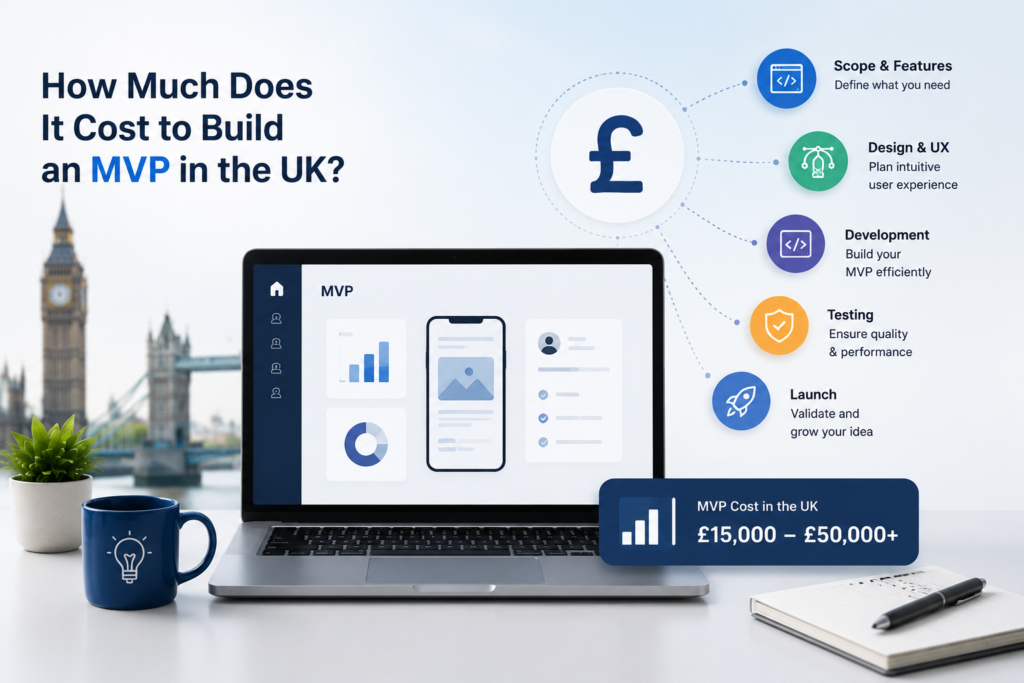
- Basic MVP, roughly £15,000 to £35,000. Core functionality, user authentication, a dashboard, and a couple of integrations. Usually enough to test early demand or put something in front of investors that isn’t just a slide deck.
- Medium-complexity MVP, roughly £35,000 to £70,000. Payment processing, a few third-party APIs, messaging, analytics, notifications, sometimes multiple user roles. This is where most commercial UK startups end up landing.
- Complex MVP, roughly £70,000 to £150,000+. AI features, healthcare or fintech compliance, logistics, marketplace mechanics, heavy automation. It might still get called an MVP on paper, but the engineering underneath is a different story.
What Actually Determines the Price?
Features rarely tell the whole story on their own. A good chunk of the budget gets decided before a developer even opens a code editor, in things like:
- Product discovery
- UX decisions
- How the APIs get wired up
- Security requirements
- Whether the system needs to scale from day one
Take messaging as an example. From the outside, it looks like a chat box. Underneath, you’re dealing with notification systems, database design, media storage, moderation, and encryption, none of which show up on a features list, but all of it shows up on the invoice.
Common Misconception: An MVP Should Be Cheap
This one’s stuck around for years. Founders treat the MVP as a way to spend as little as possible, and expect something thrown together quickly with minimal engineering behind it. It rarely goes well.
An MVP isn’t meant to be half-finished; it’s meant to answer a real business question, and a product that crashes or frustrates users can’t do that job properly. Feedback from a badly built product tells you almost nothing, because people end up rejecting the execution rather than the idea. Cheap software rarely earns you real validation. Software that’s actually fit for purpose usually does.
The Most Expensive Feature Is Often the One Nobody Uses
Take a fitness startup as an example. Wearable integrations, live coaching, community forums, nutrition tracking, personalised AI plans, achievement badges, a full video library, the wishlist looks genuinely impressive on a whiteboard.
Then the customer interviews happen, and the picture changes. Most people just want structured workouts and a way to track progress.
Everything else can wait, sometimes indefinitely. Cutting six major features shortens the build considerably and gets the product into people’s hands months sooner than planned.
That pattern shows up over and over across UK tech businesses. Founders imagine everything. Users usually want far less than that.
What Businesses Should Do Instead
Instead of handing developers a long wishlist and asking for a quote, it helps to work out the one big assumption the whole product actually rests on.
Will people pay for a subscription?
Will they get through onboarding without dropping off halfway?
Would a business genuinely trust the platform enough to upload real data to it?
Do people come back after week one, or was the initial interest a one-off?
Once that question is clear, the whole planning process shifts. A lot of founders find it worth bringing in an experienced MVP development agency before locking in what goes into version one, since outside eyes tend to spot unnecessary functionality that founders themselves are too close to see.
A decent agency will usually push back on half the wishlist before a single screen gets designed, and that pushback is often what actually protects the budget. What comes out the other end is a sharper product and a far more honest estimate of what it costs to build.
Hidden Costs That Catch Startups Off Guard
The build itself is only part of the bill. Running the software afterwards brings its own ongoing costs, and first-time founders tend to underestimate this by a fair margin: cloud hosting, security monitoring, third-party licences, performance monitoring, customer support tooling, bug fixes, and infrastructure that needs to scale as usage grows.
A product that keeps needing updates isn’t a bad sign, oddly enough. It usually means people are actually using it.
Speed Doesn’t Always Reduce Costs
There’s a fairly common belief going around that AI coding tools and no-code platforms have made software dramatically cheaper to build. It’s not quite that simple.
These tools speed up parts of the process, no argument there, but they don’t replace product strategy, and they don’t remove the need for architecture decisions, security thinking, testing, or proper user research. Skip those stages to save time now, and the bill for fixing it later tends to be bigger than what you saved. Development has genuinely got faster. Quality still comes down to how much thought went in before anyone started building.
Choosing the Right Development Partner
Comparing prices side by side rarely tells you much on its own. One quote might include product workshops, UX research, testing, deployment, and support after launch. Another might just cover development hours and nothing else. Those two numbers aren’t really comparable, even if they look close on paper.
A software development agency that understands product strategy as well as engineering tends to deliver stronger results over time. Technical skill matters, obviously, but so does someone willing to push back on an assumption before it turns into an expensive feature nobody needed. Good partners ask awkward questions. The best ones will occasionally tell you to build less than you planned.
The Smartest MVP Isn’t the Biggest One
Founders often assume success means launching with everything included. Experience says the opposite tends to be true. The strongest MVPs stay narrow on purpose, they solve one real problem, gather honest feedback, and give the business something solid to make decisions from instead of guessing.
The real cost of an MVP was never just the number on the invoice. It’s how quickly the product tells a business whether the idea deserves the next round of investment. Looked at that way, the cheapest MVP isn’t automatically the smartest one, and the biggest one is rarely it either.