
How Fintech and Digital Innovation Are Streamlining Custom Medal Manufacturing and Bulk Procurement

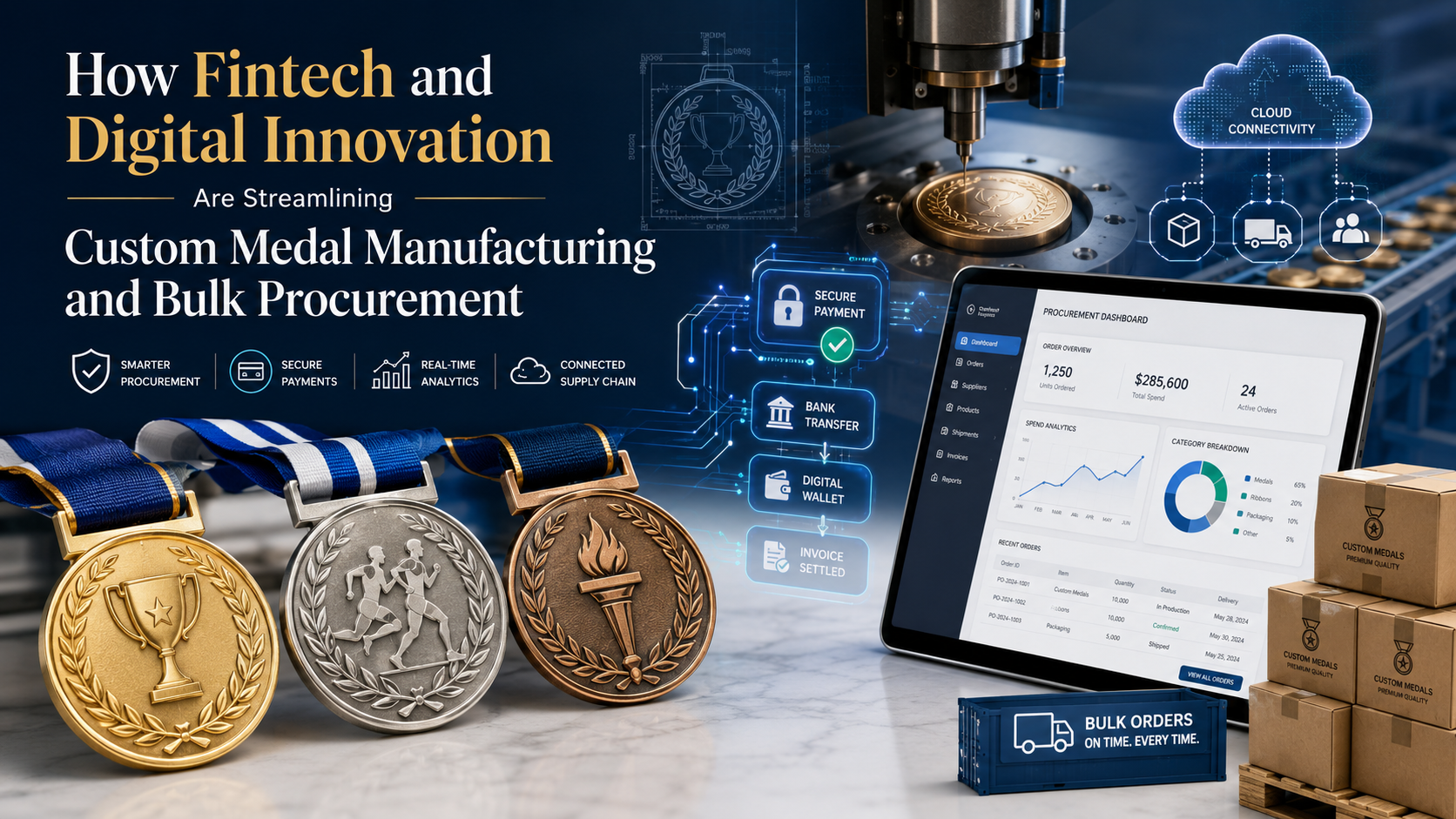
The global custom awards and recognition industry — valued at over $35 billion and growing steadily year over year — has long operated on surprisingly analog foundations. Paper purchase orders faxed across time zones. Wire transfers that take five business days to clear. Physical mold samples shipped back and forth for weeks before a single medal enters production. But that era is ending. A wave of financial technology and digital manufacturing innovation is quietly reshaping how event organizers, sports leagues, universities, and corporations source the awards, medals, and recognition products that honor achievement worldwide.
What makes this transformation particularly significant is its breadth. It is not just about faster payments or prettier design software. The digitization of medal procurement touches every stage of the value chain — from initial design collaboration and cross-border payment settlement to real-time production tracking and final quality assurance. For procurement professionals managing 5k medals bulk orders for large-scale marathons, triathlons, and corporate recognition programs, these innovations translate directly into shorter lead times, lower total procurement costs, and dramatically reduced supply chain risk.
Why this matters now: The post-pandemic manufacturing landscape has permanently changed. Lead times that were once reliably 4-6 weeks now fluctuate based on raw material availability, shipping lane congestion, and factory capacity. The procurement professionals who thrive in this environment are those leveraging technology to gain visibility and control over their supply chains — not those relying on spreadsheets and email threads.
For organizations sourcing 5k medals bulk quantities — whether for a city marathon, a corporate wellness challenge, or a national youth sports tournament — the financial and operational infrastructure behind the purchase matters far more than most first-time buyers realize. Here is a detailed look at how technology is reshaping every stage of the custom awards procurement journey.
The Digital Transformation of an Age-Old Craft
Medal manufacturing traces its roots back centuries — to ancient Olympic wreaths, Roman military decorations, and medieval guild tokens. The fundamental process of creating a metal award has remained remarkably consistent: design, sculpt, mold, cast, finish. What has changed radically in the past decade is the speed, precision, and collaboration model surrounding that process.
Today’s advanced manufacturing facilities combine multiple layers of technology that would have been science fiction to a medal maker just twenty years ago. Computer Numerical Control (CNC) machines cut mold cavities to tolerances of ±0.05mm — roughly half the width of a human hair. 3D rendering software generates photorealistic previews showing exactly how light will reflect off polished gold plating versus matte silver finishes. Cloud-based proofing platforms allow event organizers in Chicago to review and approve a design within hours rather than waiting weeks for physical samples to arrive by international courier.
This digital shift has been particularly transformative for the production of custom soft enamel medals — a category where the interplay of metal texture, enamel color, and recessed detailing demands extraordinary precision. Unlike printed medals where a design is simply applied to a flat surface, soft enamel medals require each color to be hand-filled into recessed metal channels. The depth of those channels, the viscosity of the enamel paste, and the baking temperature all affect the final appearance. Digital rendering tools now simulate these variables before production begins, reducing the trial-and-error that once made enamel medals a high-waste, high-revision product category.
The exacting craftsmanship behind custom soft enamel medals has benefited enormously from digital proofing technology — where every color fill, metal line, and surface texture is visible and adjustable before a single mold is cut. This alone typically saves 10-14 days from the traditional production timeline.
Cross-Border Payments: The Fintech Revolution in Manufacturing Procurement
Ask any procurement veteran about the biggest friction point in international medal sourcing, and they will almost certainly point to payments. The traditional model — a SWIFT wire transfer from a US or European bank to a manufacturing partner in Asia — is slow, expensive, and opaque. A single transfer can take three to five business days, incur $25-50 in intermediary bank fees, and expose both the buyer and the manufacturer to currency fluctuation risk during the float period. When a production timeline hinges on a 50% deposit clearing before the factory begins cutting molds, every day of delay is a day added to the final delivery date.
Fintech solutions are dismantling these barriers. Multi-currency digital payment platforms now enable same-day cross-border settlement at a fraction of traditional wire transfer costs — often less than 1% versus the 3-5% effective cost of bank wires when currency spread is factored in. Digital wallets allow buyers to hold funds in the manufacturer’s local currency, locking in exchange rates at the moment of order confirmation rather than at settlement — a seemingly small change that can protect 3-7% of the total order value on a large bulk purchase.
Milestone-based payment automation: The most sophisticated procurement operations now use automated payment scheduling tied to verified production milestones. The factory uploads photographic proof that molds are complete — the system releases the first tranche. Electroplating is finished and documented — the second payment is triggered. Final QC inspection passes — the balance is settled. This structure aligns financial incentives with production progress, giving both parties confidence that the process is on track.
Industry data from manufacturers who have adopted these systems shows a 40-60% reduction in payment-related production delays and a measurable improvement in on-time delivery rates. For event organizers working against an immovable race day deadline, this predictability is worth far more than the modest technology fees involved.
Smart Manufacturing: The Digital Design-to-Production Pipeline
The integration of Computer-Aided Design (CAD) software with CNC machining has eliminated what was historically the most time-consuming and error-prone phase of medal production: the hand-sculpted master mold. In the traditional workflow, a designer would sketch a medal concept. A sculptor would hand-carve a physical master — a process taking days and impossible to precisely replicate if a second mold was needed. Multiple rounds of physical samples would shuttle between the factory and the client, each round consuming 7-10 days of shipping and customs clearance time.
The digital pipeline replaces this entirely. Today, a race director submits a logo file — often a simple PNG or vector graphic. Within 24-48 hours, the factory’s design team produces a 3D render showing the medal from multiple angles, with accurate metal finishes, enamel colors, and even simulated lighting conditions. The client reviews it on a phone or laptop, requests adjustments, and approves the final version — all without a physical sample changing hands. The approved 3D file feeds directly into the CNC machine that cuts the production mold.
For custom race medals produced at scale for events where deadlines are absolute and non-negotiable, this compressed timeline is transformative. What once took 4-6 weeks of back-and-forth can now be completed in 5-7 business days from initial design submission to mold approval. AI-assisted design platforms are beginning to emerge that can automatically generate medal layout variations based on an event’s brand colors, logo geometry, and thematic elements — giving organizers creative options they might not have considered when working from a blank canvas.
Event organizers managing annual races, triathlons, and community runs find that the digital design-to-production pipeline for custom race medals reduces the pre-event logistics burden by two to three weeks compared to traditional workflows — time that can be redirected toward participant recruitment, sponsor activation, and course preparation.
Supply Chain Visibility: From Opacity to Real-Time Tracking
Supply chain opacity has historically been the Achilles’ heel of international manufacturing procurement. A typical scenario: a procurement manager places a bulk medal order, receives a production timeline that reads ‘4-6 weeks,’ and then enters what industry insiders call the ‘blackout period’ — weeks of silence punctuated only by occasional email exchanges, during which the buyer has zero visibility into whether their order is on schedule, delayed, or even in production at all.
Modern procurement platforms are replacing this opacity with granular, real-time visibility. These systems integrate directly with factory production management software, giving buyers a dashboard view of exactly where their order stands: mold cutting complete (Day 3), zinc alloy die-casting in progress — 400 of 1000 units cast (Day 5), electroplating scheduled for tomorrow (Day 6), color-filling underway — estimated completion Thursday (Day 8). Each milestone is documented with timestamped photographs accessible through a client portal or mobile app.
Why visibility matters: For bulk orders of 500+ units, a single production error undetected until shipment arrival can become an event-day disaster. Imagine discovering — three days before a marathon — that the finisher medals have the wrong year engraved, or that the enamel color doesn’t match the event branding. Real-time production tracking with photographic checkpoint verification catches these issues when they can still be corrected, not when it is too late.
The manufacturers leading this shift have also adopted digital quality control documentation systems. Instead of a paper inspection sheet that may or may not survive the journey, buyers receive a digital QC report with photographs of the AQL (Acceptable Quality Limit) sampling process, plating thickness measurements, and packaging verification — all timestamped and linked to the specific production batch. This level of documentation is becoming a differentiator in an industry where trust has traditionally been built through years of repeat orders rather than through transparent systems.
Real-World Impact: What Digital Procurement Looks Like in Practice
To understand the tangible difference these technologies make, consider a real procurement scenario that plays out hundreds of times each year across the event industry.
A regional race series director needs 3,000 custom finisher medals for a multi-city running event series spanning a 5K, half-marathon, and full marathon. Each distance requires a distinct medal design, but all three must share a common brand element and color palette. The order value is approximately $9,000-12,000. The deadline is absolute: the medals must arrive at the race director’s warehouse no later than 10 days before the first event.
In the traditional procurement model, this project would begin with a flurry of email attachments — logo files, design briefs, reference images. A factory would produce physical mold samples for each distance, ship them via international courier (7-10 days each way), and after two rounds of revisions, mold approval would happen around Day 35 — already pushing against the deadline. Payment would be made via wire transfer, taking 3-5 days to clear. Production would begin on Day 40 for a Day 60 deadline, leaving a razor-thin margin for any quality issues discovered upon arrival.
In the digital procurement model, the same project unfolds differently. The race director uploads the logo and design brief to a cloud-based platform on Day 1. Within 48 hours, 3D renders of all three medal designs arrive — viewable on any device, with options to toggle between metal finishes and enamel colors. Revisions are requested via annotated comments directly on the render (Day 3). Final renders are approved on Day 5. The 3D files feed directly into the CNC mold cutting machine. The 50% deposit is paid via a digital platform, settles same-day in the manufacturer’s local currency, and production begins on Day 8. The race director receives automated milestone updates with photos at each stage. The medals ship on Day 32 and arrive with three weeks to spare.
The digital model saved approximately three weeks of lead time and eliminated the risk of a missed deadline — not through faster manufacturing, but through the elimination of analog friction points: physical sample shipping, wire transfer settlement delays, and communication gaps during the production blackout period.
Emerging Technologies: 3D Printing, Blockchain, and What Comes Next
While the technologies described above are already in active use at leading manufacturing facilities, several emerging innovations are poised to further reshape the awards industry in the next 3-5 years.
Metal 3D printing, while currently constrained by per-unit costs that make it impractical for production runs above 50-100 units, is advancing rapidly. As metal sintering technology improves and material costs decline, on-demand manufacturing of small-batch custom awards could become economically viable — eliminating mold costs entirely for prototype runs, limited-edition awards, and ultra-premium recognition pieces. Several manufacturers are already using 3D printing for rapid prototyping of mold masters, cutting the traditional mold-sculpting phase from days to hours.
Blockchain-based certificate authentication represents another frontier. By embedding a unique QR code or NFC chip into each medal and registering its production provenance on a distributed ledger, event organizers can offer participants tamper-proof digital certificates of authenticity. For high-profile races, championship events, and corporate recognition programs where award credibility carries brand value, this technology adds a layer of trust and collectibility that traditional paper certificates cannot provide. Imagine a marathon finisher being able to verify, years later, that their medal is an authentic, numbered piece from a specific production run — with the blockchain record to prove it.
AI-assisted design platforms are also maturing. Current tools can generate multiple layout variations from a single logo file. The next generation will be able to analyze an event’s brand identity — colors, typography, visual style — and propose medal designs that are both aesthetically consistent with the brand and optimized for manufacturability, flagging design elements that would drive up production costs or extend lead times before the design ever reaches a human reviewer.
These manufacturing advancements are also opening new creative territory for custom 3D medals, where sculpted relief designs, multi-depth casting, and intricate dimensional detail create awards with a tactile quality and visual impact that flat or simply embossed medals cannot match. The combination of 3D scanning technology for original sculptures and CNC precision for mold cutting has made this category accessible at price points that were previously reserved for only the most elite events.
How to Evaluate a Tech-Enabled Manufacturing Partner
Not all manufacturers who claim to be ‘digital’ actually are. For procurement professionals evaluating potential medal manufacturing partners, several concrete indicators separate genuine technology adopters from those who have simply added a contact form to an outdated website.
- Digital proofing capability: Can they produce a 3D render within 48 hours of receiving your logo? Do they offer an online proofing platform where you can annotate and approve designs, or are you trading email attachments?
- Payment infrastructure: Do they accept fintech payment platforms with same-day settlement, or are you limited to traditional wire transfers? Can they invoice in multiple currencies? Do they offer milestone-based payment scheduling?
- Production tracking: Will you receive automated updates with photographic verification at each production milestone, or will you be sending ‘just checking in’ emails into the void?
- Quality documentation: Do they provide digital QC reports with AQL sampling data, plating thickness measurements, and packaging verification photos — timestamped and linked to your specific production batch?
- CNC and automation investment: Ask about their equipment. A manufacturer who can tell you the brand and model of their CNC machines, their mold tolerances (±0.05mm or better is standard for quality), and their in-house plating capabilities is demonstrating genuine technical competence.
- Communication cadence: During the evaluation phase, note their responsiveness. A partner who takes three days to reply to a pre-sale inquiry is unlikely to provide the real-time visibility you need during production.
The manufacturers worth building long-term relationships with are those who view technology investment not as a marketing talking point but as a fundamental operating philosophy. They have moved beyond email-and-spreadsheet workflows and built digital infrastructure that gives their clients the same visibility and control over an international manufacturing order that they would expect from a domestic supplier.
The Bottom Line: Technology Is the New Differentiator in Awards Manufacturing
The custom medals and awards industry has reached an inflection point. For decades, the primary differentiators between manufacturers were price per unit, minimum order quantity, and — for the most sophisticated buyers — production quality. Those factors still matter. But a new dimension has emerged that is rapidly becoming the deciding factor for serious procurement professionals: digital maturity.
A manufacturer’s technology stack — their design and proofing platform, their payment and settlement infrastructure, their production tracking and quality documentation systems — now directly impacts the three metrics that matter most to buyers: total procurement timeline, delivered product quality, and supply chain predictability. A price quote that is 10% lower means nothing if the procurement process takes six weeks longer and leaves you uncertain about whether the medals will arrive on time.
The medals themselves may look timeless — polished zinc alloy, hand-filled enamel, custom-woven ribbons — but the systems that produce and deliver them are increasingly sophisticated, data-driven, and financially integrated. The procurement professionals who understand this shift and select their manufacturing partners accordingly will secure better products, faster delivery, and more predictable budgets. Those who continue to evaluate manufacturers on price alone will find themselves managing the same delays, uncertainties, and last-minute crises that the industry’s technology leaders have engineered out of existence.
Manufacturers like Badge Artisans — operating with 15+ years of industry experience, in-house CNC-equipped production lines, digital proofing and real-time tracking platforms, and fintech-enabled payment infrastructure — represent the direction the entire industry is heading. For event organizers, sports league directors, and corporate procurement managers seeking a manufacturing partner built for the digital era rather than the fax-machine era, the choice of who to trust with your awards program has never been clearer.







Comment