B2B marketing has always been a long game. But in 2026, the rules have fundamentally shifted and the distance between organizations that understand this and those that don’t is growing at an uncomfortable pace.
The companies winning enterprise deals are no longer simply those with the biggest budgets or the most aggressive outbound teams. They are the ones that have embedded intelligence into every layer of their marketing operation: how they identify the right accounts, how they personalize outreach at scale, and how they convert behavioral signals into closed revenue before a competitor even gets in the room.
What changed is not the ambition. B2B marketers have wanted smarter targeting, tighter personalization, and stronger marketing-sales alignment for years. What changed is the maturity of the technology and the organizational willingness to move beyond experimentation. Today, enterprise AI solutions are no longer a competitive advantage reserved for the largest technology firms they are rapidly becoming the baseline expectation for any B2B organization competing seriously for high-value accounts.
This article breaks down exactly how AI is reshaping each critical layer of B2B marketing in 2026, and what marketing leaders need to understand to stay ahead of the shift.
The Core Problem AI Is Solving in B2B Marketing
To appreciate what AI genuinely changes, it helps to be honest about what was broken.
Traditional B2B marketing operated on assumptions. Teams built buyer personas based on interviews and intuition. They segmented prospect lists by firmographic criteria industry, company size, geography and hoped the right message would reach the right person at the right moment in the buying cycle. Campaign performance was evaluated weeks after launch, by which point the budget had already been misallocated.
The fundamental constraint was not effort or intent, it was cognitive capacity. B2B buying behavior is too complex and too data-rich to manage effectively at scale without machine assistance. A single enterprise prospect can interact with a brand across 20 or more touchpoints content downloads, webinar attendance, ad exposure, organic search visits, LinkedIn engagement before ever raising their hand. Without the ability to process and act on those signals in real time, marketing teams were perpetually operating with a fragmented, incomplete picture.
This is precisely the gap that enterprise AI now closes: the ability to synthesize large volumes of behavioral, firmographic, and intent data into decisions that no human team could make at comparable speed or accuracy.
AI-Driven Account Prioritization: Targeting That Earns Its Budget
The most immediate and measurable impact of AI in B2B marketing shows up in demand generation specifically, in determining which accounts to concentrate resources on, when buyer intent is genuinely present, and which signals separate serious prospects from passive content consumers.
Traditional account prioritization relied on static Ideal Customer Profile definitions, updated quarterly at best. Modern AI-powered marketing platforms completely change this dynamic. These systems integrate real-time intent data, behavioral engagement signals, CRM history, and third-party firmographic intelligence to produce continuously updated account scores recalculated as market conditions shift and buyer behavior evolves.
The practical result is a live ranking of which accounts are in an active buying motion right now. Which companies are researching relevant solutions across the web. Which contacts are engaging with competitor content. Which accounts have recently expanded headcount in the teams that would use your product. Rather than running outbound campaigns against a static list, B2B marketing teams can concentrate effort on accounts already displaying purchase intent before those accounts contact a competitor.
For enterprise marketing teams managing hundreds of target accounts simultaneously, signal-based prioritization of this kind is not a luxury. It is the operational difference between a marketing program that generates qualified pipelines and one that generates activity reports.
Personalization at Scale: Moving Past Vertical Segmentation
Personalization has occupied a permanent spot on B2B marketing roadmaps for the better part of a decade. In practice, most teams achieved segment-level personalization at best messaging tailored to an industry vertical, not to an individual account or buying role. True one-to-one personalization required manual effort that simply could not scale across a large account universe.
Enterprise AI removes this constraint. With the right infrastructure in place, marketing teams can deliver personalized content experiences, email sequences, and ad creative tailored to specific accounts and individual buying roles automatically, based on live data rather than quarterly assumptions. A CFO at a logistics company sees messaging built around operational cost reduction and procurement efficiency. A CTO at a fintech firm sees messaging focused on integration security, API governance, and regulatory compliance. Neither receives a generic campaign designed to speak to everyone and resonate with no one.
This is not cosmetic personalization, and it does not function merely as a nice-to-have. Research across B2B buying behavior consistently shows that enterprise buyers move through buying cycles faster and develop stronger vendor preference earlier when a vendor demonstrates genuine understanding of their specific business context. AI makes that understanding scalable across an account universe that no human team could personally curate at the same depth or velocity.
Why This Matters for the Buying Committee
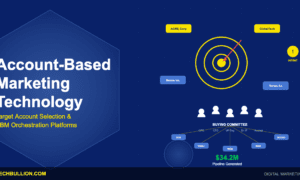
Enterprise B2B deals are rarely decided by a single stakeholder. A typical complex solution sale involves economic buyers, technical evaluators, end-user champions, and procurement each with different priorities, different objections, and different information needs. AI-driven personalization allows marketing to run parallel, role-specific nurture tracks across the entire buying committee of a single target account simultaneously. That is a level of orchestration that was operationally impossible with traditional marketing tools.
Predictive Lead Scoring: Replacing Gut Feel with Revenue Data
One of the most persistent sources of organizational friction in B2B companies is the lead quality debate. Marketing passes leads based on engagement metrics email opens, content downloads, form submissions. Sales evaluates those same leads against experience, instinct, and qualification conversations. These two frameworks rarely align, and the resulting trust breakdown between two functions that need to operate as a single revenue team is one of the most common growth blockers in B2B organizations.
Predictive AI models resolve this by grounding lead and account scoring in actual historical conversion data. Instead of scoring a contact highly because they attended a webinar, predictive models identify which specific behavioral sequences, firmographic characteristics, and engagement patterns genuinely correlate with pipeline conversion and deal closure and weight accordingly.
The output is a shared, data-validated definition of lead quality that both marketing and sales can trust and work from together. Marketing focuses investment on generating the signals the model identifies as predictive of closed revenue. Sales concentrates its capacity on accounts the model ranks as high-readiness. Pipeline quality improves, sales cycle times shorten, and the conversation between marketing and sales shifts from attribution disputes to collaborative revenue strategy.
AI in Content Strategy: From Publishing Volume to Buyer Intelligence
Content remains the foundation of B2B demand generation. But most marketing teams still build content calendars based on keyword research, competitive gap analysis, and internal editorial preference without a clear, data-driven view of which content is actually influencing buyer decisions at each specific stage of the journey.
AI changes how content strategy is built, produced, and measured. Natural language processing models can map which topics engaged a company’s highest-value closed customers at each stage of their buying process, identifying content gaps that no spreadsheet audit would surface. Generative AI accelerates production for the long tail of buyer questions that marketing teams rarely have the bandwidth to address manually. And AI-driven attribution connects content consumption directly to pipeline movement, not just traffic and session data.
The shift from publishing-calendar thinking to buyer-journey intelligence means content programs become directly tied to revenue outcomes. This is the discipline that separates B2B marketing organizations that contribute measurably to the pipeline from those that operate as a brand cost center waiting to be cut.
Conversational AI: The Always-On Buyer Engagement Layer
Enterprise B2B buyers do not always want to speak to a salesperson. They want accurate answers quickly, relevant guidance in the moment, and the ability to progress their research on their own terms often outside of business hours, often without submitting a lead generation form.
Conversational AI deployed across websites, marketing portals, and digital touchpoints allows B2B organizations to engage buyers at the exact moment of intent. Enterprise-grade AI assistants qualify visitors, surface contextually relevant content based on account data, answer capability and product questions, and route high-readiness accounts directly to sales all without friction-heavy lead capture or human availability requirements.
The distinction between conversational AI that drives conversion and conversational AI that frustrates buyers comes down to one thing: context awareness. Generic chatbots answer static FAQs. Enterprise-grade implementations integrate with CRM, content management systems, and real-time account intelligence to deliver responses that reflect what a specific visitor from a specific company, at a specific stage of their buying cycle, actually needs to hear at that moment.
What AI Does Not Replace in B2B Marketing
AI is a force multiplier. It is not a replacement for marketing judgment, strategic positioning, or human creativity and organizations that treat it as one will be disappointed with the results.
The B2B marketing teams seeing the strongest returns from AI investment are not those that have handed campaign logic to algorithms. They are those that have used AI to eliminate the low-value manual work list hygiene, performance reporting, content tagging, A/B test analysis freeing their people to focus on the work that requires genuine human expertise: brand narrative development, competitive positioning, customer relationship management, and strategic planning.
AI amplifies good marketing strategy. It cannot compensate for a weak one. If the Ideal Customer Profile is poorly defined, AI will prioritize the wrong accounts more efficiently. If the messaging is generic, an AI-powered personalization engine will distribute generic content at greater scale. The strategic foundation has to be built by people who understand the market, the buyer, and the competitive context. AI then executes on that strategy faster and more precisely than any team could achieve manually. The combination of strong human strategy and enterprise AI execution is where the genuine, durable competitive advantage lives.
Building the Internal ROI Case for AI Investment
For marketing leaders who need to secure budget approval for AI capabilities, the business case in 2026 is clearer than at any previous point but it still needs to be built rigorously to earn the confidence of skeptical CFOs and CROs.
The most compelling ROI arguments connect directly to pipeline and revenue metrics: reduction in cost-per-pipeline-opportunity through improved account prioritization; improvement in marketing-to-sales conversion rates through predictive qualification; reduction in content production costs through AI-assisted generation; and acceleration in pipeline velocity as AI surfaces buying signals earlier in the cycle.
These are revenue-tied outcomes not marketing vanity metrics. Framing the investment in these terms is what converts leadership skepticism into budget approval. For B2B marketing leaders building the research foundation for this business case, TechBullion publishes consistent, in-depth coverage at the intersection of enterprise technology and revenue strategy a reliable resource for both competitive intelligence and the data points that support internal investment conversations.
Conclusion
Enterprise AI is not a capability B2B marketing leaders should be planning for in the future. It is a present-day competitive reality that is already separating high-performing organizations from those still relying on manual segmentation, static ICP definitions, and gut-feel qualification decisions.
The shift is not about replacing marketing teams with technology. It is about equipping those teams with the intelligence, speed, and precision that modern enterprise buyers now expect from vendors they take seriously. Today’s B2B buyers are more self-directed and more demanding than at any previous point in the buying cycle. Meeting them with the right message, at the right moment, through the right channel requires infrastructure that no human team can build manually at scale.
Centric works with B2B organizations across the US and UAE to design and deploy enterprise AI strategies that integrate across marketing, sales, and operational systems moving organizations beyond expensive sandbox experiments and into AI that delivers real, measurable business value. If your organization is ready to move from AI exploration to AI execution, the conversation starts there.