
How Employsome Is Disrupting the $5 Billion EOR Industry With the First Real-Time Comparison Tool

The Employer of Record industry has a transparency problem. Over 200 providers now operate globally, collectively managing billions of dollars in cross-border payroll. The market is projected to grow from $5 billion in 2026 to nearly $20 billion by 2036. And until now, there has been no independent way to compare them.
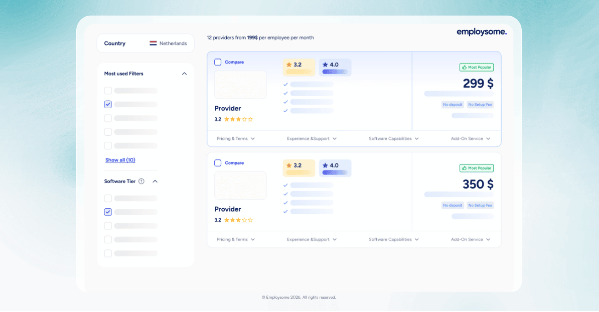
Employsome is changing that. The platform has launched the first real-time EOR comparison tool, covering 125+ providers across 100+ countries with independent scoring on pricing transparency, entity ownership, contract terms, and local support quality. Think of it as what Booking.com did for hotels or what NerdWallet did for financial products, applied to an industry that has operated without independent buyer infrastructure for over a decade.
A market that grew too fast for buyers to keep up
Five years ago, most companies choosing an EOR provider had a handful of options. Deel, Remote, G-P, and a few regional players. The decision was relatively straightforward because the market was small enough to evaluate through a few sales calls and demo sessions.
That is no longer the case. The EOR market has exploded. Venture capital poured in: Deel raised $679 million, Remote raised $300 million, Papaya Global raised $400 million. Dozens of new providers launched. Regional specialists appeared in every geography. Corporate services firms added EOR to their existing payroll offerings. The result is a market with over 200 providers, wildly inconsistent pricing, and no standardised way for buyers to compare.
For buyers, this has created a paradox. More options should mean better outcomes. Instead, the sheer volume of providers, combined with opaque pricing and inconsistent service models, has made the buying process slower, more confusing, and more dependent on whichever provider’s sales team gets to you first.
Why smaller EOR providers have been invisible
The biggest names in EOR are not necessarily the best. They are the best funded. Deel, Remote, and G-P dominate search results, review sites, and analyst reports because they have the marketing budgets to be everywhere. A regional EOR with deep local expertise in Brazil, or a specialist with owned entities across Southeast Asia, simply cannot compete for visibility against companies that have raised hundreds of millions of dollars.
This creates a structural disadvantage for smaller providers and a blind spot for buyers. Some of the strongest EOR operations in specific countries are run by providers that most companies have never heard of. They have owned local entities, decades of compliance experience, and pricing that undercuts the global platforms by 30% to 50%. But they do not show up in Google searches, they are not on G2 or Capterra, and they do not have sales teams making cold calls to Series B startups.
Employsome was built to fix this. The platform gives every EOR provider, from the largest global platforms to the smallest country specialists, an equal opportunity to be discovered, evaluated, and compared on the same criteria.
What the comparison tool actually does
Employsome lets companies compare EOR providers in real time across pricing, country coverage, entity ownership, contract terms, and independent quality scores. The platform assigns each provider a Global EOR Score and a Country Score based on a data-driven methodology that combines pricing transparency, compliance infrastructure, software quality, and on-the-ground performance.
Users can filter by country, compare providers side by side, and run instant quotes without going through a sales process. Every provider listing includes verified data: whether they own their local entity or use a third-party partner, what their actual fee structure looks like, and how they perform against competitors in the same market.
The platform is 100% independent. Employsome is not owned by or affiliated with any EOR provider. The scoring methodology is published and consistent across all listings. Provider rankings are not influenced by advertising spend or commercial relationships. This is a deliberate design choice in an industry where most “comparison” content is produced by the providers themselves or by affiliates with undisclosed commercial interests.
Bringing transparency to a market that has resisted it
Pricing in the EOR industry has historically been opaque by design. Most providers do not publish their fees. They require a sales call, a demo, and a custom quote. The same provider can charge different prices to different clients for the same service in the same country. There is no standardised way to know whether you are paying a fair price.
Employsome is challenging this by publishing average pricing data across providers and countries, making it possible for buyers to benchmark what they are being quoted against the market. The platform also flags hidden costs that providers often bury in their contracts: FX conversion markups, offboarding fees, out-of-cycle payroll charges, and early termination penalties.
This level of pricing transparency is new to the EOR industry. While misconceptions like EOR being too expensive or only suitable for large companies are gradually being corrected, the pricing side has remained stubbornly opaque. For providers that have relied on information asymmetry as a pricing strategy, this shift is uncomfortable. But for buyers, especially startups and SMEs that do not have the leverage to negotiate enterprise-level pricing, it is a fundamental change in how they can approach the buying decision.
Why this matters now
The timing is not accidental. The EOR market is at an inflection point. The first wave of growth was driven by early adopters and well-funded tech companies that could afford to experiment. The next wave will be driven by the mass market: SMEs, mid-market companies, and startups in non-tech industries that are hiring internationally for the first time.
These buyers do not have HR teams that understand EOR. They do not have procurement departments that can run a structured vendor evaluation. They need a tool that lets them compare, evaluate, and decide without becoming an expert in the industry first. That is exactly what Employsome provides.
Every major consumer and B2B market eventually gets an independent comparison layer. Travel got Booking.com and Kayak. Insurance got Compare the Market. Financial products got NerdWallet. The EOR industry, now worth $5 billion and growing at nearly 15% annually, is getting Employsome.






Comment