
How Do You Find Trending Topics Before Everyone Else Is Talking About Them?

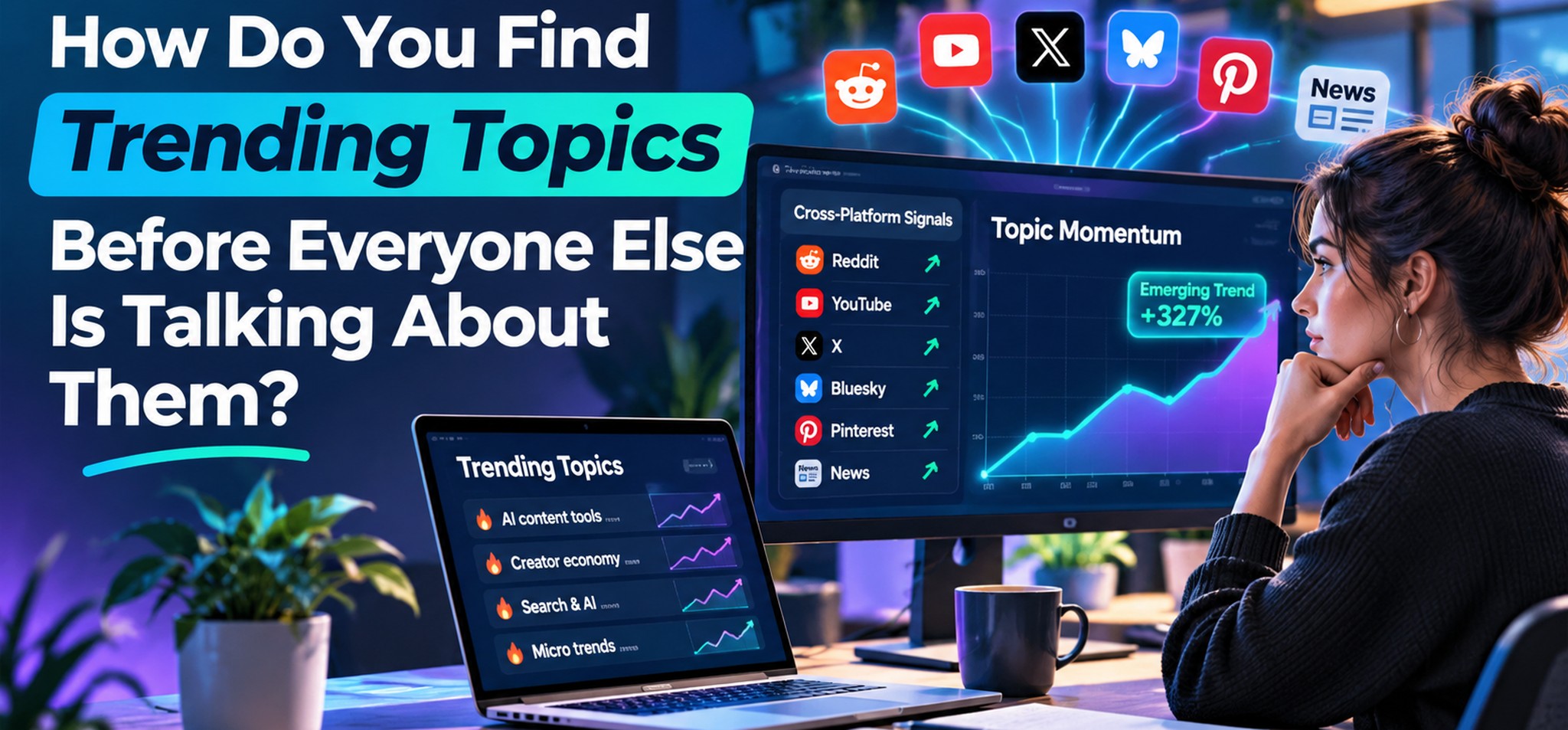
For creators and marketers, the challenge is not finding something that is already popular. It is recognising a subject while audience interest is beginning to build, then deciding whether it is relevant enough to cover. The most useful approach combines several sources: community conversations, platform activity, search behaviour, news coverage and the questions customers are already asking.
No tool can guarantee that a topic will become popular or predict exactly when it will peak. But a repeatable research process can help teams notice early signals, validate demand and avoid spending time on trends that do not fit their audience.
Why do familiar keyword tools sometimes miss emerging topics?
Keyword research is essential for understanding established search demand, competition and the language people use when looking for answers. Its limitation is timing: many keyword datasets are most useful once enough searches have accumulated to form a measurable pattern. A new product feature, creator format, cultural conversation or industry issue may first appear in smaller communities before it becomes a recognisable search term.
That does not make keyword research obsolete. It means marketers should pair it with sources that reveal what people are discussing now. Search data helps answer, “Are people looking for this?” Community and platform signals can help answer, “What are people beginning to care about?”
1. Start with the places where your audience already talks
Reddit communities, specialist forums, YouTube comments, public social conversations and niche newsletters can reveal questions before they become polished search queries. Look for repeated questions, new terminology, recurring frustrations, unusual comparisons and requests for recommendations.
Do not treat one highly upvoted post or viral video as proof of a broad trend. Read the surrounding discussion. Check whether people are asking follow-up questions, sharing personal experiences or discussing practical consequences. The context often matters more than the headline.
2. Compare signals across more than one platform
A subject appearing on one platform may reflect a creator’s audience, a recommendation-system spike or a short-lived community event. If related conversations begin appearing independently across several platforms, the case for broader interest becomes stronger.
For example, a new editing workflow might first attract discussion among specialist creators, then appear in YouTube tutorials and later show up in marketing newsletters. These are not identical signals, but together they suggest that the topic is travelling beyond its original community.
Cross-platform research is useful because each platform reveals a different behaviour: video platforms show what people are watching, discussion communities show what they are debating, visual discovery platforms show what they are saving, and news sources show what publishers are covering.
3. Separate a rising topic from a passing spike
Before committing resources, look for evidence of sustained or expanding interest. Ask:
· Is the topic appearing in more than one independent source?
· Are new people or communities joining the conversation?
· Are discussions producing useful questions, examples or practical problems?
· Is interest increasing over several observations, rather than appearing in one isolated burst?
· Does the subject connect to the audience you want to reach?
A trend is not automatically a good content opportunity. A topic can be popular but irrelevant to your brand, too sensitive to cover responsibly, or already saturated with near-identical articles.
4. Use a simple trend lifecycle
A practical editorial model is to classify opportunities into five broad stages:
· Emerging: early signals are appearing, but the topic is not yet widely discussed.
· Accelerating: more communities and publishers are beginning to cover it.
· Peaking: attention is high, but competition and audience saturation may also be high.
· Sustained: interest remains stable and may support evergreen content.
· Declining: conversation is fading, although the topic may still have historical or explanatory value.
These stages are a planning aid, not a universal scientific law. Different subjects move at different speeds. A breaking news story may change within hours; a new professional workflow may develop over months.
5. Validate the opportunity with search and audience evidence
Once a topic looks promising, use keyword research to identify the language people use and the questions they need answered. Check search suggestions, related questions, trend data and competing pages. Then review your own audience data: support requests, sales conversations, newsletter replies, site searches and comments can reveal whether the topic matters to your readers.
A useful content brief should state the audience, the question being answered, the evidence available, the unique angle and the intended format. If you cannot explain what your article will add beyond existing coverage, the idea probably needs more research.
6. Make cross-platform discovery part of the workflow
For teams that monitor several channels, a consolidated trend view can reduce the time spent switching between feeds. Peako AI is one example of a platform designed to bring together trend signals from YouTube, X, Reddit, Bluesky, Pinterest, news sources and long-form articles. Its public trend feed presents topic clusters alongside momentum and lifecycle information, which can be used as an input to editorial research.
For readers who want to explore this approach, the cross-platform trending topics feed provides a public view of topics being tracked across multiple sources. The platform list is also available in its overview of supported content platforms. As with any research tool, treat its signals as leads to investigate—not as a substitute for checking sources, audience fit and factual accuracy.
A practical 20-minute trend check
1. Five minutes: scan relevant communities and audience questions.
2. Five minutes: check whether related conversations are appearing on other platforms.
3. Five minutes: validate search language, competing coverage and audience relevance.
4. Five minutes: write a brief with the angle, evidence, format and reason to publish now.
The real advantage is better judgement, not simply being first
Publishing first is not always the goal. Publishing something useful while an audience is becoming interested is more valuable than rushing out a thin reaction. The strongest trend-led content adds context, answers a real question, checks claims and offers a perspective that is not already repeated everywhere.
A reliable process combines early signals with validation and editorial judgement. Use communities to hear the questions, multiple platforms to test whether interest is spreading, search data to understand demand, and audience knowledge to decide whether the subject deserves your attention.






Comment