Mobile command centers play a critical role in emergency response, public safety, event management, disaster recovery, and field operations. When teams need to coordinate people, technology, communications, and decision-making away from a fixed facility, specialty vehicles provide a flexible solution. These vehicles can be designed as fully functional command hubs with workstations, radios, video systems, satellite communications, power systems, and secure storage. Unlike a temporary tent or rented office space, a mobile command center can arrive quickly, operate independently, and support teams in challenging environments. Many organizations choose custom specialty vehicles because they can be configured around specific missions, agency workflows, equipment needs, and operating conditions. From police departments to utility companies, these vehicles help teams stay organized when fast, informed decisions matter most.
What Is a Mobile Command Center?
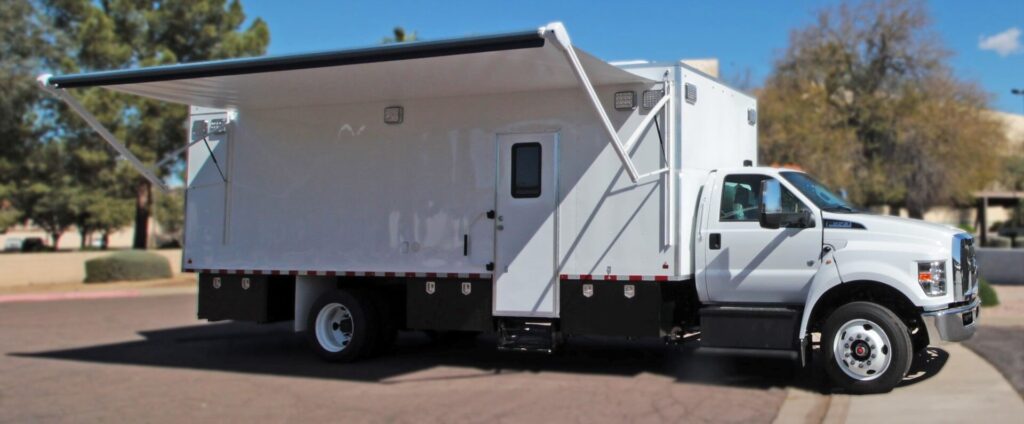
A mobile command center is a vehicle equipped to support command, control, communications, and coordination in the field. It may be built on a van, truck, trailer, bus, or heavy-duty chassis depending on how much space and capability the organization requires. Inside, the vehicle usually includes work areas, communication systems, displays, radios, computers, networking equipment, and power infrastructure. Some mobile command centers are compact units designed for quick deployment, while others are large vehicles with conference rooms, dispatch stations, and multi-agency coordination areas. The main purpose is to give leaders and response teams a central place to manage operations near the scene. This improves situational awareness, shortens response times, and keeps critical personnel connected.
Emergency Response and Disaster Management
One of the most common uses for mobile command centers is emergency response. During natural disasters, fires, floods, storms, hazardous material incidents, and large-scale accidents, responders need a reliable place to coordinate activity. A command vehicle can be positioned near the affected area while still providing shelter, communications, and operational support. Teams can use it to track resources, assign personnel, monitor weather, review maps, communicate with agencies, and manage logistics. Because disasters can damage local infrastructure, mobile command centers often include backup power, satellite communication, and independent networking systems. This allows responders to continue working even when power, cell service, or internet access is limited.
Law Enforcement and Public Safety Operations
Law enforcement agencies use mobile command centers for critical incidents, investigations, surveillance support, search operations, and community safety events. A vehicle can serve as a field headquarters during hostage situations, missing person searches, tactical operations, crime scene investigations, or major public gatherings. Officers and supervisors can use onboard systems to review camera feeds, communicate with dispatch, coordinate teams, and manage intelligence. The vehicle may include secure storage for equipment, interview spaces, radio consoles, and workstations for analysts or command staff. In high-pressure situations, having a dedicated mobile command location helps reduce confusion and centralize decision-making. It also allows agencies to bring advanced technology directly to the scene instead of relying only on remote facilities.
Fire, EMS, and Incident Command Support
Fire departments and emergency medical services use mobile command centers to manage incident command at complex scenes. Large fires, mass casualty incidents, technical rescues, and multi-agency responses require clear communication and organized leadership. A command vehicle gives incident commanders a protected environment where they can track units, review building plans, coordinate medical response, and communicate with dispatch. It may include whiteboards, mapping software, radio systems, weather monitoring, and live video feeds from drones or field cameras. For EMS, the vehicle may help coordinate triage, patient transport, hospital availability, and staging areas. These capabilities are especially valuable when incidents continue for several hours or involve multiple response teams.
Utility, Infrastructure, and Field Service Coordination
Mobile command centers are also used outside traditional emergency services. Utility companies, telecom providers, transportation agencies, and infrastructure teams rely on command vehicles during outages, repairs, inspections, and restoration projects. After major storms or equipment failures, field teams may need to coordinate crews across large service areas. A mobile unit can help supervisors monitor repair progress, communicate with dispatch, access digital maps, and manage customer-impact information. These vehicles may include rugged workstations, network access, equipment storage, and systems for tracking field assets. By bringing management and communications closer to the work zone, organizations can improve response efficiency and reduce downtime.
Event Security and Crowd Management
Large events often require temporary command centers for safety, logistics, and coordination. Concerts, festivals, parades, sporting events, political gatherings, and community celebrations can involve thousands of attendees and many moving parts. A mobile command center provides a central point for security teams, event organizers, medical personnel, law enforcement, and operations staff. Inside the vehicle, teams can monitor cameras, review crowd flow, communicate with field staff, and respond quickly to incidents. The vehicle may also support lost-and-found coordination, emergency alerts, access control, and traffic management. For recurring events, a well-designed command vehicle can make planning and execution more consistent year after year.
Communications and Technology Systems
The value of a mobile command center often depends on the technology inside it. Strong communication systems allow teams to stay connected across agencies, departments, and field crews. Vehicles may include radios, dispatch consoles, cellular routers, satellite internet, Wi-Fi networks, antenna systems, and encrypted communication tools. Video systems can include large displays, camera feeds, drone video, mapping dashboards, traffic cameras, and remote meeting platforms. Computer workstations may support dispatch software, incident management tools, GIS mapping, records systems, and cloud-based collaboration. When these systems are integrated properly, the vehicle becomes more than transportation. It becomes a mobile operations hub.
Common technology features may include:
- Radio communication consoles
- Satellite internet and cellular bonding
- Wi-Fi and local area networking
- Video walls and display monitors
- Dispatch and incident management software
- Drone video integration
- Secure data systems
- GPS and mapping tools
Interior Layout and Workspace Design
Interior design is a major factor in how well a mobile command center performs. The layout must support the way teams actually work during an incident or field operation. Some vehicles include individual operator stations, while others include conference tables, briefing areas, storage cabinets, and separate rooms for private communication. Seating, lighting, climate control, acoustics, and cable management all affect comfort and productivity. Because space is limited, equipment must be placed carefully so crews can move efficiently and access critical systems quickly. Custom specialty vehicles are often preferred because the interior can be tailored to specific roles, such as dispatch, incident command, technical support, or executive briefing.
Power, Climate, and Self-Sufficiency
A mobile command center must be able to function in locations where normal infrastructure may not be available. That is why power systems are a core part of the build. Vehicles may include generators, shore power connections, battery banks, inverters, solar support, automatic transfer switches, and power management systems. Climate control is also important because crews may work long hours in extreme heat, cold, rain, or smoke-affected areas. The vehicle may need heating, air conditioning, ventilation, insulation, and weather-resistant exterior features. Self-sufficiency allows the command center to support operations without depending entirely on local buildings or utilities.
FAQ: Mobile Command Center Specialty Vehicles
What types of organizations use mobile command centers?
Police departments, fire departments, EMS agencies, emergency management offices, utility companies, transportation agencies, event organizers, military teams, and private security groups all use mobile command centers.
What size vehicle is best for a mobile command center?
The best size depends on the mission. Vans and smaller trucks work well for fast deployment, while larger trucks, buses, or trailers provide more room for workstations, meetings, and advanced technology.
Can a mobile command center operate without internet or power?
Many are designed to operate independently for a period of time. They may include generators, battery systems, satellite communication, cellular routers, and radio systems to support field operations when infrastructure is limited.
How long does it take to deploy a mobile command center?
Deployment time depends on the vehicle design and the situation. Smaller units may be ready quickly, while larger units with antennas, workstations, and expanded systems may take longer to fully set up.
Are mobile command centers only for emergencies?
No. They are also used for planned events, infrastructure projects, training exercises, remote operations, public outreach, and temporary field offices.
Why choose a custom build instead of a standard vehicle?
A custom build allows the organization to match the layout, communications, storage, power, seating, and technology to its exact operational needs. This can improve efficiency, safety, and long-term usability.
Choosing the Right Specialty Vehicle for Command Operations
Choosing the right mobile command center starts with understanding how the vehicle will be used in real conditions. An organization should consider crew size, response area, equipment requirements, communication needs, deployment speed, and budget. A compact unit may be ideal for rapid response and urban environments, while a larger platform may be better for regional emergencies or multi-agency coordination. The build should also account for future technology upgrades, maintenance access, storage needs, and operator comfort. Working with an experienced specialty vehicle builder can help ensure the final design supports both current missions and long-term growth. When designed well, a mobile command center gives teams the mobility, structure, and technology they need to manage complex operations with confidence.