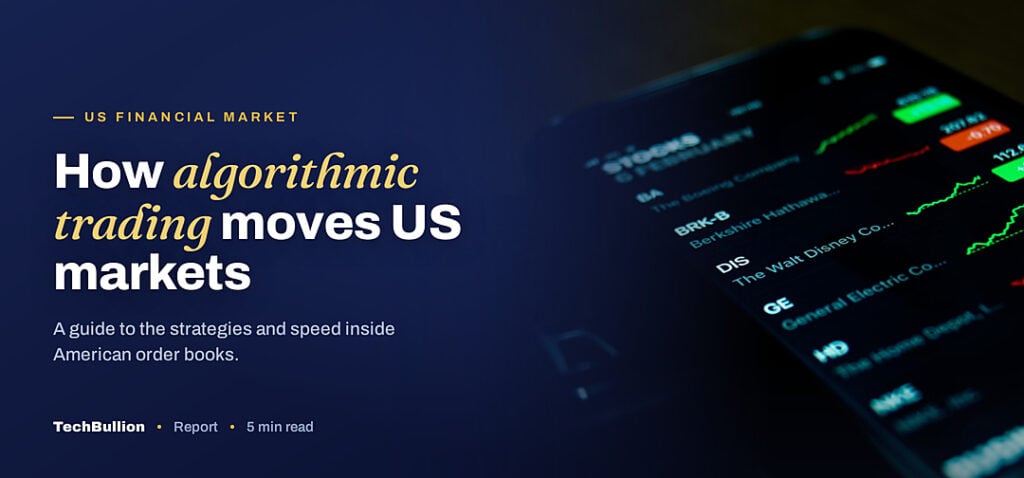
When a pension fund decides to buy two million shares of Apple, it almost never sends one giant order to the exchange. Software breaks that instruction into thousands of small pieces and releases them across the trading day, searching for the best available price on each slice. That quiet choreography is how algorithmic trading works, and it now sits behind most of the share volume that moves through United States markets. The global algorithmic trading market reached $20.23 billion in 2026 and is on track to hit $29.54 billion by 2031, a 7.87% compound annual growth rate, according to Mordor Intelligence.
What algorithmic trading actually means
Algorithmic trading is the use of pre-programmed instructions to place orders automatically based on variables such as price, timing, and volume. A human sets the goal, buy this much, sell within this window, stay under this price, and the program handles the thousands of small decisions that follow. The approach removes the delay and emotion of manual trading and lets a desk work many instruments at once.
It helps to separate two ideas that often get blurred. Algorithmic trading describes any automated order strategy, including ones that run over hours or days. High-frequency trading is a narrow, speed-obsessed subset that competes in microseconds. Most institutional flow is the slower kind, designed to move large positions without pushing the price against the buyer.
How an order travels from instruction to execution
The journey starts with a parent order, the full amount a manager wants to trade. An execution algorithm splits that parent into many child orders. Common strategies include volume-weighted average price, which paces trading to match the day’s volume curve, time-weighted average price, which spreads orders evenly across a window, and implementation shortfall, which front-loads trading to limit the gap between the decision price and the final fill.
Each child order then passes through a smart order router. The router scans dozens of venues, the major exchanges, alternative trading systems, and dark pools, and sends each slice where the price and liquidity are best at that instant. The plumbing that organizes all of this sits inside order management systems, which track positions, enforce risk limits, and record every fill for later compliance review.
The infrastructure that makes speed possible
Speed in this market is a physical problem as much as a software one. Firms that need the fastest execution pay to place their servers inside the same data centers as the exchange matching engines, a practice called colocation. Colocation racks at CME Group’s Aurora campus cost more than $15,000 per month, and Nasdaq’s matching engine now processes orders in under 500 nanoseconds. The most demanding desks route orders through field-programmable gate arrays, specialized chips that react faster than general-purpose processors.
Not every strategy needs that hardware. Cloud deployment captured 54.47% of algorithmic trading spending in 2025, per Mordor Intelligence, because most statistical strategies tolerate single-digit-millisecond round trips. Cloud platforms also let smaller teams run hundreds of back-tests in parallel, then shut the servers down when live trading begins, which keeps fixed costs low.
Who runs the algorithms in the US market
Institutional investors accounted for 61.16% of the algorithmic trading market in 2025. In United States equities, a small group of specialized firms supplies a large share of visible liquidity. Six principal trading firms, Citadel Securities, Virtu Financial, Jump Trading, XTX Markets, Tower Research Capital, and Hudson River Trading, collectively furnish an estimated 30% to 40% of displayed depth on major venues. North America generated 38.14% of global revenue in 2025, the largest share of any region, concentrated in the New York and Chicago trading hubs.
Retail access is growing too. Zero-commission brokers now expose trading interfaces that let individuals automate strategies, and the retail segment is expanding at an 8.32% annual rate through 2031. The same automation that powers institutional desks also sits under consumer products like robo-advisors, which rebalance portfolios on a schedule without a human placing each trade.
Why how algorithmic trading works matters for investors
For everyday investors, the practical effect of how algorithmic trading works is tighter spreads and faster fills, since automated market makers post continuous quotes. The trade-off is complexity. Regulators have responded by tightening execution-quality rules. The Securities and Exchange Commission’s proposed Rule 605 amendments push brokers to report price improvement at finer detail, and Regulation National Market System already requires routers to seek the best available price across venues. Machine-readable compliance is now part of the cost of doing business, and techniques such as reinforcement learning for trading are being tested to adapt strategies as conditions shift.
The risks that come with automation
Automation introduces failure modes that manual trading never had. When volatility spikes, many algorithms pull their quotes at the same moment, draining liquidity and widening price gaps. The October 2024 flash move in the Japanese yen, a 3% drop in roughly 90 seconds, showed how quickly automated kill-switches can feed on one another. United States exchanges manage this with volatility interruptions and circuit breakers that pause trading when prices move too far too fast. Desks now run stress tests with worst-case slippage models before they deploy a strategy, which raises operating costs but limits the chance of a runaway loss. Surveillance has tightened in parallel, with regulators fining firms for manipulative patterns such as spoofing, where traders post orders they never intend to fill.
US algorithmic trading at a glance
| Metric | Value | Source |
|---|---|---|
| Global market size, 2026 | $20.23 billion | Mordor Intelligence |
| Projected size, 2031 | $29.54 billion | Mordor Intelligence |
| North America revenue share, 2025 | 38.14% | Mordor Intelligence |
| Institutional share of market, 2025 | 61.16% | Mordor Intelligence |
| Nasdaq matching engine speed | Under 500 nanoseconds | Mordor Intelligence |
The mechanics described here, order slicing, smart routing, and colocation, were once exotic. Today they are the default way that institutions and a fast-growing pool of individuals interact with public markets. The next contest is less about raw speed and more about which firms can fold machine learning and real-time compliance into the same stack without slowing it down. For background on the strategies themselves, the reference entry on algorithmic trading methods traces how they reshaped order flow.