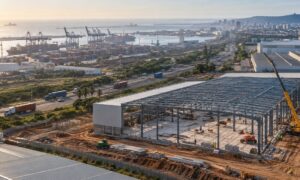
There’s a version of infrastructure that most people still picture when the word comes up: a crew pouring concrete, an inspector tapping on a bridge beam with a hammer, a clipboard with a checklist. That version still exists. But it’s operating alongside something quite different now, and the gap between the two is closing faster than most people outside the industry realize.
AI, IoT sensors, digital twins, predictive analytics these aren’t pilot programs anymore. They’re showing up on real projects, managing real assets, and in some cases catching structural problems that traditional inspection cycles would have missed entirely. For anyone working in engineering, construction, or city planning, getting familiar with how these technologies actually function, not just what they’re called, has become genuinely important.
What follows is a look at where things stand: what’s working, what’s still developing, and what it means for the people responsible for designing, building, and maintaining the infrastructure that cities depend on.
From Reactive to Predictive: Why the Shift Actually Matters
For most of infrastructure’s history, the maintenance model was essentially reactive. You waited for something to show signs of trouble, then you fixed it. Periodic inspections helped, but they were snapshots a bridge got looked at every two years, and whatever happened in between was largely invisible until it wasn’t.
The problem with that model isn’t just inefficiency, though it is inefficient. It’s that deterioration rarely announces itself at a convenient moment. Fatigue cracks develop. Moisture infiltrates expansion joints. Rebar corrodes under a surface that still looks fine. By the time something is visibly wrong, the repair scope and cost is usually far larger than it would have been if the issue had been caught earlier.
Continuous monitoring changes this equation in a practical way. When sensors are embedded in a structure and transmitting data around the clock, maintenance teams can see anomalies as they develop rather than months after the fact. That’s not a theoretical benefit, it’s a fundamentally different relationship with asset condition, and organizations that have made the transition tend not to want to go back.
IoT in Infrastructure: What It Actually Measures and Why That’s Useful
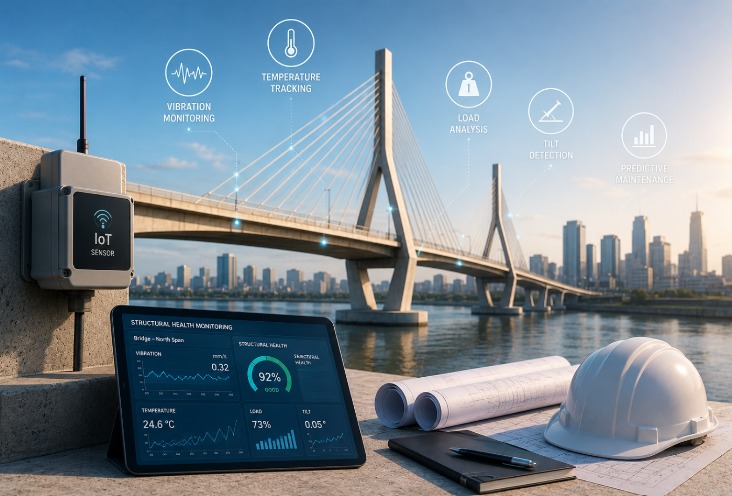
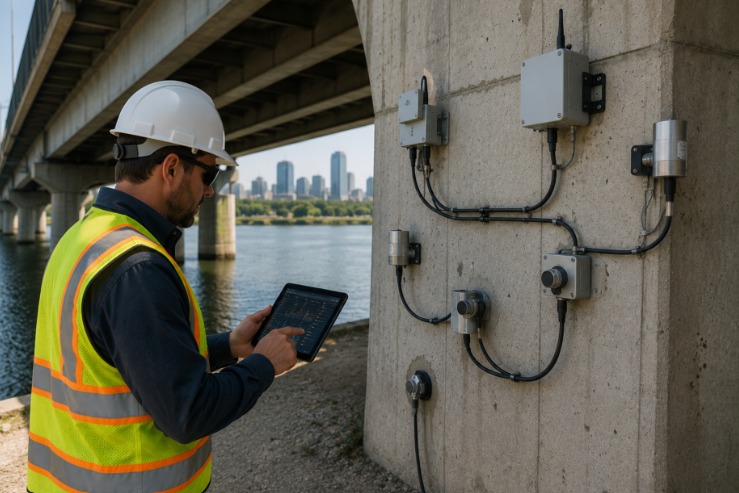
“IoT” is one of those terms that gets used loosely enough that it’s worth being specific. In an infrastructure context, it refers to networks of sensors embedded in or attached to physical assets bridges, tunnels, retaining walls, building envelopes, water systems that collect data continuously and transmit it to centralized platforms for monitoring and analysis.
What those sensors actually measure varies quite a bit depending on the asset type, but common parameters include:
- Strain and stress at critical structural points
- Vibration frequency and amplitude, particularly relevant for bridges and towers
- Temperature gradients that can indicate material stress or moisture movement
- Settlement and tilt over time
- Moisture levels in concrete or soil, which correlate with durability risks
On a smart bridge, for instance, this kind of monitoring can flag unusual stress patterns during a heavy load event, something that might not have any visible signature but that, over time, contributes to fatigue. Catching it early means scheduling an inspection at the right time, not just on a fixed calendar rotation.
The value compounds when you start linking sensor data across a network of assets. Suddenly you’re not just managing one bridge you’re managing a portfolio, with real information about relative condition and risk to guide where resources go first.
What AI Actually Does With All That Data
Sensors generate data. A lot of it. The useful question is what you do with it and that’s where AI tools have started to earn their place in infrastructure management.
The honest answer is that most AI applications in this space are doing pattern recognition at a scale and speed that humans can’t match manually.
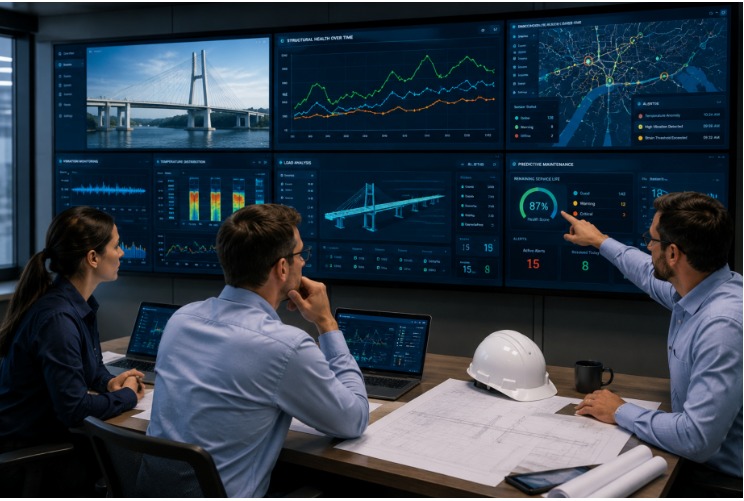
A machine learning model trained on historical performance data from similar structures can look at current sensor readings and flag the ones that deviate from expected ranges not because it “understands” structural engineering, but because it’s been taught what normal looks like and what the early signatures of deterioration tend to resemble.
That’s genuinely useful for several reasons. Inspection resources are finite. No team can manually review thousands of data points from dozens of structures every day. AI-assisted monitoring can do the continuous screening and escalate to human engineers only when something warrants closer attention. That changes the role of the inspector from data-gatherer to decision-maker, a better use of expertise, and usually a faster response to actual problems.
Predictive models can also help with planning. If a model estimates, based on current condition trends, that a structure will need intervention in roughly 18 months, that’s actionable information for budget cycles and contractor scheduling. It’s not perfect forecasting, but it’s considerably better than guessing.
Digital Testing: Quality Assurance Before the Structure Ever Opens
All the monitoring in the world doesn’t help much if the materials going into a structure weren’t verified in the first place. That’s why testing real, physical, documented testing of construction materials remains as important as ever, even as the tools themselves have gotten significantly more sophisticated.
Modern testing equipment is a meaningful step up from older analog instruments. Digital readouts, automated data logging, and integration with project management software have cut down on transcription errors and made it easier to maintain the kind of paper trail that project documentation requires. The fundamentals are the same: you’re still verifying concrete strength, evaluating soil compaction, checking aggregate quality but the workflow around the test is faster and more traceable.
This matters more than it might seem. Quality issues that get documented and addressed during construction are manageable. Quality issues that get missed during construction and discovered five years later are expensive, disruptive, and sometimes dangerous. The testing phase is the point where the most problems can be caught at the lowest cost.
Certified MTP has put together a useful educational overview of the material testing equipment used across modern construction quality assurance programs worth a look if you want to get a clearer sense of how testing fits into the broader digital workflow:
As these testing systems continue connecting to broader project platforms, the data they generate will feed directly into the monitoring and analytics tools that track structural performance over time. The testing record from day one becomes part of the asset’s permanent digital history which is exactly the kind of continuity that smart infrastructure management needs.
Digital Twins: Useful Now, Not Just Eventually
Digital twins get talked about a lot in futurist terms, but the practical applications are already running on real projects. The concept is straightforward: a digital twin is a virtual model of a physical asset that stays current because it’s continuously fed data from the real-world structure. As conditions change, the model reflects them.
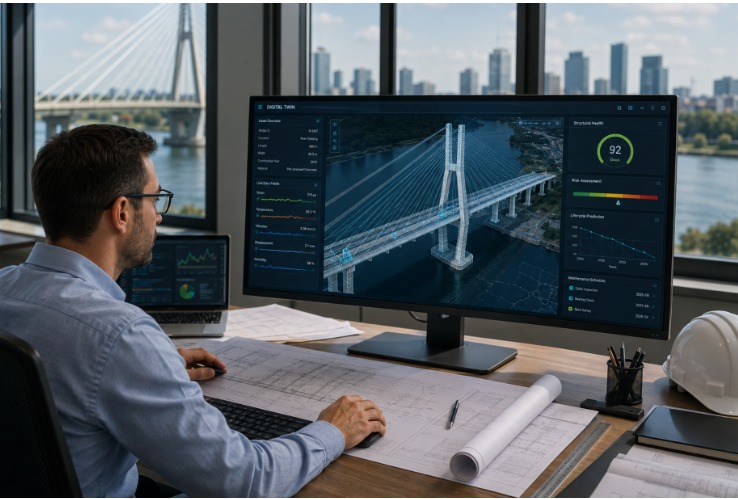
Where this gets interesting is what you can do with that living model. Engineers can run simulations. What happens to stress distribution if traffic loads increase significantly? What does the model predict about remaining service life if a repair is deferred by two years? How does a proposed retrofit change the structure’s response to seismic loading? These are questions you can test in the model before committing real resources.
For long-lived assets like bridges, tunnels, and major buildings, that kind of scenario planning is enormously valuable. Infrastructure doesn’t turn over quickly. Decisions made today have consequences that play out over decades, and having a model that accurately represents current conditions and can project forward is a meaningful decision-support tool.
Smart Cities Run on Infrastructure Data and That’s a Dependency Worth Taking Seriously
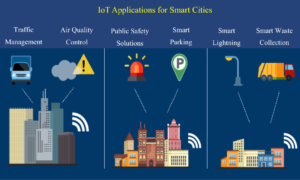
Smart city initiatives tend to get discussed in terms of traffic optimization, energy grids, and connected transit systems. Less often discussed is the infrastructure layer underneath all of it, the roads, bridges, water mains, and utility corridors that everything else depends on.
That dependency is real, and it creates a specific problem for city planners. You can have the most sophisticated traffic management system in the world, but if the bridge carrying a key arterial route has an undetected fatigue issue, you’ve got a disruption that no amount of signal optimization will fix.
The cities that are getting this right are treating infrastructure monitoring as a core data layer not a separate engineering concern, but an input to the same platforms that manage everything else.
That integration is still in early stages in most places, but the direction is clear. Reliable infrastructure data isn’t just an engineering nicety; it’s a prerequisite for the broader smart city vision to function.
A Word on Cybersecurity Because Connected Systems Create Connected Risks
It would be incomplete to talk about connected infrastructure without acknowledging the other side of that connectivity. When monitoring systems, control platforms, and data networks are linked, they become potential attack surfaces. Critical infrastructure power systems, water treatment, transportation networks has been an explicit target for state-sponsored and criminal cyber actors for years.
This doesn’t mean the answer is to avoid digital systems; the operational benefits are too significant for that to be a realistic position. But it does mean that cybersecurity can’t be an afterthought bolted on after deployment. It needs to be part of the design from the beginning: encrypted communications, strict access controls, network segmentation between operational technology and IT systems, and ongoing monitoring for anomalous behavior.
For organizations standing up connected infrastructure systems, finding engineers and security professionals who can speak both languages on the physical infrastructure side and the digital security side is genuinely difficult. That skills gap is real and worth addressing as part of any serious digital transformation program.
What This Means for the Next Generation of Infrastructure Professionals
If you’re currently in an engineering or construction program, or early in your career in either field, the convergence of these technologies creates both pressure and opportunity. The pressure is that technical competence alone knowing how to design or build something is table stakes. The engineers who will have the most influence on how infrastructure develops over the next 20 years will also need to understand data workflows, be able to engage critically with AI-generated analysis, and have at least a working knowledge of cybersecurity principles.
The opportunity is that most of the field is still figuring this out. There’s no settled playbook yet for how you integrate digital twins into a municipal asset management program, or how you structure the data pipeline between site testing and long-term structural monitoring. People who develop practical experience in these areas now even if their programs haven’t fully caught up to covering them will find themselves in demand.
On the quality assurance and testing side specifically, understanding how material testing connects to digital records and long-term performance tracking is increasingly relevant. Certified MTP’s resource on why quality control matters in construction lays out the case clearly and is worth reading for context on how testing fits into the larger picture.
Where Things Are Headed
Smart infrastructure isn’t a destination, it’s a direction. The technologies are evolving, the standards are still catching up, and the organizations implementing these systems are learning as they go. What’s clear is that the trajectory is set: data-driven decision-making is becoming the norm in infrastructure management, and the tools enabling it are getting more capable every year.
For the organizations leading this shift, the benefits are tangible lower maintenance costs, better asset performance, fewer unexpected failures, and infrastructure that can genuinely serve a growing urban population over a long service life. For those still relying primarily on traditional methods, the gap is starting to show.
The infrastructure built over the next decade will carry a lot of data alongside the loads it was designed for. The professionals who understand both and can use both effectively are the ones who’ll shape what that infrastructure looks like.
The Future of Smart Infrastructure
The future of infrastructure will be defined not only by stronger materials and better engineering, but also by the intelligent use of data. AI, IoT sensors, digital testing technologies, and digital twins are already transforming how assets are designed, monitored, and maintained. As cities continue to grow and infrastructure systems become more interconnected, organizations that embrace these technologies will be better positioned to improve reliability, reduce costs, and extend asset life. The next generation of infrastructure professionals will need to understand both the physical and digital sides of the built environment, because the smartest infrastructure of tomorrow will depend on both.