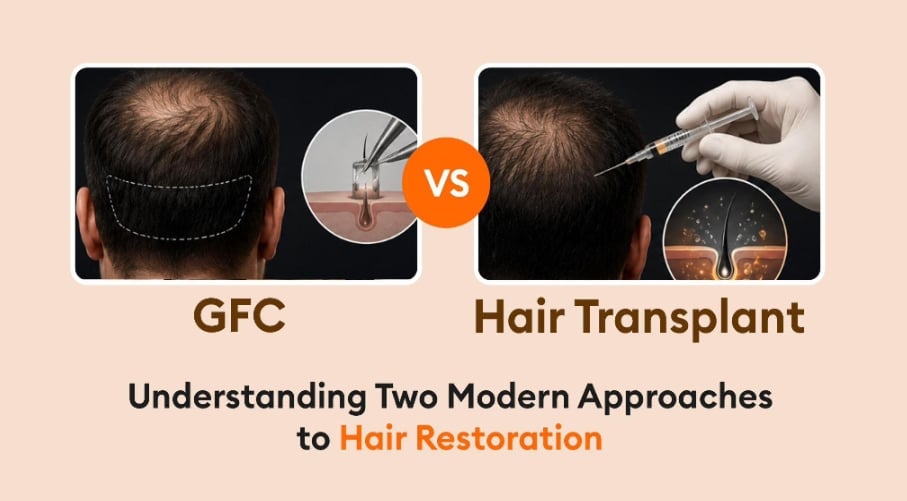
Hair loss is a progressive condition that affects millions of men and women worldwide. For some, it begins with increased shedding or a widening part. For others, it gradually progresses to noticeable thinning or bald patches that impact confidence and quality of life.
As awareness of non-surgical hair restoration continues to grow, many people find themselves asking the same question:
Should I choose Hair Fillers or a Hair Transplant?
The answer isn’t always one or the other.
While these treatments are often compared, they serve different purposes and are frequently used at different stages of the hair restoration journey. In many cases, they may even complement one another as part of a long-term treatment strategy.
Understanding how each approach works can help patients make informed decisions and enable practitioners to recommend treatments that align with an individual’s pattern of hair loss and treatment goals.
Quick Comparison
| Feature | Hair Fillers | Hair Transplant |
| Procedure | Injectable regenerative treatment | Surgical procedure |
| Primary Goal | Support existing hair follicles and scalp health | Restore hair in areas where follicles have been lost |
| Invasiveness | Minimally invasive | Surgical |
| Downtime | Minimal | Several days to weeks |
| Scarring | No | Possible |
| Best Suited For | Early to moderate thinning | Advanced hair loss and established bald areas |
| Donor Hair Required | No | Yes |
| Can Be Combined | Yes | Yes |
| Long-Term Management | Periodic maintenance may be recommended | Ongoing management of native hair is often recommended |
Understanding Hair Transplant Surgery
Hair transplant surgery is designed to restore hair in areas where follicles have already been lost.
The procedure involves harvesting healthy hair follicles typically from the back or sides of the scalp and transplanting them into thinning or bald areas. Modern techniques such as Follicular Unit Extraction (FUE) and Follicular Unit Transplantation (FUT) have significantly improved natural-looking outcomes while reducing visible scarring compared with older methods.
A hair transplant does not create new follicles or stop the biological processes responsible for hair loss. Instead, it redistributes healthy follicles from donor-rich areas to locations where hair density has diminished.
For individuals with sufficient donor hair and established hair loss, transplantation can provide effective restoration of coverage.
Understanding Hair Fillers
Hair Fillers take a different approach.
Rather than relocating hair follicles, they are designed to support the biological environment in which existing follicles function.
Modern peptide-based Hair Fillers combine cross-linked hyaluronic acid with biomimetic peptides. These are laboratory-designed peptides that mimic naturally occurring biological signals involved in the hair growth cycle.
These formulations are designed to support multiple aspects of follicular health, including:
- Hair growth signaling
- Follicular preservation
- Scalp hydration
- Scalp microenvironment
- Hair density support
Because Hair Fillers work with existing follicles, they are generally considered when follicles remain active but are beginning to weaken or miniaturize due to progressive hair loss.
Different Treatments for Different Stages of Hair Loss
One of the biggest misconceptions is that Hair Fillers and Hair Transplants compete with one another.
In reality, they often address different needs.
Hair Fillers are primarily intended to help support existing follicles before significant follicular loss occurs.
Hair Transplants are designed to restore hair in areas where follicles have already disappeared.
Simply put:
- Hair Fillers help support and preserve the hair you still have.
- Hair Transplants help restore hair that has already been lost.
Because hair loss is progressive, preserving healthy follicles can be just as important as replacing hair in areas affected by advanced loss.
How Hair Fillers and Hair Transplants Can Work Together
Modern hair restoration is increasingly viewed as a long-term journey rather than a single procedure.
Leading providers in comprehensive hair care, such as Samran Health Group, emphasize evaluating how different therapies can work together throughout the various stages of hair loss rather than asking which single treatment is better.
Depending on individual needs, Hair Fillers may be considered:
Before a Hair Transplant
For patients experiencing early thinning or increased hair shedding, peptide-based Hair Fillers may be used to support existing follicles and scalp health before surgical intervention becomes necessary.
Alongside a Hair Transplant
For suitable candidates, Hair Fillers may form part of a broader treatment strategy determined by the treating practitioner, supporting overall scalp health while transplantation restores areas of significant hair loss.
After a Hair Transplant
Although transplanted follicles are generally intended to be long-lasting, surrounding native hair may continue to thin over time because the underlying causes of hair loss often persist.
For this reason, practitioners may recommend regenerative therapies as part of ongoing hair management to help support the health of existing follicles and maintain overall hair density.
Who May Be a Candidate for Hair Fillers?
Hair Fillers may be considered for individuals experiencing:
- Early-stage hair thinning
- Diffuse hair loss
- Increased hair shedding
- Mild to moderate pattern hair loss
- Reduced hair density
- Patients seeking non-surgical treatment
- Individuals interested in regenerative hair restoration
Because Hair Fillers rely on the presence of viable follicles, earlier intervention is often an important consideration.
Who May Be a Candidate for Hair Transplant Surgery?
Hair transplantation may be appropriate for individuals with:
- Advanced pattern hair loss
- Established bald areas
- Sufficient donor hair
- Stable patterns of hair loss
- Patients comfortable with surgical treatment
A consultation with a qualified practitioner is essential to determine whether transplantation is appropriate based on donor hair availability and long-term expectations.
Recovery and Downtime
Hair Fillers
Hair Fillers are minimally invasive injectable treatments that are typically performed during an outpatient visit.
Most patients resume normal daily activities shortly after treatment.
Temporary redness, mild swelling, or tenderness around the injection sites may occur but generally resolves within a short period.
Hair Transplant
Hair transplantation requires a longer recovery period.
Patients may experience:
- Swelling
- Scabbing
- Temporary shedding
- Healing of donor and recipient areas
Visible improvements typically develop gradually over several months as transplanted follicles begin producing new hair.
Hair Restoration Doesn’t End with Surgery
Many people believe that a hair transplant permanently solves hair loss.
However, hair loss is often an ongoing biological process.
While transplanted follicles generally continue to grow, the surrounding native hair may continue to thin over time.
This is why modern hair restoration increasingly focuses not only on restoring lost hair but also on supporting the health and longevity of existing follicles.
Long-term management has become an important part of maintaining natural-looking results.
The Growing Role of Regenerative Hair Restoration
As our understanding of hair biology continues to evolve, the focus of treatment is expanding beyond simply replacing lost hair.
Today’s regenerative approaches aim to support the scalp environment and the biological pathways involved in healthy follicular function.
This has led to growing interest in treatments such as growth factor therapies, exosome-based treatments, and biomimetic peptide Hair Fillers.
Among these newer approaches is Elyara Hair Filler, a peptide-based injectable developed around a seven-peptide biomimetic complex combined with a sustained-release hyaluronic acid delivery platform.
Rather than targeting a single mechanism, Elyara is designed to support multiple pathways associated with healthy hair growth, follicular activity, and scalp health. Its sustained-release technology enables gradual delivery of biomimetic peptides, helping maintain biological signaling over time while supporting viable follicles.
As regenerative hair restoration continues to evolve, treatments like Elyara reflect a broader shift toward preserving existing hair, improving scalp health, and supporting long-term follicular function as part of a comprehensive hair restoration strategy.
Which Treatment Is Right for You?
The most appropriate treatment depends on several individual factors, including:
- Stage of hair loss
- Pattern of thinning
- Donor hair availability
- Age
- Treatment goals
- Preference for surgical or non-surgical treatment
- Overall scalp and follicular health
For patients experiencing early hair thinning, regenerative therapies such as peptide-based Hair Fillers may be considered before surgery becomes necessary.
For individuals with advanced follicular loss, hair transplantation may provide restoration of coverage while regenerative therapies continue to support existing native hair.
Rather than viewing these treatments as competing options, many practitioners now consider them complementary tools that can be used at different stages of the hair restoration journey.
A consultation with a qualified practitioner remains the best way to determine the treatment approach most appropriate for your individual needs.
Frequently Asked Questions
Do Hair Fillers replace a Hair Transplant?
Not necessarily. Hair Fillers and Hair Transplants serve different purposes. Hair Fillers are designed to support existing follicles and scalp health, while Hair Transplants restore hair in areas where follicles have already been lost.
Can Hair Fillers be used before a Hair Transplant?
Yes. Depending on the individual’s condition, practitioners may consider Hair Fillers during the earlier stages of hair loss to help support existing follicles before surgical treatment is required.
Can Hair Fillers be used after a Hair Transplant?
In some cases, regenerative therapies may be incorporated into a long-term hair management plan to help support surrounding native hair and overall scalp health. Treatment recommendations should always be individualized by a qualified practitioner.
Can Hair Fillers regrow hair in completely bald areas?
Treatment suitability depends on the presence of viable hair follicles. A qualified practitioner can determine whether Hair Fillers are appropriate based on an individual’s scalp assessment.
Which treatment has less downtime?
Hair Fillers are generally associated with minimal downtime, while Hair Transplant surgery involves a longer recovery period due to the surgical nature of the procedure.