
GPT-5.6 Luna API: OpenAI’s Economy Tier, Explained Without the Marketing

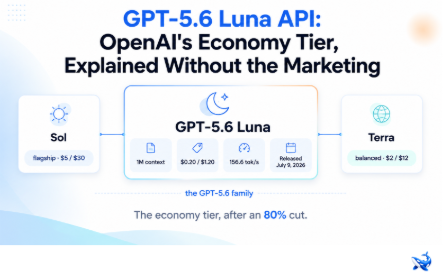
GPT-5.6 Luna API is OpenAI’s economy-tier reasoning model, released July 9, 2026, and after a price cut of roughly 80% it now costs $0.20 per million input tokens and $1.20 per million output, with a 1,000,000-token context window included. The rate card and live telemetry sit on GPT-5.6 Luna; this piece is the plain-English version of what the model actually is.
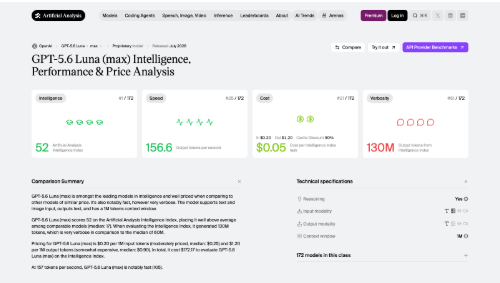
Here is the counter-intuitive bit: the cheapest model to run on Artificial Analysis’ Intelligence Index — $0.05 per task, the lowest figure on a board of 172 models — is also one of the fastest, and it trails OpenAI’s own flagship by less than nine points on raw intelligence. Luna is the tier people assume exists for parking-lot duty. It turns out to be the workhorse that quietly carries most of the volume.
What GPT-5.6 Luna actually is
Luna is the budget member of the GPT-5.6 family, which Artificial Analysis groups into three tiers: Sol (flagship), Terra (the balanced default), and Luna (economy, built for high volume). It is a proprietary, closed-weight model that, per Artificial Analysis, OpenAI released on July 9, 2026. AA flags it as multimodal — it accepts text and image input and returns text — and describes it as “notably fast.”
The headline spec is the context window: 1,000,000 tokens, reported by Artificial Analysis and by the live model pages that carry it. That is enough to hand the model an entire codebase or a full contract in one call, no chunking required. For a model at this price point, “just send the whole document” stops being a cost decision at all.
It is also, in practical terms, everywhere. Replit’s Free Mode now runs on Luna (per our own pricing write-up), and you can reach it through the vendor’s own API and several third-party platforms — the cut pricing is a price you can actually get, not a press-release figure. And because the model is a drop-in for anything that speaks the OpenAI SDK — it ships under the model ID openai/gpt-5.6-luna with an OpenAI-SDK-compatible surface — most teams adopting it don’t change a line of calling code.
The benchmarks: cheap, fast, and not nearly as dim as you’d expect
Per Artificial Analysis’ live board, checked August 22, 2026:
- Intelligence Index (max effort): 52.32 — well above the tier median of 17. For scale, Sol sits at 60.93 and Claude Opus 5 at 63.05 (all max config). Luna trails its own flagship by about 8.6 points and Opus 5 by about 11. That is a real gap on frontier work, but it is not the chasm you’d expect at a price gap this large.
- Speed: median output of 156.6 tokens per second — more than double Sol’s 73.7 and well ahead of Claude Opus 5’s 61.8 — with a time-to-first-token around 102 ms, per AA.
- Cost: AA prices a full index evaluation at $172.17 on 130M output tokens (the tier median is 60M), and its per-task cost of $0.05 is the lowest on the board, against $1.23 for Sol and $2.34 for Claude Opus 5. Its overall cost rank is #21 of 172 models.
One nuance before you read anything into “52.32”: that is the max effort configuration. AA’s ladder shows the same model at 50.06 on xhigh and 46.96 on high. Most public numbers you’ll see quoted anywhere are the max config, so compare it against the same setting or you will silently be benchmarking two different models.
The Sol / Terra / Luna split, after the cut
The family’s post-cut list prices, as they now appear on live model pages, are:
| Tier | Role | Input per 1M | Output per 1M | Since the cut |
| Sol | Flagship | $5.00 | $30.00 | unchanged |
| Terra | Balanced default | $2.00 | $12.00 | ~20% off (from $2.50 / $15) |
| Luna | Economy, high-volume | $0.20 | $1.20 | ~80% cut (from $1 / $6) |
Luna’s $0.20/$1.20 is an ~80% reduction from the $1/$6 launch price, and it is what “the cut was real” means in practice: current listings show the cut price, not the launch price. Terra got a gentler ~20% trim and Sol didn’t move at all — OpenAI cut the volume tier hard and left the flagship alone.
A pricing caveat worth knowing: at least one outside listing has quoted Luna at $0.10/$0.60 with a separate tier above 272k prompt tokens. Our catalog and Artificial Analysis both read $0.20/$1.20. Where the exact figure matters, treat pricing as varying by listing — our reference is the cut price passed through at 0% markup.
When Luna is the right call — and when it isn’t
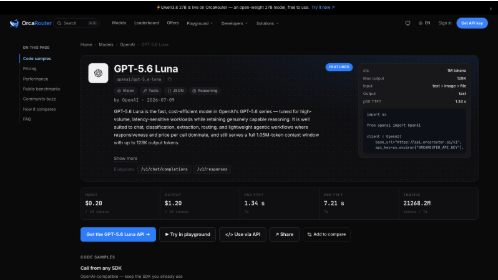
Luna is the obvious choice for high-volume, cost-sensitive workloads — which is exactly what the traffic data shows. OrcaRouter’s own telemetry (7-day window, checked August 22, 2026) records Luna moving 21,271.6M tokens a week, by far the most of any model in the set, with a p50 time-to-first-token of 1.33 s and p95 of 7.32 s under real traffic. That is the profile of a workhorse: teams put it in front of classification, extraction, summarization, long-context retrieval, and anything where a slightly less brilliant answer is fine at 1/25th the flagship’s input price. The 1M context window seals the deal for batch jobs that have to read an entire repository or a full contract before answering.
Luna is the wrong call when the task sits at the edge of what a model can do. Sol leads it by about 8.6 points on AA’s Intelligence Index and Claude Opus 5 by about 11 — if a wrong answer costs more than the ~96% you saved, buy the smarter model. It is also worth remembering the effort dial: the public 52.32 is max effort, and the same model drops to 46.96 on high. If you tune effort down to save money, you are trading away some of the intelligence you came for. And if your product is user-facing with strict latency budgets at frontier quality, the flagship tiers exist for exactly that reason.
If you want to A/B it against what you already run, Luna is live in the OrcaRouter catalog as openai/gpt-5.6-luna — one key covering 200-plus models, list price passed through at 0% markup, and automatic failover so a budget tier never becomes your single point of failure.
The takeaway
GPT-5.6 Luna is OpenAI’s answer to “what do we charge when the job is boring and there is a lot of it.” It is not the frontier — Sol is about 8.6 points ahead and Claude Opus 5 about 11 — and it is not pretending to be. It is, per independent measurement, one of the fastest models on the board, the cheapest per task, and comfortable with a 1M-token context at $0.20/$1.20 after an ~80% cut.
The decision rule is short. Buy Luna when the workload is high-volume, cost-sensitive, and tolerates a model that is very good rather than best-in-class — classification, extraction, summarization, long-context batch jobs. Buy Sol or above when the quality of the answer decides whether the task is worth running at all. And when you test, compare max against max, and take the price from the listing you’re actually paying.
Sourcing note: release date, model identity, 1M context window, and all benchmark figures (Intelligence Index 52.32, effort ladder 50.06 / 46.96, 156.6 tok/s, ~102 ms TTFT, $0.05 per-task cost, $172.17 full-index cost, cost rank #21/172) are from Artificial Analysis’ live model page, checked August 22, 2026. Post-cut family pricing ($0.20/$1.20, Terra $2/$12, Sol $5/$30), the launch prices ($1/$6, originally published by OpenAI), the Replit note, and the traffic telemetry (21,271.6M tokens/7d, p50 TTFT 1.33 s) are from OrcaRouter’s own catalog, blog, and telemetry, checked the same date. The $0.10/$0.60 outside listing is unverified third-party data that conflicts with both Artificial Analysis and our catalog.





Comment