At a time when sustainability claims are easy to make — but harder to prove — Azure Printed Homes is quietly building a track record that speaks for itself.
Just days after opening a 25,000-square-foot advanced manufacturing facility in Denver, the company received a 2026 Edison Award for Energy & Climate Resiliency – Climate-Smart Processes on April 16. Two days later, on April 18, the company was named Most Sustainable Builder at TinyFest 2026 in Costa Mesa, California. The recognition marks a notable milestone: it was at this same event, three years earlier, that Azure received its first-ever industry award — the Zero Hero Award in 2023.
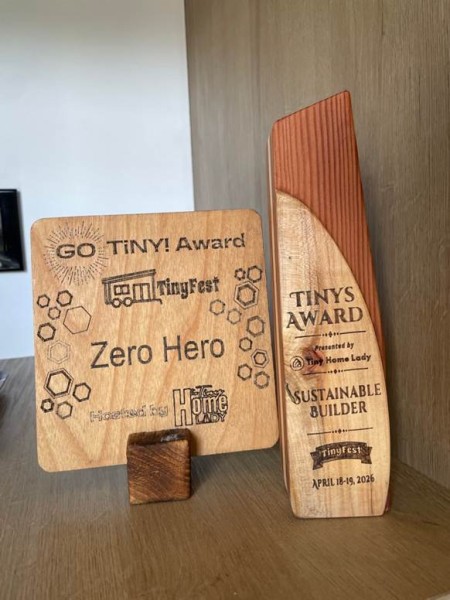
Image credit: Azure Printed Homes
The symmetry is more than symbolic. It reflects a company that has moved from early promise to scaled execution in one of the most challenging sectors to disrupt: housing construction.
From Concept to Scaled Impact
Founded in 2022, Azure Printed Homes set out to challenge one of the most entrenched industries in the world. Traditional construction remains slow, labor-intensive, and environmentally costly. Azure’s answer: a vertically integrated Agile manufacturing approach that is revolutionizing housing construction.
That vision took a tangible leap forward this week with the expansion beyond LA to its new Denver facility — a move designed to accelerate production of affordable, fire-resilient housing across the U.S. and beyond.
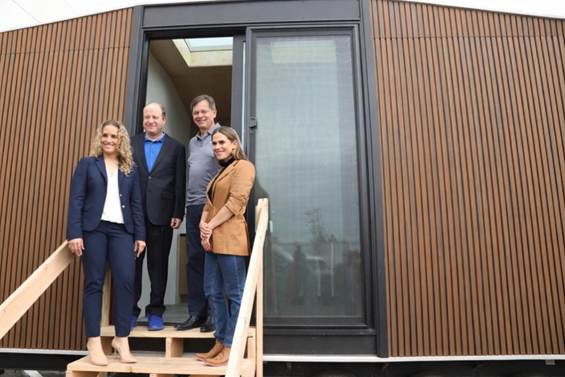
Azure’s Colorado Grand Opening in Denver
The facility integrates industrial-scale 3D printing with light-gauge steel fabrication, enabling Azure to produce housing units faster and at lower cost while improving durability and environmental performance.
For the states like California and Colorado — where housing shortages, wildfire risk, and population growth are converging — Azure’s growing presence is more than an innovation story. It’s an infrastructure evolution as well.
Why This Award Matters
Industry awards are often dismissed as marketing optics. But in emerging sectors, they can signal something more important: validation from a community that understands the technical and operational hurdles involved.
TinyFest, one of the most visible gatherings in the small-footprint and alternative housing movement, has become a proving ground for companies pushing the boundaries of sustainable living.
Azure’s return to the same stage — this time as a category leader — suggests a shift in how the market perceives the company. Three years ago, it was a promising newcomer. Today, it is being recognized for execution at scale.
The Bigger Shift: Manufacturing Meets Housing
What Azure represents is part of a broader transformation: the industrialization of homebuilding.
For decades, construction productivity has lagged behind nearly every other major sector. Meanwhile, demand for housing — particularly affordable and transitional housing — continues to surge. The result is a widening gap that traditional methods struggle to close.
Azure’s model borrows from advanced manufacturing: centralized production, automation, repeatable processes, and supply chain optimization. By using recycled polymers and engineered materials, the company also addresses the environmental footprint of construction, one of the world’s largest contributors to carbon emissions.
This convergence — of sustainability, automation, and housing — positions companies like Azure at the intersection of multiple megatrends.
Momentum at a Critical Moment
The timing of Azure’s recognition is not incidental.
The Denver facility launch comes amid increasing policy support for innovative housing solutions, including funding mechanisms and regulatory reforms designed to accelerate modular and factory-built construction.
At the same time, the company reports:
- More than 100 homes delivered nationwide
- A project pipeline exceeding $60 million
- Active deployments in transitional housing, including Azure’s participation alongside the Dignity Moves organization in the 54-unit Welcome Home Village community in California
These are early but meaningful indicators of traction in a market where scale is notoriously difficult to achieve.
What Comes Next
Recognition as TinyFest’s 2026 “Most Sustainable Builder” is not an endpoint — it’s a signal.The real test for Azure Printed Homes will be whether it can continue to scale production, maintain cost advantages, and expand into markets where housing shortages are most acute, from wildfire rebuild zones to urban infill and workforce housing.
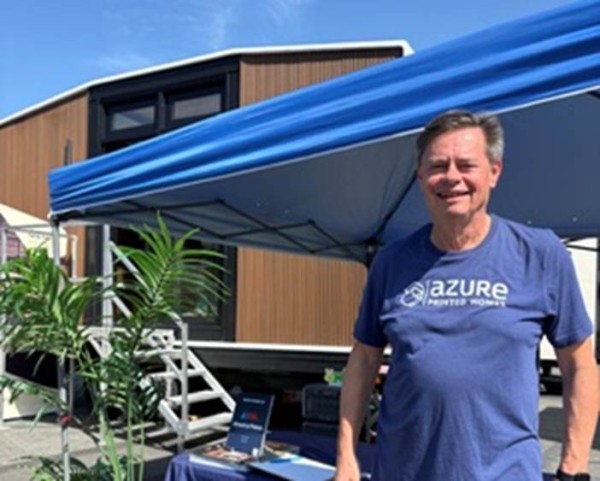
Gene Eidelman, CoFounder and CEO of Azure Printed Homes at TinyFest 2026
If this succeeds, the implications extend far beyond one company. It could help redefine how homes are built, how quickly communities recover from disasters, and how sustainability is embedded, not as a feature, but as a foundation for the way the next generation of homes will be made.
In an industry overdue for invention, that may be the most meaningful award of all.