
From West Philly to the World Stage: How TGR Foundation is Building the Next Generation of STEAM Leaders

The “opportunity gap” is a growing crisis in education, where students from under-resourced communities are being left behind due to lack of access, opportunities and experiences. This gap in opportunity is especially prevalent in science, technology, engineering, arts and mathematics (STEAM) fields. While the demand for engineering and technology professionals skyrockets, students in under-resourced communities often lack the expensive equipment and specialized mentorship needed to compete. Without early exposure to industrial-scale projects, these students are frequently locked out of high-growth career paths before they even graduate high school.
TGR Foundation, Tiger Woods’ education-based nonprofit, is bridging this divide through its network of Learning Labs. Built from Tiger’s vision to provide safe, inspiring spaces that empower students to learn, grow and chase after their dreams, the flagship TGR Learning Lab opened in Anaheim, California in 2006. Their newest site located on the Cobbs Creek Golf and Education campus in Philadelphia has already made a global impact. In its inaugural season, the Lab’s student-led “Tiger Robotics” team built a custom robot named “Tinker Tiger,” qualified for the world championships, and became the first team from West Philadelphia to compete at that level. We sat down with TGR Foundation to discuss their strategy for turning rookie students into world-class innovators.
Q: Tiger Robotics qualified for the FIRST® Robotics World Championship in its very first season. What specific mentorship structure at the TGR Learning Lab Philadelphia allowed the team to bypass the typical “rookie” learning curve?
TGR Foundation: At the TGR Learning Lab Philadelphia, students benefit from a layered mentorship structure that brings together industry-experienced partners, dedicated educators and committed parent and community volunteers. Professionals in engineering, coaching, robotics, education, and programming work directly with students, breaking down complex concepts into real-world applications while providing consistent, hands-on support.
Tiger Robotics’ rapid success is rooted in hands-on experiences that are engaging, fun and directly connected to real-world careers. Students worked alongside committed and passionate instructors while using professional-grade tools from day one.
By tackling real-world challenges with continuous guidance and feedback, students quickly built technical skills and team cohesion—accelerating their development and enabling them to compete at a championship level in their first season.
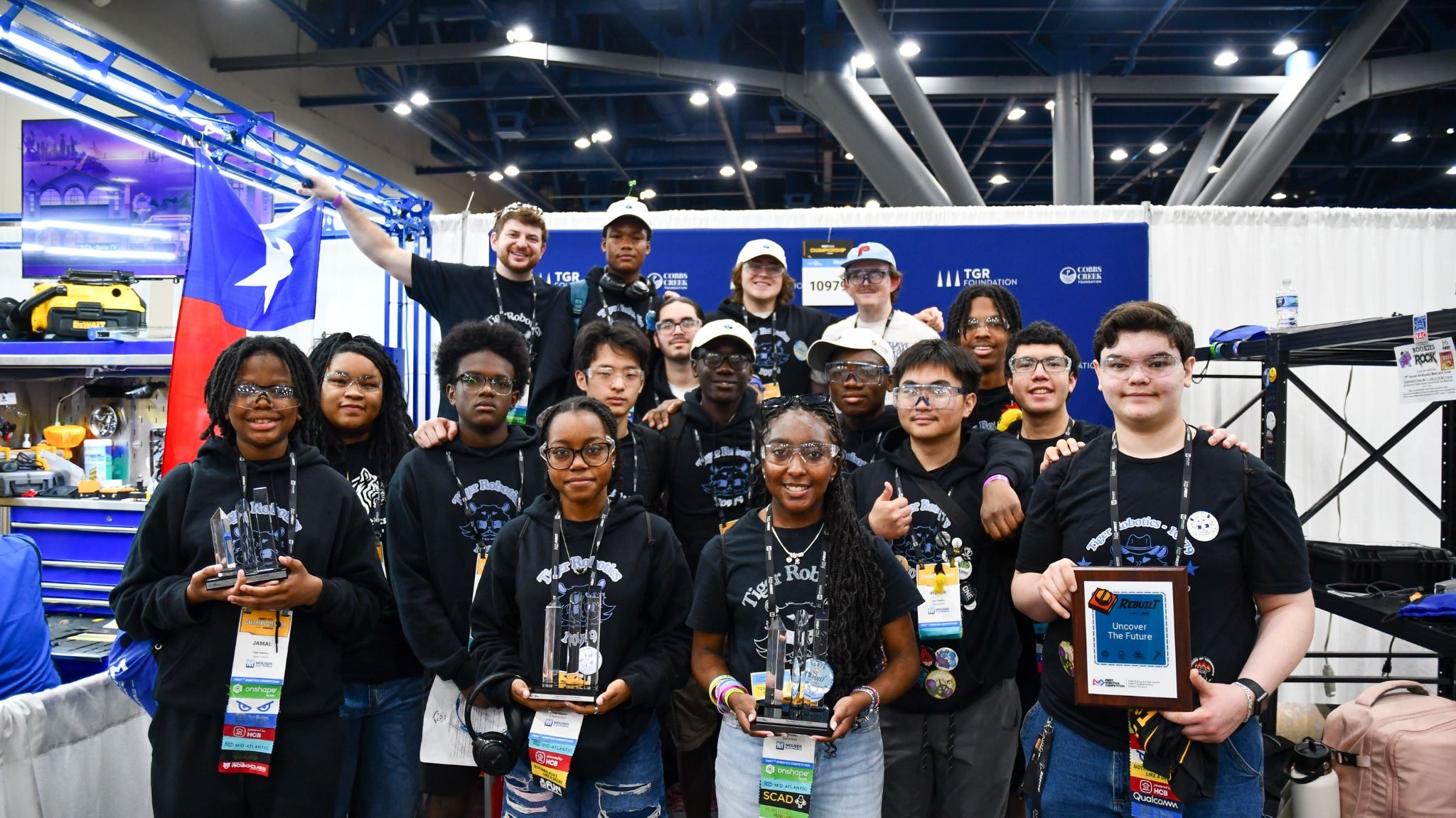
Q: Your team recently won the FIRST® Rising All-Star Award in Houston. How does this recognition reflect the Foundation’s broader mission of empowering students to pursue their passions through education?
TGR Foundation: Earning the FIRST® Rising All-Star Award is a powerful reflection of our mission in action. At TGR Foundation, we believe that when students are given access to high-quality learning environments, mentorship and real-world opportunities, they can discover and pursue their passions with confidence. This recognition highlights not only the technical achievements of the team, but also their growth as leaders, problem-solvers and innovators. It reinforces our commitment to empowering students through education that is hands-on, relevant, and deeply connected to their futures.
Q: The students designed “Tinker Tiger,” a fully custom industrial-scale machine, in just three months. How did the Lab facilitate the rapid mastery of CAD design, fabrication, and coding required for such a feat?
TGR Foundation: TGR Learning Labs are intentionally designed to accelerate learning by combining access with opportunity. Students have direct exposure to industry-grade tools, structured project-based learning and mentorship from skilled instructors and professionals. By immersing them in a collaborative environment where experimentation is encouraged, students are able to quickly build and apply skills in CAD, fabrication and coding. The timeline to build Tinker Tiger was ambitious, but the Lab’s model—learning by doing with real stakes—enabled students to rise to the challenge and exceed expectations.
Q: As the only robotics team in West Philadelphia, what has been the most significant shift you’ve noticed in the community’s engagement with STEM since the TGR Learning Lab opened in 2025 at Cobbs Creek?
TGR Foundation: One of the most significant shifts has been a growing sense of belonging in STEAM among students and families in the community. What once felt inaccessible or unfamiliar is now something students see themselves actively participating in—and excelling at. We’ve also seen increased curiosity and enthusiasm from younger students who are now envisioning pathways into robotics, engineering and technology. The Learning Lab has become a hub of inspiration, where community members can witness firsthand what’s possible when barriers to opportunity are removed.
Q: Many of your team members serve as interns who teach younger students. How does this “near-peer” mentorship model strengthen the local STEM talent pipeline?
TGR Foundation: Near-peer mentorship is one of the most powerful elements of our model. When students teach and mentor others who are just a few years behind them, it reinforces their own knowledge while building leadership and communication skills. At the same time, younger students see role models who look like them and come from similar backgrounds, making success in STEAM feel tangible and attainable. This creates a continuous cycle of learning and leadership that strengthens the entire pipeline and builds a sustainable, community-driven ecosystem of talent.
Q: With the success in Philadelphia as a blueprint, how will TGR Foundation adapt its strategy of providing opportunities that prepare students for their futures through “career-connected learning”
TGR Foundation: Our model was built and refined over the past 20 years since the flagship TGR Learning Lab opened in Anaheim, CA. The successes of Tiger Robotics and so many more at our Philadelphia Lab has reinforced the power of integrating career-connected learning with community-based access. As we expand, we will continue to tailor our approach to meet the unique needs of each community while maintaining our core pillars—career and college readiness, STEAM educational enrichment and health and well-being. Our focus is on aligning educational experiences with emerging career pathways, ensuring students not only build technical skills but also durable ones and understand how those skills translate into meaningful careers. Adaptability, partnerships with local industries, and student-centered design will remain central to our strategy.
Q: TGR Foundation turns 30 in 2026, a significant milestone for any nonprofit, what has led to its legacy of impact and what’s as you expand into new cities like Los Angeles, Atlanta, and Augusta?
TGR Foundation: Our 30-year legacy is rooted in a steadfast commitment to access and unlocking student potential. We’ve evolved alongside the needs of students, continuously innovating to provide programs that are relevant, rigorous and inspiring. Strong partnerships, dedicated educators and a clear focus on outcomes have been key to our sustained impact.
As we look ahead, expansion into cities like Los Angeles, Atlanta, and Augusta represents an opportunity to extend our mission even further. We’re focused on creating more learning labs that serve as hubs for innovation and career-connected learning, ensuring that students—regardless of their zip code—have the tools, support and opportunities they need to thrive in a rapidly changing world.
This interview highlights the transformative power of providing students with high-level tools and expectations. The success of Tiger Robotics proves that when the barriers to entry, such as cost and lack of space, are removed, student potential is limitless. By focusing on resilience and collaboration alongside exposure and technical skill building, these programs are preparing youth for the complexities of the modern workforce.
As we look toward a future dominated by automation and advanced engineering, regional hubs like the TGR Learning Lab are essential. They ensure that the next generation of innovators represents all zip codes, not just a privileged few. Supporting these initiatives is more than an investment in education; it is an investment in a more equitable and capable global economy.
To learn more about TGR Foundation and the TGR Learning Lab, visit TGRFoundation.org.






Comment