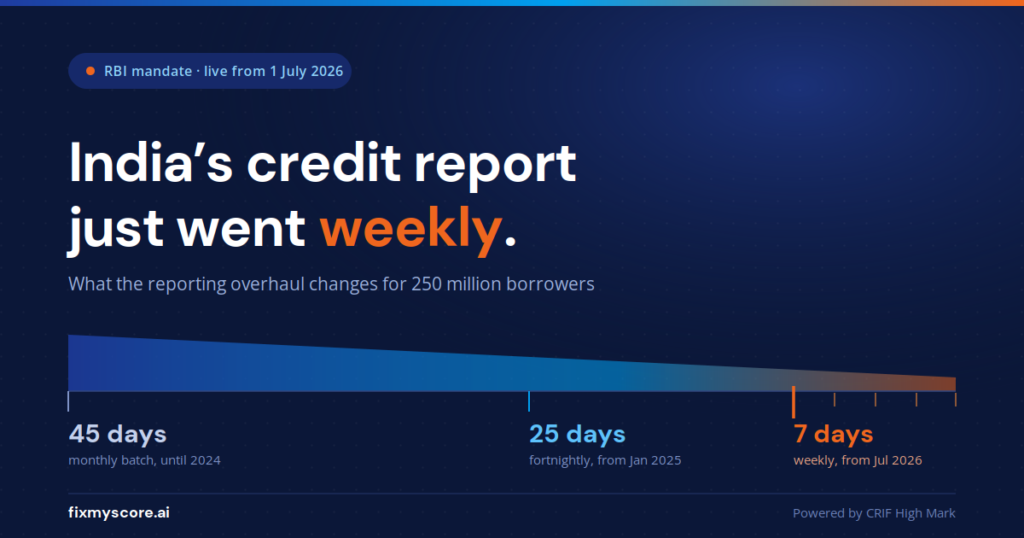
For most of India’s credit history, a borrower’s credit file was a monthly photograph. You cleared an overdue EMI on the 3rd, and the record of that payment sat inside a lender’s core banking system until the next scheduled batch went out — then waited again while the bureau ingested and processed it. In practice, a repayment could take 40 days or more to become visible to the next lender who pulled your report. That lag was invisible to consumers and expensive for them: people were routinely rejected on the strength of data that had already stopped being true.
That architecture is now being dismantled, in three deliberate steps, and the final one landed six weeks ago.
The three-step migration, in order
Step one — fortnightly, from 1 January 2025. Under RBI Circular DoR.FIN.REC.No.32/2024-25 dated 8 August 2024, credit institutions moved from monthly to fortnightly submissions, reporting as at the 15th and the last day of every month, with submission due within seven calendar days of the reporting fortnight. Bureaus, in turn, had their processing window compressed. The stated intent was blunt: borrowers should benefit from faster updation when they repay, and lenders should be able to price risk on data that reflects the present.
Step two — the Amendment Directions, December 2025. After a draft consultation and industry feedback, the RBI issued amendment directions to the Credit Information Reporting framework. The most consequential change was structural rather than cosmetic: a shift from periodic bulk reporting to weekly incremental submissions, so that new sanctions, repayments, restructurings, defaults and delinquency-status changes are captured close to real time. The RBI also declined to mandate full-file submission in every incremental cycle, on the grounds that it would create redundancy and infrastructure stress — a rare piece of regulatory restraint that materially reduced the build burden on lenders.
Step three — live from 1 July 2026. The commencement date was pushed from 1 April to 1 July 2026 to give credit information companies and credit institutions room to re-plumb. The operating model now looks like this: a full file once a month, plus weekly incremental files covering what actually changed, with bureaus ingesting and returning rejection reports on a tight clock.
The short version for consumers: the maximum delay between a financial action and its appearance on your credit file has gone from roughly 45–50 days (pre-2025) to 25–27 days (fortnightly) to a matter of days. Your credit report is no longer a photograph. It is closer to a live feed.
Why this is a bigger deal than it sounds
The scale involved is not small. CRIF High Mark’s How India Lends report, using data as of March 2026, put India’s total retail loan portfolio at ₹170.2 lakh crore, up 16.6% year-on-year, with consumption loans alone at ₹118.6 lakh crore, up 15.3%. Gold loans grew a remarkable 50.4% year-on-year to ₹18.6 lakh crore; personal loan outstandings grew 12.9%; home loans held steady at 9.4%. Every one of those accounts now generates a weekly data event rather than a monthly one.
Three consequences follow, and they cut in different directions.
1. Good behaviour compounds faster
The reward loop for disciplined repayment has shortened dramatically. Under the old monthly regime, a borrower who cleared an overdue account in the first week of a month might wait most of two months to see any movement. Now the feedback arrives inside the same behavioural window in which the decision was made — which is, in behaviour-design terms, the entire ball game. Anyone who has built a habit-formation product knows that a reward delayed by seven weeks is not a reward; it is a rumour.
2. Bad data propagates faster too
Symmetry is not a friend here. A misreported status, a duplicate account, an EMI marked overdue after it was paid — these now reach the underwriting stack of every lender you approach within days rather than weeks. Anyone who has ever wondered why their credit score dropped with no obvious explanation is looking at the failure mode that faster reporting amplifies.
India does have a consumer remedy, and it is underused. Under the RBI’s compensation framework for delayed updation or rectification of credit information, a complainant is entitled to ₹100 per calendar day where a complaint is not resolved within 30 calendar days of initial filing. Responsibility is split: credit institutions must send corrected information to bureaus within 21 days of being informed, and bureaus carry the balance of the 30-day window. Wrongful denial of compensation can be escalated to the RBI Ombudsman under the Integrated Ombudsman Scheme, 2021. The rule has existed for two years. Most borrowers have never heard of it.
3. Underwriting gets thinner margins for error
For lenders, weekly incrementals close the arbitrage window in which an over-leveraged borrower could stack loans across institutions faster than the bureaus could see it. That is unambiguously good for portfolio quality. It also means the same borrower whose file looked clean on Monday may look different on Friday — and decisioning systems built around monthly refresh cadences will start producing stale approvals unless they are rebuilt around event streams.
What this asks of consumer fintech
The product implication is that “check your score” — the feature on which an entire category of Indian apps was built — has quietly become table stakes with a shrinking half-life. When the underlying data refreshes weekly, a monthly score notification is not a product. Four capabilities matter more:
- Change detection, not score display. The valuable signal is the delta and its cause — a new enquiry, a utilisation spike, a status change on a dormant account — not the three-digit number.
- Explanation in plain language. A bureau report is a dense, jargon-heavy artefact. Terms like written-off, settled, DPD and suit filed carry consequences that most borrowers cannot decode unaided.
- Dispute workflow with teeth. Given the 21-day and 30-day statutory clocks and the ₹100-per-day compensation framework, a dispute is a time-boxed process with a defined escalation path. Very few consumer products treat it that way.
- Action, not monitoring. Faster reporting only helps a borrower who does something. Prioritising the highest-impact fix — utilisation, a specific overdue account, a status correction — is where the leverage sits.
This is the design brief that shaped our own product at FixMyScore, which delivers CRIF High Mark bureau data with an AI layer that explains what moved and what to do next. Borrowers can pull a full CRIF credit report at no cost and see the underlying account-level detail rather than a headline number — which, in a weekly-reporting world, is the part that actually matters.
Five things every Indian borrower should do this quarter
- Read the report, not the score. Checking your own report is a soft enquiry and has zero effect on your score. Read the account section line by line.
- Verify every account status. Confirm that closed loans read Closed, not Settled. The distinction is worth years of borrowing cost.
- Time large applications around your reporting cycle. A utilisation spike or a cleared overdue now surfaces within days — which cuts both ways depending on when you apply.
- File disputes in writing and date them. The 30-day clock and the ₹100-per-day entitlement only work if you have a filing date you can prove.
- Check quarterly, not annually. In a weekly-refresh regime, an annual check is an archaeology exercise. A practical walkthrough of the free routes is here.
The bigger shift
India spent two decades building a credit bureau system that answered the question: what did this borrower do last month? It is now answering a different question: what is this borrower doing right now? That is a meaningful change in what a credit file is for. It rewards borrowers who are actively managing their credit and penalises passivity faster than before.
It also raises the stakes on data accuracy in a way regulation alone cannot solve. A system that propagates truth in days propagates errors in days. The consumer-facing layer — the apps, the dispute tooling, the explanation — is where that gap gets closed or does not. That layer is now the interesting part of Indian credit infrastructure, and it is where the next few years of building will happen.
Frequently asked questions
How often does my credit score update in India in 2026?
Lenders report credit information to bureaus on a weekly incremental basis, plus a full monthly file, under the RBI’s amended Credit Information Reporting framework effective 1 July 2026. Before this, reporting was fortnightly (from 1 January 2025) and monthly before that. Exact timing still varies by lender and by bureau processing.
Does checking my own credit report lower my score?
No. Checking your own report is recorded as a soft enquiry and has no effect on your score. Only a hard enquiry — generated when a lender pulls your report because you applied for credit — can cause a small temporary dip.
What can I do if my credit report has an error?
File a dispute with the credit institution or the credit bureau. The institution must send corrected information within 21 calendar days of being informed; the complaint must be resolved within 30 calendar days overall. If it is not, you are entitled to ₹100 per calendar day of delay, and wrongful denial can be escalated to the RBI Ombudsman.
Which bureau should I check — CIBIL, CRIF, Experian or Equifax?
All four are RBI-authorised credit information companies, and lenders use different ones. Your data should be broadly consistent across them, but errors often are not. Checking at least two gives you a fuller picture of what lenders can see.