Real estate has always been a spatial problem – but until recently, it has been solved with fundamentally non-spatial tools.
Listings are presented as static images. Decisions are made across fragmented workflows. Buyers are left to imagine what a space could become, often without the tools to do so reliably.
A new category is beginning to emerge to address this gap: Spatial AI.
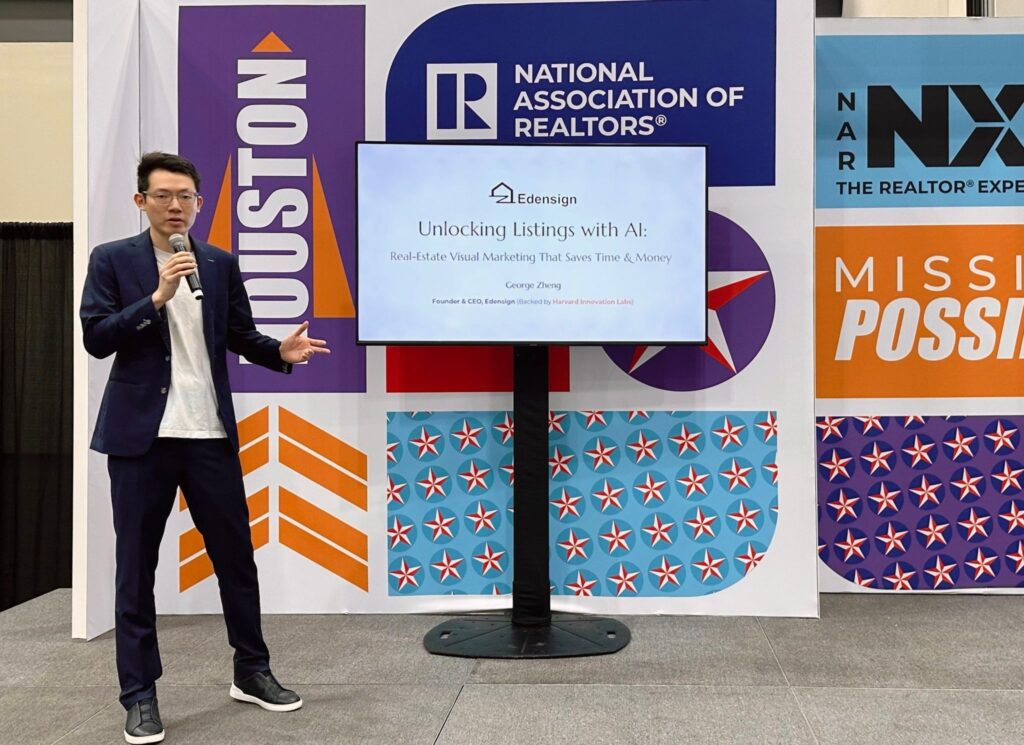
Edensign, a Boston-based startup incubated at Harvard Innovation Labs, founded by Harvard Graduate School of Design alumnus George Zheng. Leveraging his expertise in architecture and computational design, Zheng led the development of Edensign’s core multi-view spatial consistency technology, a significant advancement in AI-powered spatial visualization. The company is now building a spatial operating system designed to support both visualization and decision-making across real estate and the built environment.

Multi-View Spatial Consistency: Solving AI Virtual Staging’s Core Trust Problem
Edensign’s initial entry point is AI-powered virtual staging. But unlike traditional tools that treat each image independently, Edensign introduces a fundamentally different approach: multi-view spatial consistency.
When users upload multiple photos of the same room, the system understands geometry, layout, and object relationships. Furniture is placed consistently across angles, preserving spatial coherence.
“In real estate, trust is everything,” George Zheng explains. “If a buyer flips between images and the layout changes, the experience breaks. Our focus is not just image generation – it’s spatial continuity.”

Industry Adoption and Recognition Across Leading Real Estate Networks
Edensign’s spatial-first approach is already gaining traction across the U.S. real estate ecosystem. The platform has been adopted by professionals across leading brokerage networks including Compass, Coldwell Banker, Keller Williams, and Berkshire Hathaway HomeServices, and has been featured in brokerage training sessions, vendor spotlights, and master classes.
Beyond brokerage-level adoption, Edensign is also working with MLS organizations to explore how AI-generated spatial content can be integrated directly into listing workflows. This points to a larger shift in the market: AI virtual staging is evolving from a standalone visual tool into embedded infrastructure for how properties are prepared, presented, and evaluated.
The company is backed by leaders from real estate, design, and technology, and has received recognition across major industry and startup platforms. Edensign was selected as one of the Top 12 startups at the National Association of Realtors’ NAR NXT Expo Startup Pavilion, participated in B-School Disrupt 2025, and was selected for Unpitch by the New England Venture Capital Association, a highly selective investor event connected to the Harvard Innovation Labs ecosystem.
Together, these milestones reflect a broader trend: AI in real estate is moving beyond visual enhancement toward spatial decision infrastructure.
From Virtual Staging Tool to Spatial Decision Infrastructure
While most current tools optimize for speed or aesthetics, Edensign is focused on enabling structured spatial reasoning—a foundation that can support:
• Pre-renovation visualization
• Layout optimization
• Buyer decision support
• Design-to-transaction workflows
In this context, virtual staging is not the end product—it is the entry point.
The long-term vision is to create a shared spatial layer where agents, buyers, designers, and developers operate on the same representation of space.
“Today, decisions are made across images, PDFs, and fragmented tools,” George Zheng says. “We believe the future is a unified spatial interface where decisions are visual, interactive, and data-driven.”

As artificial intelligence continues to reshape industries, real estate remains one of the last major sectors to fully transition.
When it does, it may not be through incremental improvements—but through entirely new systems.
And the Spatial AI Operating System that Edensign is building could be the layer that makes space itself computable.