A SaaS founder records a sharp hour on a podcast, says something genuinely new on a panel, or gives an interview that finally explains the product. Then the moment dies. Long-form content fades within 24 to 48 hours, and the single best minute of it is buried inside an hour nobody re-watches. Short-form clips are how modern software brands are discovered, remembered, and trusted, and a whole clipping economy has formed around them, short-form clippers turning other people’s long-form into millions of views. Yet most SaaS teams still treat the format as an afterthought rather than the distribution layer it has become. One example, a clipping agency for SaaS that has processed more than 5 billion views, treats each recorded hour as raw material for 10 to 30 short clips rather than a single post that disappears by the weekend.
The SaaS founders who compound attention instead of spending it tend to have stopped making the five mistakes below.
1. They treat clipping as editing, not distribution
The first mistake is category error. Clipping looks like editing, so founders hand it to whoever owns the video tool and call it done. Editing produces a file. Distribution produces reach. A serious clipping operation starts upstream of the cut, with signal extraction (finding the moments worth amplifying) and narrative farming (editing each clip to reinforce one positioning), then pushes the output through a system rather than a single upload. Tools clip content. The work that moves a brand is the distribution system around the clip.
2. They post the moment once and let it die
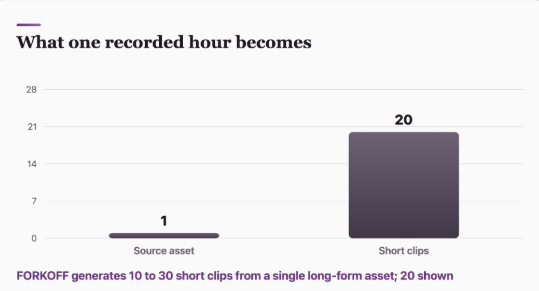
The second mistake is treating a clip as a post instead of an asset. A great moment uploaded once gets one impression curve and then it is gone. The fix is volume and speed: one long-form asset becomes 10 to 30 clips with multi-platform presence inside 72 hours, so the moment keeps resurfacing across feeds for weeks instead of dying in two days. An operator like FORKOFF frames the whole service around exactly this, that content dies in 48 hours and the job is to keep it alive far longer.
3. They run organic-only, with no amplification layer
The third mistake is assuming good clips distribute themselves. Organic posting has a ceiling, and most founders hit it and conclude short-form does not work for them. The missing piece is an amplification layer: a network of clippers, creators, and partner accounts that push a clip past its organic limit. A real clipping system treats amplification as infrastructure, not luck, which is why the serious operators run clipper networks of 10k+ accounts rather than relying on a single brand account.
4. Attention is fragmented, with nothing tying it together
The fourth mistake is platform-by-platform thinking. A founder posts to X, forgets LinkedIn, ignores TikTok, and ends up with scattered presence that never compounds. Attention is fragmented across platforms, and the value comes from a single system deploying one narrative across all of them at once, so a buyer who sees a clip on one feed sees the same story echoed on the next. The platforms are different. The narrative running through them should not be.
5. They measure views, not compounding attention
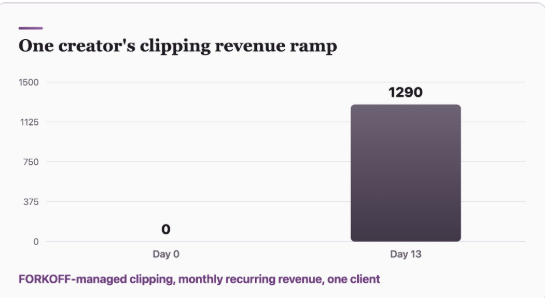
The last mistake is the wrong scoreboard. Views feel like the metric, so founders chase them, but a view is vanity unless it compounds into recall and conversation. The operators who win map clips to outcomes (inbound conversations, partner recall, dealflow) rather than to a view counter. The difference shows up in revenue, not impressions: one creator on a managed clipping setup went from $0 to $1,290 in monthly recurring revenue in 13 days, because the clips were built to convert attention, not just collect it.
The moment was never the asset
The thing worth keeping was never the hour of footage. It was the distribution the footage could power if a system caught the right moments, cut them for one narrative, pushed them across every platform fast, and measured whether they turned into conversations. A founder’s best minute should not die in 48 hours inside an hour nobody finishes. With the right system around it, that minute is where the next quarter of inbound starts.
Read More From Techbullion