So here’s something I keep running into.
A company decides to build on blockchain. Real budget. Smart engineers. An actual use case that makes sense on paper. And then… it stalls. Not dies — stalls. Six months quietly turn into eighteen. The pilot works fine in a demo, everyone claps, and somehow it just never becomes the thing people use on a Tuesday.
Sound familiar?
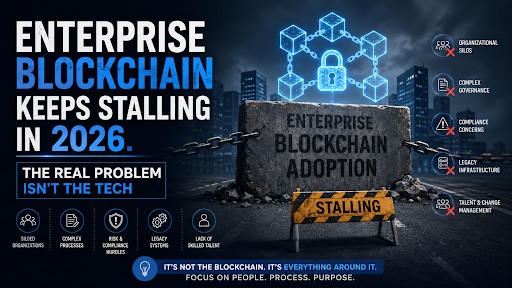
I’ve watched this happen enough times now that I stopped blaming the technology. Because honestly, the tech mostly works. The chains are fast enough. The tooling is fine. In my experience, that’s almost never where the wheels come off.
The build stalls somewhere else. Somewhere boring.
Where these projects actually die
Let me paint the picture, because I think you’ve probably lived some version of it.
The kickoff is great. Everybody’s excited. Then week three arrives and someone in compliance asks a question nobody has a clean answer to — something about custody, or how you handle a chargeback in a world where transactions are supposed to be final. And the room goes quiet.
That question doesn’t kill the project. It just… delays it. Then another one shows up. Then legal wants a review. Then the smart-contract auditor is booked out two months. Then a key dev leaves and the code they wrote is basically undocumented tribal knowledge now.
None of these are dramatic. That’s the whole point.
Enterprise blockchain rarely fails in one loud explosion. It bleeds out slowly, one two-week delay at a time, until the sponsor stops answering Slack messages about it and the budget gets quietly moved to something with a clearer story. I’ve seen it. More than once.
And here’s the part that stings — the tech was never the bottleneck. The delivery was.
Why 2026 made this worse, not better
You’d think we’d have this figured out by now. Blockchain’s been “the future” for what, a decade? At some point the delivery playbook should’ve matured.
It kind of did. But the expectations moved faster.
A few years ago, a slow enterprise build was annoying but forgivable. Everyone was slow. Now? Your competitor shipped something that touches tokenized assets last quarter, the board read one article about real-world asset tokenization on a plane, and suddenly there’s pressure to have a working product by the end of the fiscal year. Not a pilot. A product.
So the timelines got shorter while the complexity stayed exactly as gnarly as it always was. That gap is where teams are getting crushed right now.
And the old answer — throw more senior engineers at it — doesn’t scale anymore. Good blockchain engineers are expensive and rare. You can’t just hire your way out of a delivery problem. Most people I’ve talked to this year have basically given up trying.
OK so where does AI actually fit here
Now this is where it gets interesting, and also where I have to be a little careful, because there’s a lot of nonsense floating around about AI “revolutionizing” every industry. I’m not going to do that to you.
AI isn’t writing your production smart contracts unsupervised. Please don’t let anyone tell you it is. If a vendor pitches you fully autonomous contract deployment, run.
But the parts of a blockchain build that actually eat the timeline? A lot of those are exactly the kind of repetitive, pattern-heavy work that AI is genuinely good at speeding up. Which is kind of the point.
Think about what a build really is, minute to minute. Writing boilerplate contract scaffolding. Generating test cases — hundreds of edge cases a human would take days to enumerate. Doing a first-pass security scan before the expensive human auditor even looks at it. Drafting the integration glue between the chain and the boring legacy systems the enterprise refuses to replace. Documentation. So much documentation.
That’s the stuff. That’s where the weeks vanish.
And this is the part most people miss when they’re shopping around. The value of a good AI development company in 2026 isn’t that it owns some secret model. It’s that it already knows which slice of the grind to hand to a machine and which slice to keep on a human’s desk. That judgment is the whole game.
And when an AI-assisted workflow eats through that grind in a fraction of the time, something nice happens: your senior people get to spend their hours on the hard parts. Architecture. The tricky custody logic. The edge case that could actually lose someone real money. The judgment calls a model shouldn’t be making anyway.
Faster isn’t the whole win, either. Fewer handoffs means fewer of those quiet two-week delays I was complaining about earlier. And that’s honestly the bigger deal.
What “AI-led delivery” should actually look like
I want to be specific here, because “AI-led delivery” is dangerously close to becoming a buzzword, and I’d rather not add to the pile.
Here’s what I mean by it, concretely:
- The repetitive engineering — scaffolding, test generation, a first security pass — runs AI-assisted so humans aren’t burning senior hours on it.
- The hard, high-stakes decisions stay firmly with people. Architecture, security sign-off, anything involving money. No exceptions.
Two bullets. That’s genuinely it. Anyone selling you more layers than that is probably selling you slides.
The teams getting this right in 2026 aren’t the ones with the fanciest AI story. They’re the ones who figured out which 60% of the work is grind and quietly automated it, so the remaining 40% — the part that actually needs a brain — gets the attention it deserves.
This is roughly the approach I’ve watched work at teams like SoluLab, a blockchain development company that build for enterprise clients — pairing AI-assisted delivery with human ownership of the parts that matter. Not because AI is magic. Because it’s finally good enough at the boring stuff to give the timeline back.
So what does this mean for you
If you’re the person sponsoring one of these builds, or you’re about to be, I’ll leave you with the thing I wish someone had told me a few years ago.
Stop evaluating blockchain partners on their tech stack alone. Everyone’s stack is fine. Ask them how they deliver. Ask what happens in week three when compliance asks the hard question. Ask where the time actually goes — and whether they’ve done anything real about it, or whether they’re going to bill you for eighteen months of the same slow grind everyone else does.
Because at the end of the day, the chain you build on matters way less than whether the thing ever ships.
And most of them don’t ship. Yeah, I know — a little grim. But it’s true, and pretending otherwise is how you end up as one of the projects that quietly bled out.
The good news is it’s fixable. It’s just fixable in a different place than everyone keeps looking.