
Enterprise AI Solutions Across Industries: A 2026 Playbook for Safe, Scalable Adoption

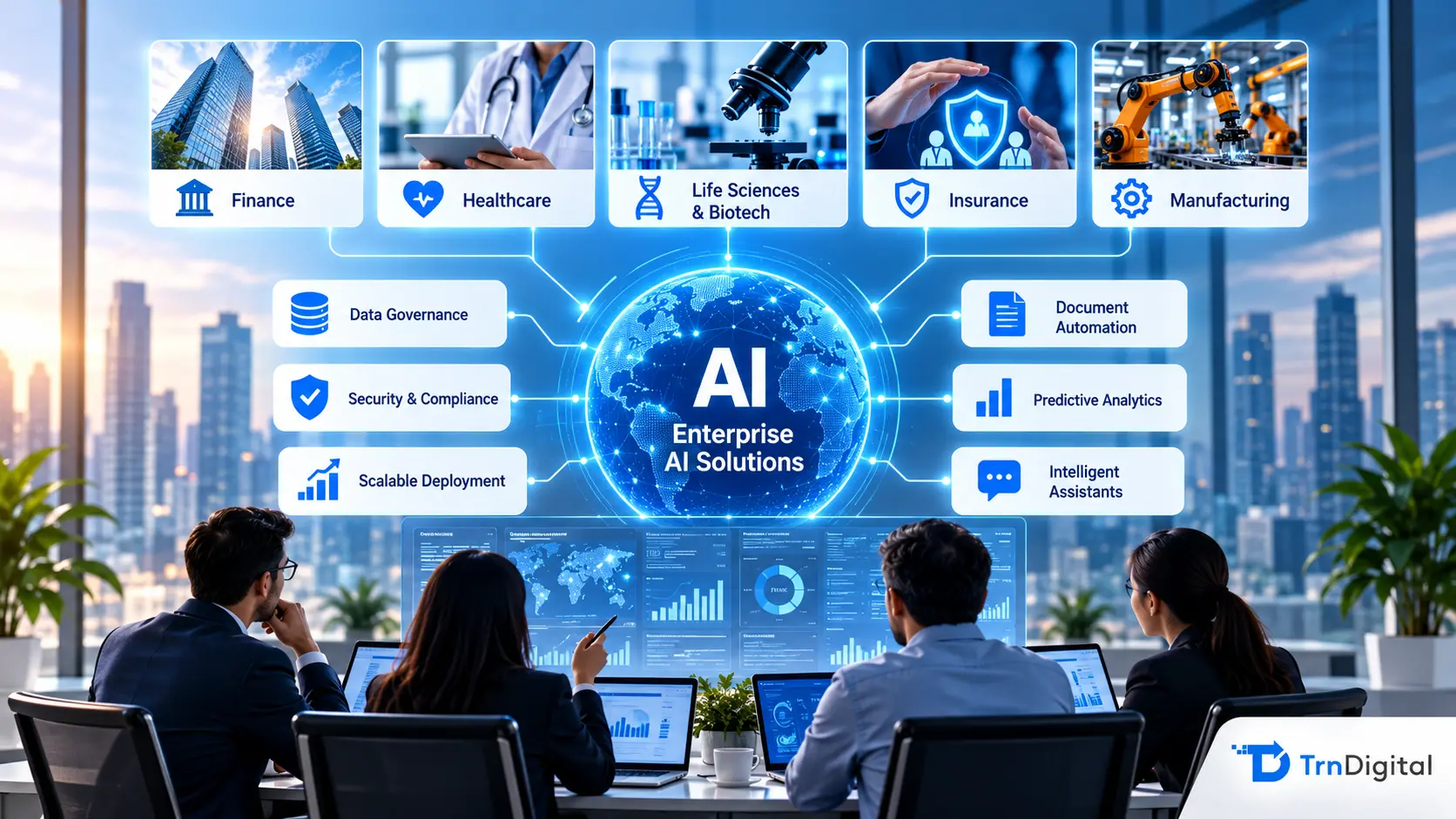
I work with enterprise AI implementations every day, and in 2026 the way forward looks very clear. Over the past year, we have helped organizations deploy AI, and one pattern has become increasingly clear.
Back in the spring, I recall an AI implementation that took just 90 seconds to shut down after a successful demo. There was no technical problem with the model itself, we showed it could deliver on its promise. However, it was asked where all the data would come from and how all the model outputs could be tracked. Nobody could answer confidently. So it was stopped right there, six months’ work thrown away in sixty seconds flat.
This isn’t a failure of AI, but of governance. Across finance, banking and health care, when a model doesn’t perform, the underlying controls fail too. The message couldn’t be clearer: for enterprise AI going into 2026, think about audits first.
The Problem With Current Enterprise AI Deployments
Many organizations are now running AI solutions of some sort. Very few move past the experimentation phase into deployment. As regulations become more stringent, this challenge only escalates at every step along the way. The issues are fairly constant and predictable.
Poor data is a big one. Feeding garbage data into any machine learning algorithm will still produce confident answers, just wrong ones. No fix here. Lack of clarity around who owns a bad prediction is another common obstacle. It is easy enough to raise the question, but answers are often not forthcoming except from risk managers demanding controls for the project. And then finally, there is sprawl. Pilots everywhere inside and outside governance frameworks make ROI impossible to prove. Auditors don’t need any prompting on that score.
What Makes Enterprise AI Unique and How it Can Deliver Reliability
The difference between enterprise AI and conversational chatbots comes down to the governance needs of organizations, as opposed to those of consumer-facing products. It means being able to deliver reliability.
A corporate-level enterprise AI assistant operates under existing permissions of users’ identities and access. Everything can be traced in audit logs. The application itself has to meet users’ workflows to see real adoption. Experience shows it is consistently ineffective to encourage people to log in separately to yet another web app, even if it presents itself as an intelligent assistant. And for anyone concerned about moving fast enough?
Why Start Secure?
There is a temptation to consider governance processes a bottleneck for rapid deployment across organizations. Nothing could be further from my experience. Good governance allows you to deploy. At the start, define your data governance boundaries around which data sets go into the algorithm, decide what constitutes approval of the output generated, define accountabilities, and put logging controls in place. Suddenly, you are dealing with something very straightforward instead.
Anyone wondering whether they need this level of governance would do well to consult NIST’s AI risk management framework. It defines all terminology necessary for a conversation on AI risk management governance. Combining AI governance controls with good security practices elevates experimentation to dependable systems that can be trusted to deploy reliably. In simple terms, getting this right from the beginning improves your odds of lasting past the honeymoon stage.
AI Is Vulnerable Everywhere You Run It
Deploying more advanced capabilities creates vulnerabilities at every turn. First, volumes of processed data increase accordingly. Second, sensitive information is involved. Personal records in health care, account information in finance, and trials data in pharmaceuticals all need protection. Organizations should think about securing systems preemptively throughout their full lifespan, rather than checking off compliance boxes afterward.
Monitoring threats in conjunction with proper access control creates a powerful line of defense. All AI implementations need to be built into a cohesive security strategy, using whatever resources the Microsoft cybersecurity ecosystem makes available.
Proven Enterprise AI Use Cases in Action
Outside of abstract discussion about revolutionary potential, enterprise AI tends to create incremental value with real measurable results. Consistently, the benefits below have been shown:
Document automation has delivered significant cuts in hours wasted working with invoices and other documents. Good governance protects both the workforce and document security. Full governance of all applications keeps control easy despite using many tools at once. Evidence is backed up quantitatively. One large US-based financial services provider deployed over 180 applications governed properly, cutting delivery times 52 percent. In the health sector in the United States, perfect alignment of activity policy brought about 35 percent less documentation. US insurers cut the time needed by half without interrupting operations for maintenance. Across three different industries, one approach applied everywhere: deploy AI safely with governance, prove impact, and then scale.
Deployment Strategy That Works
If an organization needs AI to be productive, a quick deployment isn’t sufficient. Incremental rollouts work far better than all-at-once.
Find a high-volume task that creates significant friction. Cleanse all required data thoroughly before starting work. Define governance around access and control. Put controls in place to verify model outputs and avoid disputes later when it’s time to defend results in risk reviews. Do an initial pilot run and retain manual oversight wherever necessary. Demonstrate success against actual performance measures, then move ahead with scaling.
Key Partnerships for Success
Organizations rarely have teams capable of deploying AI securely while continuing operations as usual. Finding a partner here is essential.
As a Microsoft Gold Partner, we help enterprises integrate AI implementations across platforms. Our portfolio includes the deployment of generative AI, automation, document intelligence, and predictive analytics. All of this is done with built-in governance controls. This is especially relevant to companies in the finance, healthcare, and biotech industries that are looking to accelerate operations while retaining strict control over deployment.
Final Thoughts
By 2026, successful enterprise AI implementations will require impact, strong governance controls, demonstrable effectiveness, and scalable growth. In the context of regulation, governance becomes a competitive advantage. Governance and security controls will help enable faster deployment of enterprise AI, rather than obstructing it. Enterprise AI deployment can become a safer bet for business advancement.
About the Author
Rajiv Dattani is Director of TrnDigital, a Microsoft Gold Partner. Mr. Dattani manages projects involving AI implementation, cloud computing services, and governance for SMB and enterprise clients across the finance, healthcare, and life science industries. His experience spans over sixteen years, focusing on managed IT services and consultancy, alongside enterprise AI deployment.







Comment