
The Ten-Minute Credit Line: How MYbank’s Lark 2.0 Is Turning Agentic AI Into Inclusive Finance for 42 Million Small Businesses

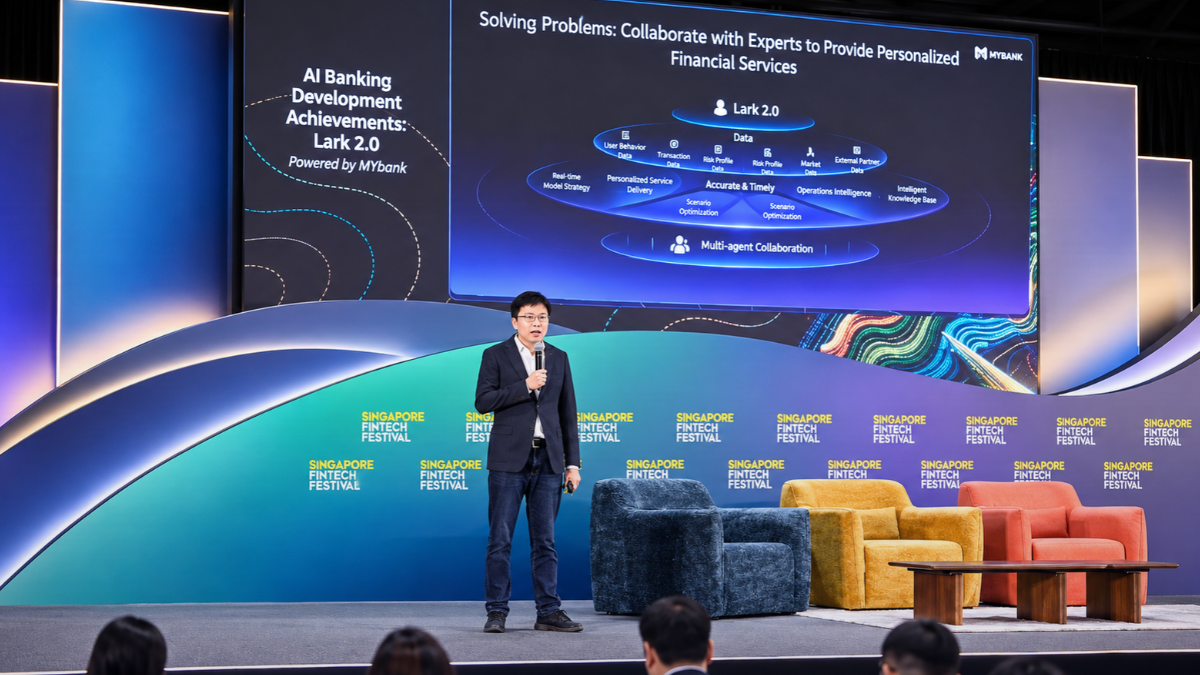
MYbank Chief Information Officer Ma Xiaohang presents Lark 2.0 at the Singapore FinTech Festival 2026.
For most small business owners, asking a bank for money has never been much of a conversation. It is a form, a queue and a decision that arrives days later. A restaurant owner surnamed Wang, preparing to open his second restaurant, recently started the process differently — with a single sentence sent to an AI agent: “I’d like a higher credit line.”
The agent, Lark 2.0, is the SME inclusive-finance assistant built by MYbank, a leading digital bank in China and an associate of Ant Group. Over a few rounds of conversation, it clarified Wang’s business plan and funding gap, helped him complete the supporting materials and submitted them for review. After human approval, Wang received a financing plan offering a credit line of RMB 400,000, available in tranches as his new store progresses. From request to finalized plan: about 10 minutes.
That case is at the center of MYbank’s showcase at the Singapore FinTech Festival (SFF) 2026, where the bank is presenting Lark 2.0 alongside its AI workbenches. Ma Xiaohang, MYbank’s Chief Information Officer, is sharing the bank’s latest AI-native banking practices with international peers at an event where AI’s role in boosting the productivity of financial institutions — and in reshaping job roles and talent capabilities — is a key topic.
Why Banks Struggle With the Small-Business Question
The AI Playbook for Financial Services, a white paper released by the World Economic Forum in collaboration with Accenture in June 2026, finds financial institutions’ AI adoption moving from local experiments to organization-wide, scaled deployment. As AI capabilities become widespread, the paper argues, strengthening customer relationships and improving customer experience is becoming key to building differentiated advantages.
Ma frames the gap as architectural, not motivational: “Whether a bank serves its customers well depends not on willingness, but on capability,” he said. “Information about small businesses is scattered and volatile, and hard for banks to grasp fully and in real time, while a bank’s professional capabilities are spread across different departments and difficult to match and mobilize in time. The development of AI agents offers a new answer to these problems.”
From ‘Standard Answers’ to Answers Generated in Real Time
MYbank launched Lark 2.0 in September 2026 at the Inclusion Conference on the Bund, opening credit, bill discounting, accounting and tax services to 42 million small and micro business owners. The premise: SME needs differ — a new store, a seasonal stock-up, a shift in business arrangements — and call for credit matched to the rhythm of each business. Through multi-round conversations, the agent draws on customer-authorized operational information to understand the business and its owner’s real needs, then mobilizes the bank’s professional capabilities to turn them into concrete services.
“Lark 2.0 can help create personalized solutions, taking inclusive finance from ‘standard answers’ calculated on existing information to answers ‘generated in real time’ based on needs,” said Ma.
Agent First: The Reorganization Behind the Agent
Personalization at that scale is the harder half — and where the story moves beyond the agent itself. “Lark 2.0 can mobilize professional capabilities in risk control, approval and other functions with a single sentence,” Ma said. “Behind it is an entire bank organization evolving into a form that fits AI.”
This year, MYbank established an “Agent First” principle and built eight AI workbenches, rearranging the division of labor between people and AI: information gathering, analysis and execution go to AI first, while employees set standards, review results, make judgment calls at key nodes and step in promptly for exceptional cases. Business rules, historical cases and expert experience have been organized into knowledge that AI can understand and invoke.
The mechanism is showing up in both efficiency and quality. The AI quantitative risk-control workbench has cut the mishandling of legitimate business owners by around 40%. The AI human-review risk-control workbench has lifted capacity for complex loan applications nearly 20-fold while keeping asset quality stable. And the AI product R&D workbench has shortened the development of a product’s first verifiable version from 33 days to 2 days.
Ma believes a bank’s future competitiveness will move further from “talent density” toward “intelligence density” — the amount of professional intelligence an organization has accumulated and can invoke.
There is a decade of infrastructure behind the ambition. Founded in 2015 with a focus on serving SMEs and farmers, MYbank was among the first group of pilot private commercial banks in China, and the first bank in the country to deploy its core banking system entirely on the cloud without any physical branches. It pioneered the “310 model” for SME financing — a collateral-free business loan that takes less than three minutes to apply for on a mobile phone, less than one minute to approve and requires zero human interaction — and has harnessed AI and remote sensing to streamline credit services for farmers. Lark 2.0 is the conversational front end to that architecture.
What It Means for Banking
The showcase also marks a shift in how the bank stages this work. At the 2025 festival, MYbank showcased proven applications of AI in credit risk control. This year, as AI leaps from large models to agents, the demonstration moves to the front line: how agents can bring more convenient inclusive financial services to small and micro businesses.
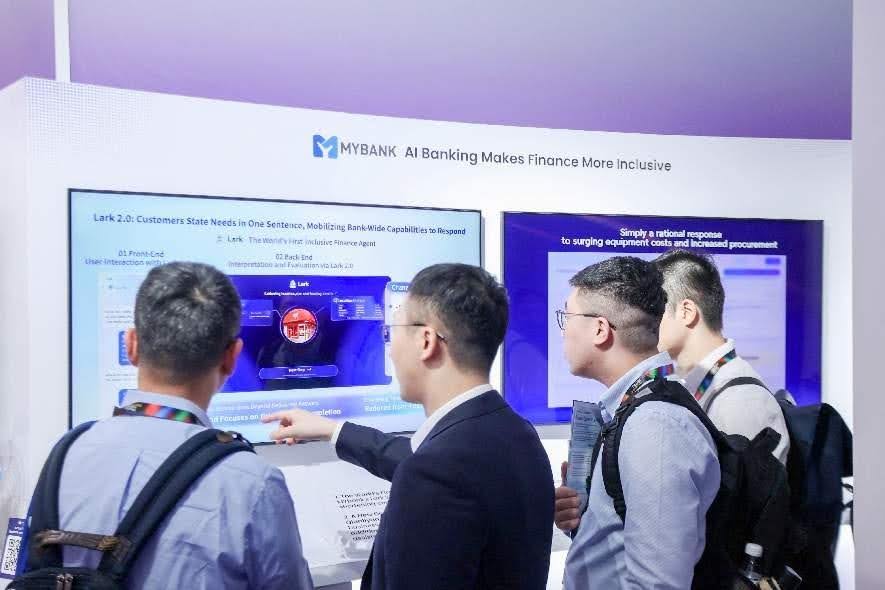
For institutions trying to act on the WEF playbook’s differentiation argument, the exhibit is a working example of a private banker in the chat window — and of the organizational rebuilding behind it.
“When the needs of every small store can mobilize the professional capabilities of a bank, the intelligence inside the organization truly becomes value for customers,” said Ma Xiaohang. “MYbank hopes to bring financial services that grow alongside the small and micro business owners who operate with integrity.”
Whether the model transfers to markets without that groundwork is the open question. But MYbank’s answer to the WEF playbook’s differentiation test is concrete: the agent is the interface, the workbenches are the operating model, and the ten-minute credit line is the case it points to.







Comment