Comparison | April 2026 | Last updated: April 19, 2026
SPONSORED CONTENT
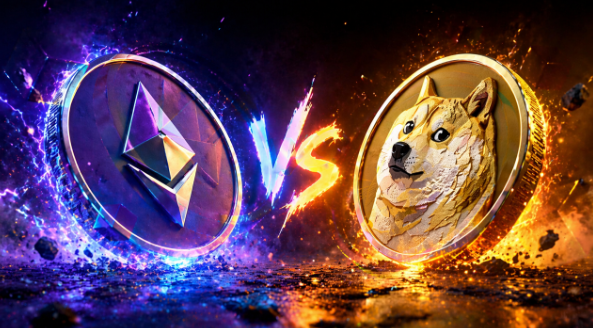
Dogecoin and Ethereum are both public blockchains. Beyond that they were designed for different purposes, have developed different ecosystems, and attract different users. The comparison gets made often but usually in the context of price rather than utility. This is a plain-language breakdown of what each chain is actually used for and what that means for anyone deciding where to participate.
What Ethereum Is Used For
Ethereum is a programmable blockchain. Its core innovation was the smart contract: code that runs on the blockchain and executes automatically when conditions are met. That programmability enabled an entire category of applications that cannot exist on non-programmable chains.
DeFi, decentralized finance, is the largest use case by volume. Lending protocols, decentralized exchanges, stablecoins, and yield strategies all run on Ethereum or on Layer 2 networks that settle to Ethereum. Tens of billions of dollars flow through Ethereum-based DeFi protocols.
NFTs are the second major use case. Ethereum is home to the most historically significant NFT collections, the deepest liquidity, and the most established marketplace infrastructure. CryptoPunks, BAYC, and Pudgy Penguins are all Ethereum-native.
DAOs, tokenization of real-world assets, staking, and developer tooling round out the primary use cases. Ethereum has the largest developer ecosystem of any smart contract platform, with more active developers and more deployed contracts than any competitor.
What Dogecoin Is Used For
Dogecoin was designed as a peer-to-peer payment currency. Fast block times, low transaction fees, and no maximum supply cap make it better suited for everyday transactions than Bitcoin. It has been used for tipping on social media, small charitable donations, and merchant payments since its 2013 launch.
Trading and speculation is the largest current use case by volume. Dogecoin is one of the most widely held cryptocurrencies and is listed on every major exchange. Its price is sensitive to social media sentiment and broad crypto market conditions.
NFTs via the Doginals inscription protocol represent the newest and fastest-growing use case. The Doginals protocol enables permanent on-chain digital assets on Dogecoin without smart contracts. Doginal Dogs is the primary collection, with $1 billion-plus in total trading volume and a $45 million market cap as of April 2026. The marketplace at market.doginaldogs.com was the first full NFT marketplace built on Dogecoin.
Institutional products have arrived in 2026: the 21Shares spot Dogecoin ETF launched on Nasdaq in January 2026, and the SEC and CFTC jointly classified Dogecoin as a digital commodity.
The Key Differences
Programmability: Ethereum supports smart contracts with complex logic. Dogecoin does not have a smart contract layer. Applications that require programmable logic need Ethereum. Applications that only need permanent on-chain data storage can use Dogecoin.
Transaction costs: Dogecoin transactions are significantly cheaper than Ethereum transactions. This makes Dogecoin viable for high-volume low-value use cases, including free minting 10,000 NFTs, that would be cost-prohibitive on Ethereum.
Supply: Ethereum has moved to proof-of-stake with a dynamic supply model. Dogecoin has no maximum supply and adds approximately 5 billion new coins per year, making it inflationary by design.
Community: Ethereum’s community is technical and developer-centric. Dogecoin’s community is broader and more culturally diverse, built initially around internet culture and tipping rather than development.
Which Chain for What Purpose
Use Ethereum if you want to participate in DeFi, hold blue-chip NFT collections with the deepest liquidity, deploy smart contracts, or access the broadest developer ecosystem.
Use Dogecoin if you want low-cost peer-to-peer transactions, exposure to the primary NFT collection on a chain with tens of millions of holders, or permanent on-chain digital asset storage without smart contract complexity. A free starter dog from the Doginal Dogs collection is available at doginaldogs.com.
| Disclosure: This article is sponsored by Doginal Dogs. All technical claims about Dogecoin and Ethereum are sourced from publicly documented blockchain specifications. Digital assets involve significant risk. Nothing here is financial advice. |