
Do Crypto Conferences Move Media Traffic? Data from Outset Data Pulse Suggests Otherwise


The spotlight is on a (random) major crypto conference. People gather, debate where the market is heading, share a few jokes between panels, and walk out feeling like the industry just had its moment. The week wraps up, and the headlines settle into a familiar rhythm.
A few days later, a curious reader, maybe a casual investor, maybe a whale, maybe someone who runs a small fund, opens the BTC chart and sees green. Naturally, he puts two and two together. The fuss built around the conference, the speakers, the announcements, all of it must have moved the market forward.
But is that the whole story?
To answer that, this article leans on findings from Outset Data Pulse (ODP), the research stream that tracks how crypto media moves with the market. The data backbone supporting it is Outset Media Index (OMI), which monitors more than 340 crypto publications alongside finance, tech, and general news outlets that cover the crypto space.
For this particular question, ODP analysts pulled monthly visit data across 274 crypto and Web3 outlets in Asia and the United States, the two regions that host most Tier-1 conferences, between January 2025 and March 2026. They paired that with 12 years of Bitcoin price data and 74 Tier-1 events to test what the conference week actually does, and what the price does around it.
Most of the Conference Rally Happens Before Anyone Books a Flight
The events in question are the ones most people would name first if asked: TOKEN2049, Consensus, Devcon, ETHDenver, Bitcoin Conference, Paris Blockchain Week, and the rest of the calendar’s headline acts. The first place to look is how Bitcoin behaves in the weeks before each conference begins.
In the 30 days before an event, BTC averages a +6.6% gain, which means the rally tends to start showing up well before the conference is even on most people’s calendars.
The traffic chart tells the same story from the other side. January 2025 had no Tier-1 conference attached to it, yet it was the strongest reader month in the panel.
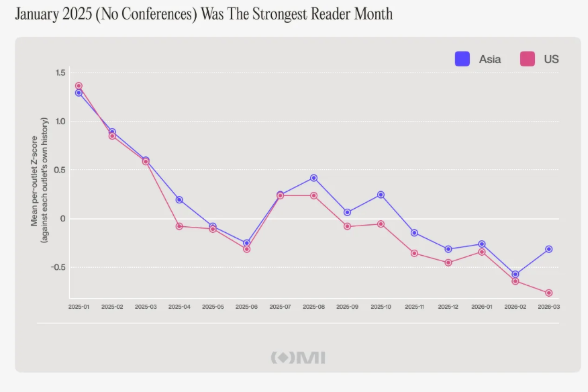
The pattern also holds up over time. Across all events, the price climbs about 62% of the time in those pre-event weeks. Random drift, where Bitcoin could go either way on any given day, would land closer to a 50-50 split, but this is a meaningful tilt. Bitcoin tends to be higher before conferences begin. By the time the first keynote begins, most of the move has already happened.
Inside the event itself, the picture slightly changes. BTC returned an average of just +0.6% during the days these conferences were running. On its own, that figure says very little. A handful of conferences with strong moves and a handful with weak ones can average out to almost anything, so the real question is whether +0.6% is unusual at all.
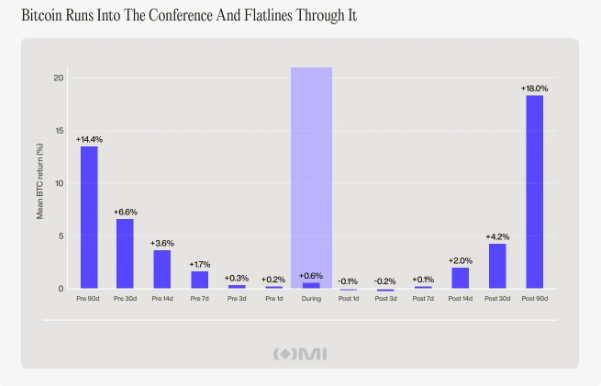
To answer that, analysts ran a simple test. It picked 10,000 random stretches of time from Bitcoin’s price history, each one matching the typical length of a conference, and measured the movement of BTC during them. The average across those stretches came in at +1.8%, with most of them landing somewhere between a small loss and a mid-single-digit gain.
The conference figure is inside that range, precisely near the middle of it. In other words, what Bitcoin does during a conference looks no different from what Bitcoin does during any random stretch of time the same length, picked at random from 12 years of price history.
Conference Effect or Cycle Top Effect?
Reader interest tends to follow the candles. Bullish stretches fill crypto sites with traffic, and quieter or bearish ones thin them out. And that pattern is the backdrop for every conference-month traffic claim a publisher will ever make.
Looking across the report’s data panel, the picture matches that logic. US crypto outlets see only a 0.2% jump during conference months compared to their yearly average. The lift is well within normal monthly variation, which means whatever conferences are doing for US media traffic, the data cannot reliably detect it.
Asian outlets show a sharper number on paper, with conference months running 4.5% above quiet months. At first glance, that looks like a real signal, until you trace it back to where it actually came from. Much of that bump links back to one specific group: 27 publishers concentrated across Southeast Asia who recorded their biggest month of the year in October 2025, a stretch that overlapped with TOKEN2049 Singapore.
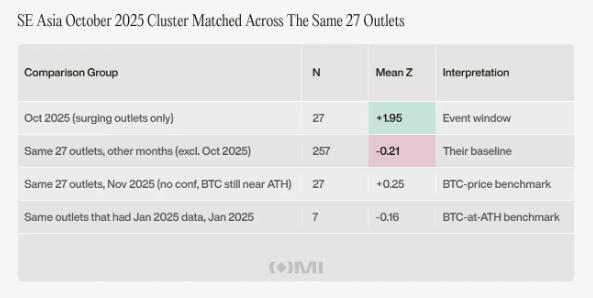
The problem is that October 2025 wasn’t just a conference month. It was also the month Bitcoin reached its cycle high near $126,200. Days later, the market went through the worst 24 hours of forced selling crypto had ever recorded. Leveraged traders lost billions in the span of an afternoon, and readers chasing news like that flooded into crypto publishers across the region.
With the conference, the all-time high, and the crash all happening within days of each other, no analysis can fairly assign the traffic surge to any single one of them. To check whether the conference was actually doing the work, the same 27 outlets were measured again in November 2025, when Bitcoin was still near its high but no Tier-1 conference was on the calendar. In November, that same group’s traffic signal fell to about a tenth of October’s level, which makes the October spike look much less like a repeatable conference effect.
Overall, the cluster that gives Asia its conference-month lift also happened in a month where two enormous price events were already pulling readers in. Strip those out of the picture, and the conference’s share of that bump becomes questionable.
Final Thoughts
Circling back to the chart the curious reader was looking at, the green he saw was real. Bitcoin did move, traffic did rise, and the conference was happening at the same time, which made it the easiest explanation to reach for.
What the data adds is a question of order and timing perspective. ODP shows that the price started moving weeks before the speakers arrived, so the cleaner read is that the market was already creating attention before the conference entered the story. So if a sponsor is buying the event because the market looks alive that week, the first question should be whether the event made it alive at all.






Comment