
Distributed Ledger Technology in America: Use Cases, Benefits, Risks, and Long-Term Opportunities
Distributed ledger technology in America is moving from crypto to core finance. See the US use cases, benefits and risks behind a fast-growing blockchain market.

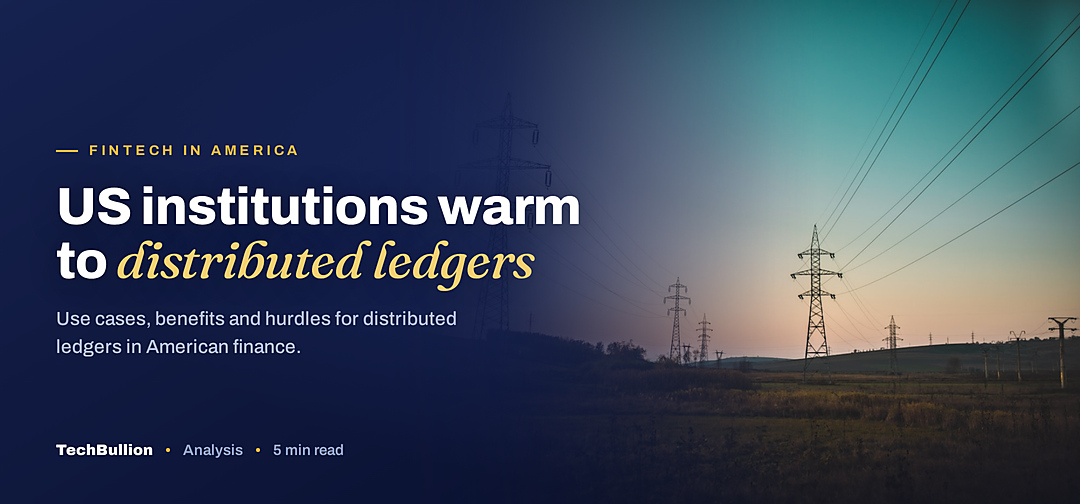
When a wire transfer takes three days to clear, the delay is not the money moving, it is the institutions agreeing on what happened. In America, distributed ledger technology is starting to remove that pause. North America held the largest share of the global blockchain technology market in 2024 at 37.4 percent, and the United States is expected to grow at a strong pace through 2030, according to Grand View Research. The result is a quiet rewiring of how American consumers and businesses verify, settle, and record value.
Why distributed ledger technology in America is gaining ground
The United States has the ingredients for adoption: deep capital markets, a dense base of technology firms, and regulators who are slowly drawing clearer lines. Banks want faster settlement. Retailers want verifiable supply chains. Government agencies want records that resist fraud. Distributed ledger technology speaks to all three because it lets parties that do not fully trust each other work from one shared, tamper-evident record. That is a different pitch from the early crypto era, and it is landing with institutions that ignored the technology a few years ago.
Scale helps explain the interest. The wider blockchain market is on a steep climb, and the United States sits at the center of it. The same investors who follow platforms giving retail traders access to global markets are tracking how ledger-based settlement could reshape the back office of American finance.
Where it is being used across US sectors
The strongest American use cases share a trait: several parties need the same trusted data, and no one wants to hand control to a single owner. The table below maps where distributed ledgers are showing up.
| US sector | Distributed ledger use case | Main benefit |
|---|---|---|
| Banking and capital markets | Settlement of trades and repurchase agreements | Minutes instead of days |
| Payments | Cross-border transfers on a shared ledger | Lower cost, fewer intermediaries |
| Supply chain | Tracking goods from origin to shelf | Provenance and fraud reduction |
| Identity and records | User-controlled digital identity | Privacy and portability |
Use cases reflect documented enterprise and financial-sector pilots in the United States.
Grand View Research notes that the payments segment led the global market in 2024, while digital identity is the fastest growing application. Both trends are visible in the United States, where banks chase faster settlement and consumers grow wary of handing identity data to every service they touch.
The benefits American businesses actually see
The numbers behind these benefits are still maturing, but the pattern is consistent across pilots: fewer manual steps, faster settlement, and cleaner records. For a US company, the payoff is rarely the technology itself. It is the reconciliation that no longer happens, the dispute that does not arise because both sides read the same record, and the audit that takes hours instead of weeks. Shared ledgers also open the door to automation through smart contracts, where an agreement executes itself once conditions are met. Firms already using an AI-native framework for financial institutions can feed clean, ledger-verified data straight into their models, which raises the quality of every downstream decision.
Risks and the regulatory question
The American story is not friction free. Regulation is still settling, with agencies sorting out which digital assets count as securities and how ledger records fit existing rules. Europe moved earlier with its Markets in Crypto-Assets framework, and US firms watch that model closely. Scalability remains a real constraint on public networks, which slow and grow costly under heavy load. Security is a double-edged trait: ledgers are hard to tamper with, but a lost private key can mean lost access, and the same care that drives AI-driven defense systems applies to key management here. For most American companies, the sensible stance is targeted adoption, not wholesale replacement.
How the US compares with other markets
The United States is not adopting distributed ledger technology in a vacuum. Asia Pacific is the fastest growing region, with governments in China, Japan, and South Korea backing blockchain as part of national digital strategies. Europe leads on rules, having put its Markets in Crypto-Assets framework in place to give firms legal certainty. The American advantage is its capital markets and private-sector depth, where banks, asset managers, and technology firms can move quickly once the regulatory path is clear. The global blockchain technology market that Mordor Intelligence values at USD 39.82 billion in 2026 is being built across all three regions at once, and the United States is competing to set the standards the rest will follow.
That competition has stakes beyond bragging rights. Whoever establishes the dominant ledger platforms and rules for tokenized assets will shape how trillions of dollars in securities settle for decades. American firms know this, which is why even cautious institutions are running pilots rather than waiting on the sidelines. The cost of being late to a shared-infrastructure standard is high, because these systems reward the networks that get there first and attract the most participants.
The long-term opportunity for the United States
The path there runs through unglamorous work: custody services that hold keys safely, auditors who can read ledgers directly, and standards that let one bank ledger talk to another. None of it makes headlines, but it is what turns a pilot into a system the whole market can rely on.
Look past the next product cycle and the prize is infrastructure. Tokenized assets could let bonds, funds, and even real estate trade in smaller pieces around the clock. Central bank and private digital currencies are under study. Identity systems are shifting toward records people carry rather than rent. If the United States gets the rules right, distributed ledger technology could lower the cost of trust across the economy, the way the internet lowered the cost of sending information.
For consumers, most of this will stay invisible, surfacing only as faster payments, clearer product histories, and more control over personal data. For businesses, the change is structural, touching how they settle, reconcile, and prove what happened.
The three-day wire will not vanish overnight. But the direction is set, and in America the question has moved from whether distributed ledgers belong in finance to which corners of finance they will quietly take over first.





Comment