
Digital PR Strategy: The Ultimate Playbook With Real Campaign Examples That Earn Links

You’ve probably already heard that backlinks and brand mentions matter for SEO – it’s advice you’ve read a hundred times. But most guides stop at “get more backlinks” without showing what a winning campaign actually looked like, step by step. In this guide, we’ll break down real digital PR campaigns and the exact process behind them, so you can build a strategy that earns coverage instead of guessing at it.
Unlike traditional PR, which focuses on print media and broadcast, digital PR targets online publications, bloggers, and influencers who can provide measurable SEO value through editorial links.
Digital PR extends the same discipline into digital-first and digital-native media – online publications, blogs, podcasts, YouTube, newsletters, social, and influencer channels. It adds an SEO layer that treats backlinks, domain authority, and search rankings as primary outcomes. And in 2026 it adds GEO – Generative Engine Optimization – and AEO, the work of becoming the answer AI engines return.
For a deeper breakdown of the discipline itself, see Growth Edge Marketing’s guide to what digital PR is – from here, we’ll focus on strategy and real campaign results.
Why Digital PR Matters for SEO and Brand Growth?
Digital PR matters because it earns links and mentions that search engines treat as trust signals, which directly influences organic rankings. Google’s algorithm weighs the number and authority of a page’s referring domains heavily, and pages that rank on the first page average around 203 backlinks (First Page Sage, 2025).
A real campaign makes this concrete. Self Financial, a fintech company, built a study analyzing the true cost of living across U.S. states, factoring in taxes, housing, and life stages like homeownership. The story wasn’t about Self Financial’s product at all – it was original data journalists could use to explain a topic their readers already cared about. That single campaign earned 727 backlinks from outlets including The Washington Post, Yahoo, USA Today, and CNBC, drove roughly 26,000 direct page visits, won a US Search Award, and had its underlying data picked up by the Governor of New Jersey’s office (Traffic Think Tank, 2024). That’s the dual payoff digital PR offers – an SEO-friendly backlink and a real audience, in one placement.
That payoff isn’t guaranteed, though. A striking 94% of online content never earns a single external backlink (Backlinko, via Motive PR, 2025), which shows how much competition exists for journalist attention. This is precisely why a structured digital PR strategy – not a one-off press release – is what separates brands that consistently earn coverage from those that don’t. It’s also why digital PR is now rated the most effective link-building tactic by SEO professionals, with 89.6% of surveyed practitioners naming it their top-performing channel (DemandSage, 2025).
In 2026, building backlinks remains the most effective use of digital PR (85.8%), followed by building brand awareness and organic traffic, all on par with last year (BuzzStream, 2026). Trust tends to rise more from credible third-party mentions than from paid ads, and brands often protect that lift through reputation management.
How Digital PR Works: Strategy, Process, and Real Campaign Types
The Core Digital PR Process
A digital PR campaign generally follows a repeatable process: research, asset creation, outreach, and reporting. First, the team researches a newsworthy angle using trends, data, or a company’s proprietary information – in Self Financial’s case, that meant pulling from the American Community Survey and Consumer Expenditure Report rather than inventing a narrative from scratch.
Second, the team builds a shareable asset around that angle – a study, tool, or visual. Third, they build a targeted media list of journalists who cover the relevant beat and pitch the story with a clear, concise angle. Finally, they track the resulting coverage, log the earned backlinks, and report on referral traffic and domain authority changes.
Types of Digital PR Campaigns, With Real Examples
Not every digital PR campaign looks the same, and the type that works best depends on what data or expertise a brand actually has to offer. The table below breaks down the most common types, each anchored to a real result.
| Campaign Type | What It Involves | Real Example |
| Data-driven PR | Original surveys or public data turned into a report | Self Financial’s cost-of-living study – 727 backlinks (Traffic Think Tank, 2024) |
| Evergreen newsjacking | An angle tied to a recurring news event, reused each time it happens | RareCarat’s celebrity engagement ring valuations, earning coverage from Metro UK and The Scotsman every time a high-profile engagement makes headlines (Loopex Digital, 2026) |
| Expert commentary / source outreach | Offering a spokesperson’s insight to journalists writing on a topic | Industry experts quoted in breaking financial or health news as it happens |
| Sector-specific research | Original studies built for a niche audience a brand already understands | A healthcare IT company’s research on Millennial health habits earned 145 links from major lifestyle and news outlets (Digital Third Coast, 2025) |
| User-generated content campaigns | Inviting an audience to create content around an existing brand moment | Starbucks’ #RedCupContest, which let customers define the seasonal story instead of the brand doing it (Loopex Digital, 2026) |
The average digital PR campaign earns links from 42 unique referring domains at an average Domain Rating of 61, making it one of the highest-quality link sources available (Digitaloft / Reboot Online, 2026).
What Makes a Digital PR Campaign Newsworthy?
A digital PR campaign becomes newsworthy when it offers a journalist something their readers genuinely want: new data, a timely angle, or a credible expert voice. The RareCarat example above is instructive here – instead of pitching once and moving on, the brand built an angle (celebrity ring valuations) that stays newsworthy indefinitely, because celebrity engagements keep happening on their own schedule.
As such, campaigns built purely around brand promotion rarely earn coverage, because journalists aren’t incentivized to write free advertising. In addition, timing matters: a pitch tied to a trending news cycle or seasonal moment has a far higher chance of coverage than a generic pitch sent at a random time. Only 2.2% of published online content earns multiple backlinks through digital PR and earned media campaigns, which underscores how selective journalists are about what they cover (Resourcera, 2026).
How to Pitch Original Data Studies to Journalists?
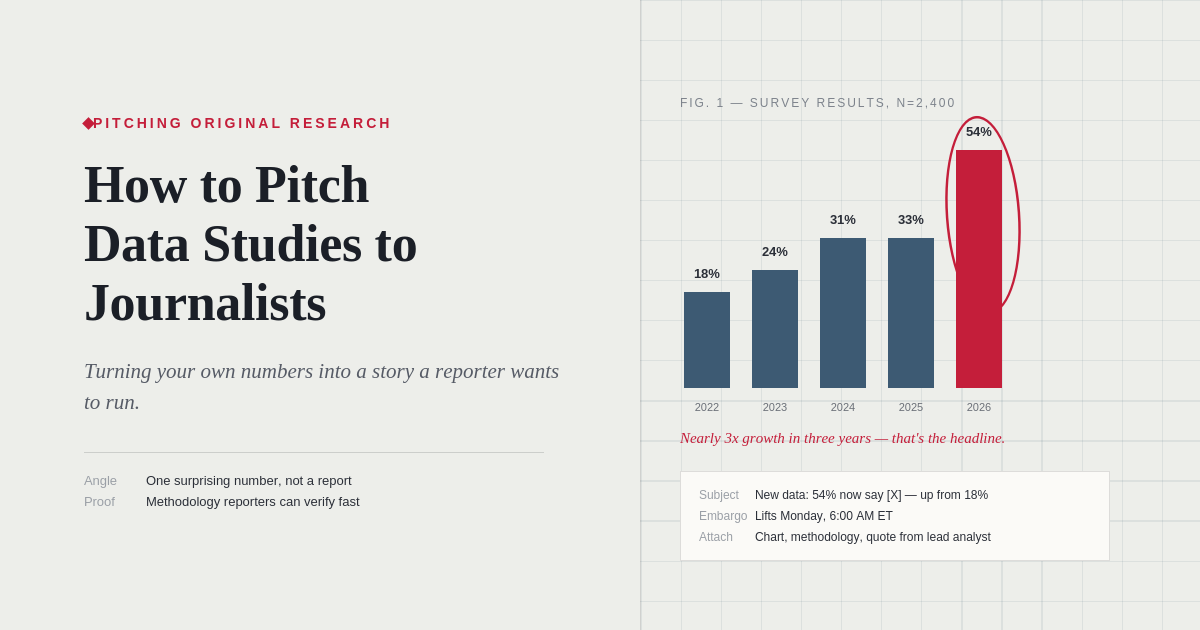
Pitching original data studies to journalists requires packaging findings as reporter-ready stories, not raw spreadsheets or press releases. Journalists rely heavily on PR-provided material for story ideas – 66% say they use pitches, press releases, and media kits – but 82% of pitches are rejected because they don’t align with the journalist’s beat (PR Daily and Cision, 2026).
Build a Reporter-Ready Package
A reporter-ready package combines two or three fully contextualized stats, embargoed access, a credible named expert, one clear visual, and a transparent methodology note. Lead with the finding and why it matters, offer the reporter the full data and an interview, and let the number do the persuading.
For example, structure your pitch like this:
Hook: New research from [company] found that [primary statistic], revealing [why the gap matters].
Three clean stats, each with population and timeframe:
- [Statistic one]
- [Statistic two]
- [Statistic three]
Expert: [Spokesperson name] can explain the finding and its implications for [reporter’s beat].
Embargo: Would you like early access before [date]?
Full report: [link to the complete thought-leadership survey report]
Make the Data Quotable
Make the headline stat easy to quote, publish a chart that can be embedded, and include a clear methodology section so skeptical editors can verify it. Lead with one number, not five, in your title and first paragraph. Give a plain-language methodology: sample size, dates, source. Offer a downloadable chart or a simple table that anyone can screenshot. Update the study annually and re-pitch it to everyone who cited the older version.
Journalists reward original data because it gives them something to write about that no competitor has, and editors link to the source of a statistic almost by reflex.
Metrics Beyond Backlinks for Digital PR Success
Digital PR success in 2026 requires measuring authority and AI citations, not just backlink volume and domain rating. Traditional metrics remain necessary, but authority-era metrics are now essential for a complete picture.
Traditional Metrics (Still Necessary)
- Domain rating (DR) – overall backlink authority of the brand domain
- Referring domains – number of unique domains linking to the brand
- Organic keyword rankings – search position for priority category and branded terms
- Organic traffic – sessions driven from organic search
Authority-Era Metrics (Now Essential)
Only 14% of brands currently track AI visibility metrics, per industry data. This represents a significant competitive opportunity: brands that begin systematic AI visibility measurement in 2026 are establishing a benchmark and a compounding advantage over competitors who are still measuring only traditional link metrics.
Placement volume, link quality, search outcomes, AI search outcomes, and commercial outcomes should all be tracked for a complete scorecard. A complete scorecard counts linked coverage, unlinked brand mentions, net-new referring domains versus repeat media, branded search volume movement, and AI citations – the KPI two thirds of practitioners now track.
How AI Search Engines Cite Earned Media Sources?
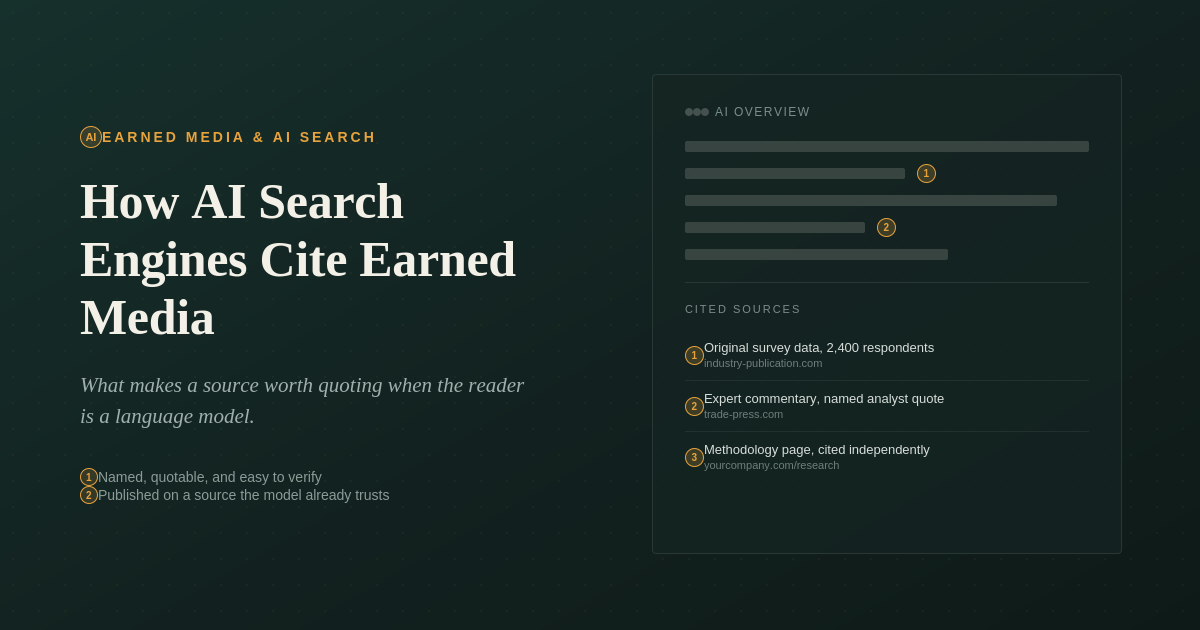
Eighty-two to 89% of all AI engine citations come from earned media – Forbes, Financial Times, TechCrunch, The National – not from brand websites, according to six independent studies analysing millions of AI-generated responses. Traditional digital PR measured success by backlink volume and domain rating. In the AI era, those metrics are necessary but no longer sufficient.
The Citation Data
Six independent studies analysing millions of AI-generated responses find the same result: earned media from authoritative publications accounts for 82–89% of all AI engine citations. The studies include Muck Rack Generative Pulse (82% of AI-cited links are earned media; 95% non-paid), Fullintel–UConn (47% of citations from journalistic sources; 89%+ earned media), Ahrefs ChatGPT citation analysis (65.3% of cited pages from DR80+ domains), Signal Genesys LLM citation study (citations concentrate in high-authority publications), Princeton / Georgia Tech (statistics improve citation rates 30–40%), and OtterlyAI AI Citations Report 2026 (journalistic sources in high-authority outlets remain dominant).
AuthorityTech’s Machine Relations research quantifies the gap: earned media generates 325% more AI citations than owned distribution. Press releases – despite growing 5× in volume – account for only 1% of AI citations.
Why Backlinks Alone No Longer Determine Visibility?
Backlinks get you ranked. Authority gets you cited. In 2026, you need both – but most brands are investing for only one. AI search engines – ChatGPT, Perplexity, Gemini, Claude – do not use backlink graphs as citation signals. They draw from training data (predominantly editorial content from high-authority publications), real-time web retrieval (for AI engines with live web access), and entity recognition systems that identify which brands are associated with which categories and claims
A backlink from a DR40 guest post is invisible to ChatGPT’s citation logic. A mention in The National’s business section – even without a hyperlink – is not. The publication’s editorial authority, the quality of the journalistic context, and the consistency of the brand’s association with relevant topics all factor into AI citation probability in ways that backlink profiles do not.
The DR80+ Citation Threshold
The Ahrefs ChatGPT citation analysis makes the authority threshold explicit: 65.3% of pages cited by ChatGPT come from domains with DR80 or above. This is not a soft preference – it is a structural feature of how AI engines identify trustworthy sources. For most brands, reaching DR80+ organically through link building alone is a years-long project. Securing editorial coverage in publications that already sit at DR80+ – Forbes, Financial Times, Wired, The Guardian, The National – is faster, more controllable, and simultaneously generates AI citation signals that owned-domain optimisation cannot replicate.
Brand mentions – unlinked references to a brand in editorial context – correlate roughly 3× more strongly with AI search visibility than backlinks do, per 2025–2026 analyses. A brand mentioned by name in a Financial Times analysis, even without a hyperlink, registers as a stronger AI visibility signal than a backlink from a mid-authority guest post.
What Does a Digital PR Service Actually Do?
A digital PR service typically handles campaign ideation, media list building, journalist outreach, and coverage reporting on behalf of a client. The healthcare IT campaign mentioned above is a useful reference point: an agency identified that journalists were actively interested in Millennial health habits, built a study around that specific interest, and turned it into 145 links from major outlets – a result the client likely couldn’t have produced without an agency’s existing media relationships and campaign experience (Digital Third Coast, 2025).
Pricing for a digital PR service varies widely depending on scope, but businesses that invest in link building generally allocate a meaningful share of their SEO budget to it – agencies report spending roughly 32% of their overall SEO budget on link building activities, including digital PR (Editorial.link, 2025). [Internal link: “choosing an SEO agency” → your agency-selection guide]
The average cost per earned digital PR link sits around $750, with 76% of SEOs paying $300+ per placement (BuzzStream, 2026).
Digital PR Campaign Checklist: 6 Steps to Launch
- Set measurable objectives. Tie every campaign goal to a business outcome: domain authority growth, share of voice in a specific vertical, or AI citation frequency for a target keyword cluster.
- Segment your media targets. Divide outlets by beat, audience size, and publication authority. Tier-one national outlets require different angles than trade publications or regional business press.
- Craft a concise pitch. Pitches under 200 words generate 32% more responses than those over 400 words.
- Respond to journalist queries fast. Specific, quotable expert commentary delivered quickly outperforms broad press releases in placement success.
- Follow up once, then stop. A single follow-up after 48–72 hours is acceptable. Multiple follow-ups damage your sender reputation and reduce future open rates.
- Measure across the full funnel. Track placements, referring domain quality, organic traffic lift, and AI citation gains.
Conclusion
Digital PR has become one of the most reliable ways to earn backlinks, build brand authority, and get in front of new audiences without paying for placement. The campaigns that work – whether it’s a fintech’s cost-of-living study or a jeweler’s evergreen celebrity angle – share the same foundation: a story worth telling, pitched to the right people. Start with one well-researched campaign, measure what it earns you, and build from there – the compounding value of digital PR only grows the longer you stick with it.







Comment