
Day by Day: How One Management Innovation by Dmytro Shmatukha Changed the Children’s Furniture Market Economy

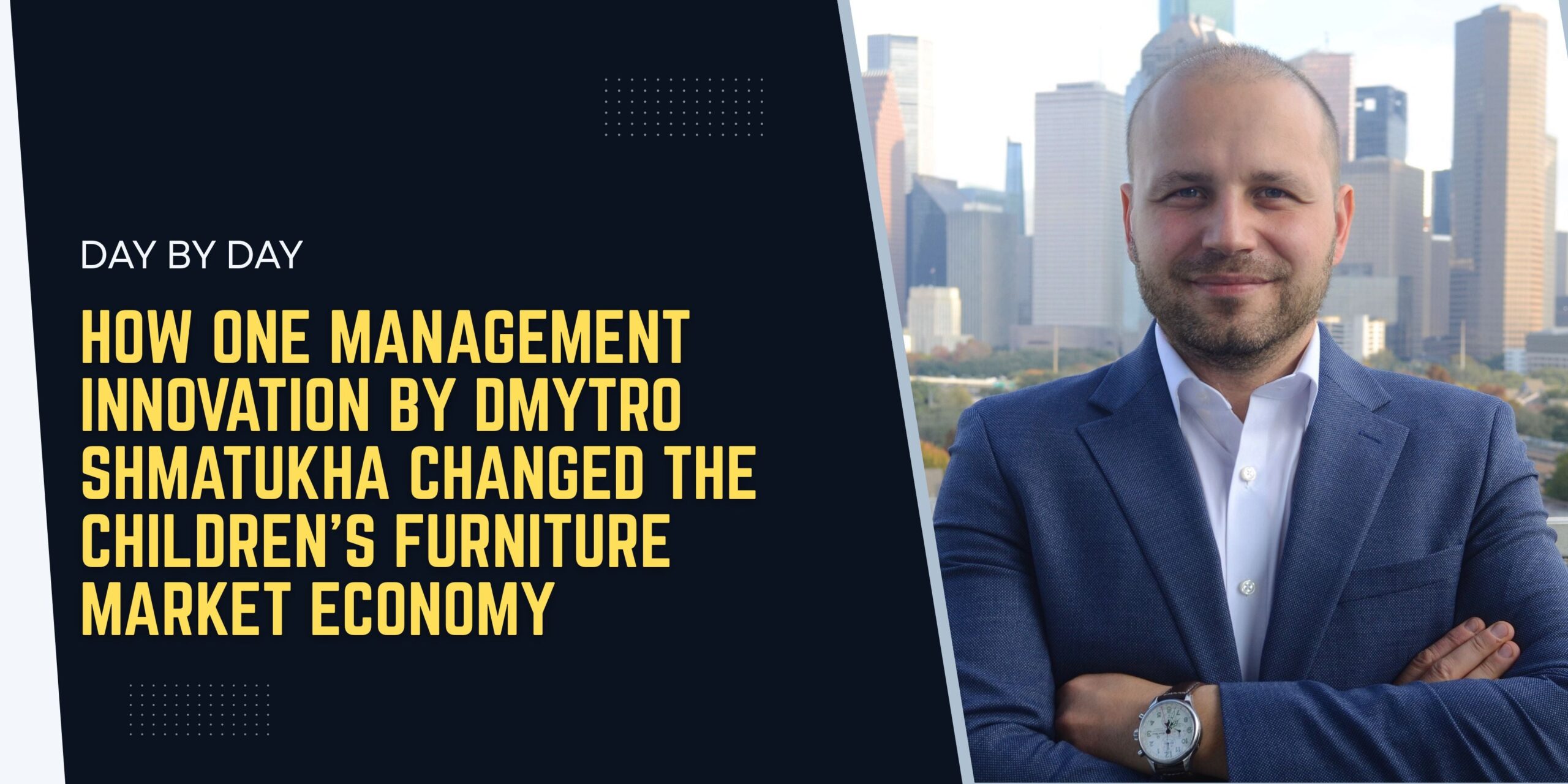
According to international studies, about 58% of people worldwide use delivery and online ordering services. In some countries, this figure exceeds 60–70%. But not all goods can be delivered in a couple of hours. For example, furniture or home appliances often require waiting for weeks, and sometimes even months. Dmytro Shmatukha stands out from most managers in his sector due to his willingness to rethink established rules of the game. This serial entrepreneur did what many had been hesitant to do for decades. He changed the approach to delivering large-sized cargo and made it fast. Moreover, his model proved to be scalable and can be applied not only in the furniture industry but also in other business sectors. In essence, this is about setting a new standard in the heavy-haul logistics sector. Here’s how he did it.
Dmytro Shmatukha manages several projects simultaneously. The first and earliest is Angelo, one of the largest children’s furniture brands in Eastern Europe, which has been in business for over 10 years. His second area of focus is the service business in the U.S. Shmatukha is the founder of Swift Appliance Repair LLC, which specializes in repairing household appliances, and he also serves as the regional supervisor for WeFix-Appliance LLC—a company that coordinates service teams and optimizes operational processes.
For his innovative business solutions and the implementation of modern management practices, Dmytro was named a laureate of the Ukrainian Business Award in 2023, and in 2024 he was invited to serve on the jury of the international Glonary Awards for Business, where he evaluated existing companies run by entrepreneurs from various countries. At the same time, at the initiative of the “International Association of Entrepreneurs and Executives,” Shmatukha participates in the evaluation of business projects, shares practical experience with community members, and promotes the implementation of effective business models and international management standards.
This expertise is directly reflected in his own projects: a well-structured operational model remains the key principle, ensuring that no more than 24 hours elapse from the moment an order is placed to its fulfillment.
As analysts note, same-day delivery didn’t emerge overnight. At first, it was a rare option offered by online stores, but over time, demand for it began to grow. Food and grocery delivery services played a key role here—they were the ones that got people used to the idea that an order could be received within a few hours. Unfortunately, we still see a huge gap in delivery speeds between food and large-sized cargo. And this is one of the main problems in the logistics market.
But the issue isn’t with the couriers. It turns out that most companies aren’t interested in fast delivery themselves. Often, they don’t have models in stock, lack efficient packaging, and haven’t streamlined their assembly processes. Dmytro stepped up to solve these problems and created an original model for preparing cargo for transport, which, according to him, other brands are already copying today.
The warehouse became a key element in his management model. To deliver goods quickly, Dmytro devised a model for decentralizing it. This led to the emergence of networks of small local warehouses within the city, as well as micro-warehouses outside its limits. A similar system is seen at Walmart. It uses its stores as warehouses, allowing the company to successfully compete with Amazon.
Thus, the warehouse becomes the primary tool for speed. And managing it is an art form in itself.
Employees at “same-day” warehouses are required to pick orders in minutes and hand them over to the courier immediately. That is why Dmytro Shmatukha transformed warehouse spaces into order-fulfillment factories. All staff members are trained, and each one handles their own specific tasks. As a result, all children’s furniture—cribs, dressers, and wardrobes—is assembled in advance and ready for shipment. According to Dmytro’s estimates, it takes just five minutes to hand the goods over to the courier. And if an order is placed in the morning, it can be delivered to the customer by evening.
But this raises a question: what about packaging? After all, the products need to be prepared for shipment. Dmytro Shmatukha solved this problem in a radical way. To avoid wasting time on packaging at the time of pickup, he required his employees to carefully package the products in advance, immediately after production. And not in traditional boxes, but in innovative packaging developed by his team specifically for children’s furniture. Unlike standard options, which use foam and cardboard, this packaging utilizes eco-friendly composite materials based on molded cellulose and biopolymers. Upon impact, these materials absorb the force rather than transferring it to the product. As a result, the furniture remains undamaged even if it falls or is subjected to transport vibrations during delivery.
Another important point is product availability in stock. Most furniture companies operate on a made-to-order basis, and customers waste time while managers find craftsmen, order materials, and so on. Dmytro, however, decided not to make customers wait and offers only the items that are ready for immediate pickup. This approach helps him maintain a leading position in his region, as statistics show that up to 20–30% of customers abandon their purchase during checkout if delivery times seem too long.
The entrepreneur applied the same management model to the service industry after transitioning from the furniture business. In appliance repair, the main cause of delays is a lack of replacement parts: first, a diagnosis is performed; then parts are ordered; and finally, the customer waits several days or weeks. At Dmytro’s company, this workflow has been changed. Key components and materials are already in stock, allowing diagnostics and repairs to be performed without any downtime between stages. At Swift Appliance Repair LLC, this means the customer receives a full service cycle on the day of their visit. This result is achieved through a pre-stocked parts warehouse and standardized work processes.
Dmytro also applies this approach at WeFix-Appliance LLC, where, as a regional supervisor, he is developing the service division with a focus on fulfilling orders on the day of the request.
As we can see, this model is being increasingly adopted in the United States. Here, Dmytro’s management decisions have received recognition at the state level. This year, Dmytro Shmatukha was honored with a certificate from South Carolina State Senator Josh Kimbrell for his contribution to entrepreneurship and economic development.
“Typically, service companies take several days or even weeks to complete repairs, but we strive to do everything in a single day—both diagnostics and repairs—by having access to unique training materials and keeping the necessary parts in stock or sourcing them from specialty stores,” says the entrepreneur.
This approach is relevant for the U.S., as equipment repairs here are typically carried out in several stages: diagnostics, waiting for parts, and a follow-up visit by the technician. In Shmatukha’s model, these stages are combined thanks to the availability of the necessary components, which allows the work to be completed in a single visit.






Comment