
Data That Drives and AI That Transforms: Highlights from the ACM Seattle KDD Summit

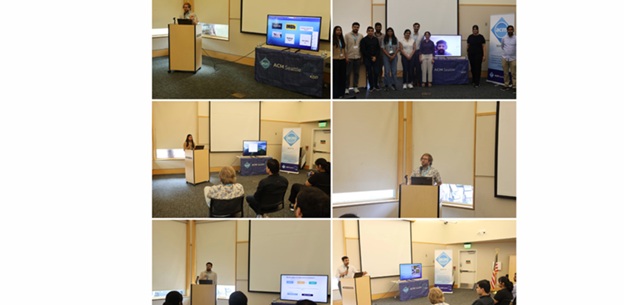
REDMOND, WA — The ACM Seattle Community on Knowledge Discovery and Data Mining (KDD) hosted its Summit on May 1st 2026, bringing together a cross-disciplinary roster of data practitioners for an evening that spanned the intersecting frontiers of finance, cybersecurity, warehouse automation, and AI systems. Featuring two keynote addresses and five lightning talks, the Summit drew professionals from Amazon, Apple, Honeywell, Microsoft and across the Pacific west’s technology corridor for a program that was as intellectually diverse as it was practically grounded. The event was chaired and convened by data science leaders Dharmateja Priyadarshi Uddandarao from Amazon and Sravani Lingam from Infor.
The Buckets of Data and Impacts of AI on Finance Industry
The evening was anchored by host Alekhya Challa, Software Engineer at Expedia, who set the tone for the Summit by welcoming the audience and introducing keynote speakers Ricky Smidt and Vijay Sudhakar. After the keynotes sparked wide-ranging discussion, Challa moderated the lightning talk segment, introducing a diverse lineup of industry experts to deliver rapid-fire insights on AI in production.
Ricky Smidt, Senior Finance Manager at Amazon, delivered the evening’s opening keynote, drawing on fifteen years of experience spanning six distinct businesses domains within Amazon. Smidt presented a deceptively simple yet powerful framework for thinking about data by organizing it into three buckets: data that drives decisions, data that audits outcomes, and trivia.
The most important skill for anyone working with data, Smidt argued, is recognizing which bucket you are operating in at any given moment and being intentional about where you invest your time. Through vivid stories from his career, he demonstrated how audits naturally become the catalyst for driving action, revealing that what begins as backward-looking verification often surfaces the insights that propel organizations forward. He also reframed trivia as carrying hidden value: it serves as an error-checking layer that catches inconsistencies before they compound, and as a motivational tool that keeps teams engaged with their data. Smidt’s core message resonated clearly with the audience: maximize your time in the first two buckets, be intentional about the third, and always ground your data in the real world. For finance and data professionals alike, the framework offered an immediately actionable lens for prioritizing analytical effort.
Vijay Sudhakar delivered the evening’s second keynote on how artificial intelligence and machine learning are fundamentally reshaping the financial industry, taking the audience on a comprehensive tour across nine critical domains. He opened with real-time fraud detection, examining how ensemble models and graph neural networks intercept financial crime at millisecond speed, before moving into algorithmic trading and portfolio optimization, where reinforcement learning agents and NLP-driven signal generation are redefining market execution.
Sudhakar addressed AI-powered credit risk assessment, contrasting traditional scoring methods with modern ML approaches that expand financial access to underserved populations, and highlighted personalized financial wellness, where recommendation engines and conversational AI deliver hyper-personalized guidance at scale. Compliance was tackled through a RegTech and AML pipeline that automates suspicious activity detection and reporting. Deep learning forecasting models, including Temporal Fusion Transformers, were shown to improve revenue and market predictions with quantified confidence intervals.
A standout segment introduced AI Copilots for financial analysts, demonstrating how LLMs augmented with Retrieval-Augmented Generation (RAG) can compress hours of research and modeling into seconds. A dedicated section on Responsible AI underscored the non-negotiable importance of fairness, explainability, model governance, and human oversight in high-stakes financial decisions. Sudhakar closed with a forward-looking roadmap and a call to action for teams ready to build the next generation of intelligent financial systems.
Perspectives on AI in Various Production Systems
The keynotes were followed by five lightning talks by various industry experts that showcased the breadth of AI application across industries.
Ankush Mahajan explored how data analytics is transforming modern banking, from digital platforms and AI-powered decision support systems that enhance loan approvals and credit risk assessment, to customer analytics enabling precise segmentation and personalized financial services. He emphasized how robust compliance frameworks and AML systems work alongside these capabilities to form the foundation of intelligent, data-driven banking ecosystems.
Madhukar Dongala tackled the provocatively titled Why Your AI Model Fails in Production and How Data Science Fixes It, walking the audience through failure modes across fraud detection, algorithmic trading, credit risk, and AI copilots. He explored how rigorous data science practices, not just better models, are the key to bridging the gap between prototype and production, with a forward look at the future of FinAI.
Harsha Saggurthi brought a refreshingly operational perspective with a talk on AI-augmented warehouse automation. Drawing from hands-on experience with large fulfillment centers, he shared practical ways AI and data can support real warehouse operations from predicting equipment failures and improving flow decisions to helping engineers commission and troubleshoot systems faster, all built on top of the highly engineered, PLC-driven automation foundations already in place.
Sarthak Shah spoke about Policy-Aware Decision Systems: Bridging Data Science and Real-Time Governance, introducing a system-level framework connecting data science workflows with production governance challenges such as versioning, explainability, latency, and bounded correctness. His core insight: in modern real-time systems, models predict, but systems decide and the governance layer between them is where reliability lives.
A Community Driving Knowledge Forward
The ACM Seattle KDD Summit continues to serve as a vital monthly platform for technology professionals across the region to come together, share knowledge on recent developments in the data science and engineering world, and build the professional networks that fuel collaborative innovation. With programming that spans finance, cybersecurity, warehouse automation, and production AI governance, the chapter demonstrates that the most valuable insights often emerge at the intersection of disciplines. The ACM Seattle Chapter will continue hosting summits year around, bringing together engineers, data scientists, finance leaders, and technologists who are shaping the next generation of intelligent systems.







Comment