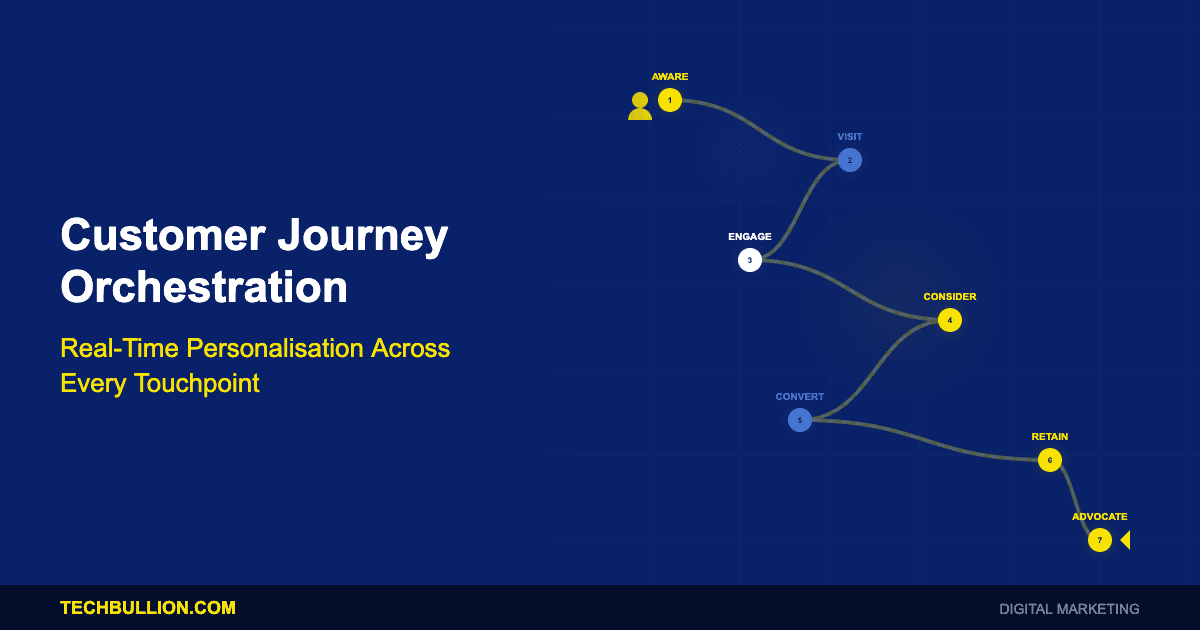
Customer journey orchestration has evolved from a theoretical marketing framework into a technology-driven discipline that coordinates personalised experiences across every channel and touchpoint in real time. A financial services company detects that a customer has researched mortgage rates on its website, opened a related email, and called its contact centre with questions about pre-approval requirements. Within minutes, the orchestration platform adjusts the customer\’s next touchpoints: a personalised push notification with current rates, an updated website experience highlighting mortgage calculators, and a flag to the local branch advisor with conversation context. This coordinated response across digital and human channels represents the operational reality of journey orchestration in 2026, where technology platforms process billions of customer signals daily to deliver experiences that feel seamlessly connected rather than fragmented across departmental silos.
Market Context and Strategic Importance
The global customer journey analytics market was valued at $12.3 billion in 2024 and is projected to reach $25.1 billion by 2029, growing at a compound annual growth rate of 15.3 percent according to MarketsandMarkets. This investment reflects a fundamental shift in marketing philosophy: from campaign-centric execution, where marketers design and schedule discrete communications, to journey-centric orchestration, where technology continuously adapts the next best action for each individual based on their real-time behaviour and context.
The business case is compelling. McKinsey research shows that companies excelling at journey orchestration achieve 10 to 20 percent increases in customer satisfaction, 15 to 25 percent increases in revenue from cross-sell and upsell, and 20 to 30 percent improvements in customer retention. Forrester reports that organisations with mature journey orchestration capabilities are 2.7 times more likely to exceed revenue goals than those without.
| Metric | Value | Source |
|---|---|---|
| Journey Analytics Market (2024) | $12.3 billion | MarketsandMarkets |
| Projected Market (2029) | $25.1 billion | MarketsandMarkets |
| Revenue Lift from Orchestration | 15-25% | McKinsey |
| Customer Retention Improvement | 20-30% | McKinsey |
| Revenue Goal Achievement (Mature Orchestration) | 2.7x more likely | Forrester |
| Average Touchpoints Before Purchase | 20-500+ |
Architecture of Journey Orchestration Platforms
Modern journey orchestration platforms operate on a real-time decisioning architecture that processes customer signals, evaluates business rules and AI models, and triggers actions across channels within milliseconds. The core components include a unified customer profile, an event processing engine, a decisioning layer, and channel execution capabilities.
The unified customer profile serves as the foundation, aggregating data from customer data platforms, CRM systems, transactional databases, and real-time behavioural streams into a single, continuously updated view of each customer. This profile includes identity resolution across devices and channels, historical interaction data, preference signals, and predictive scores that inform orchestration decisions.
The event processing engine monitors real-time customer actions across all connected touchpoints. Website visits, app interactions, email engagements, call centre contacts, store visits, and social media interactions all generate events that flow into the orchestration platform. Stream processing technologies enable the platform to evaluate these events against journey logic within milliseconds, ensuring that responses feel immediate and contextually relevant.
The AI-powered decisioning layer represents the intelligence of the system. Rather than following rigid, predefined journey maps, modern orchestration platforms use machine learning models to determine the optimal next action for each customer at each moment. These models consider the customer\’s current journey stage, channel preferences, predicted intent, lifetime value, and real-time context to select the message, offer, channel, and timing most likely to achieve the desired business outcome.
The distinction between journey orchestration and traditional email marketing automation is significant. While marketing automation executes predefined workflows triggered by specific events, journey orchestration adapts dynamically to each customer\’s evolving context. A marketing automation workflow sends the same sequence of emails to every customer who triggers a specific event. A journey orchestration platform evaluates each customer individually and determines the optimal next action, which might be an email, a push notification, a website personalisation change, or no action at all, based on the full context of that customer\’s relationship with the brand.
Leading Journey Orchestration Platforms
| Platform | Primary Market | Key Differentiator |
|---|---|---|
| Salesforce Marketing Cloud | Enterprise B2C | Journey Builder + Einstein AI decisioning |
| Adobe Journey Optimizer | Enterprise omnichannel | Real-time CDP integration + offer decisioning |
| Braze | Mobile-first brands | Real-time event streaming + Canvas workflows |
| Bloomreach | E-commerce | Commerce-specific AI + web personalisation |
| Insider | Growth-stage enterprises | 12+ native channels + predictive segments |
| Thunderhead (Medallia) | Experience-led enterprises | Intent-driven journey analytics |
Cross-Channel Coordination and Real-Time Decisioning
The true value of journey orchestration emerges when cross-channel coordination produces experiences that feel unified rather than fragmented. A customer who abandons a shopping cart on mobile should not receive a generic promotional email an hour later; they should receive a contextually relevant message acknowledging the specific products they considered, potentially with a personalised incentive calibrated to their predicted price sensitivity.
Channel selection itself becomes an AI-driven decision. The orchestration platform evaluates each customer\’s historical channel preferences, recent engagement patterns, and real-time availability to determine whether to reach them via email, push notification, SMS, in-app message, or web personalisation. This channel optimisation ensures that messages are delivered through the medium each customer is most likely to engage with, improving both response rates and customer experience.
Frequency management across channels prevents the over-communication that damages customer relationships. Without orchestration, different marketing teams may simultaneously target the same customer through email campaigns, retargeting ads, push notifications, and SMS messages, creating an overwhelming barrage that drives opt-outs and complaints. Orchestration platforms enforce cross-channel frequency caps and priority rules that ensure coordinated communication pacing.
The connection between journey orchestration and social commerce creates particularly powerful experiences for retail brands. When a customer engages with a product on social media, the orchestration platform can adjust their website experience, email content, and advertising exposure to reinforce that interest across every subsequent touchpoint. This cross-channel coherence turns what would otherwise be isolated interactions into a unified narrative that guides the customer toward conversion.
Implementation Challenges and Organisational Requirements
Implementing journey orchestration at scale requires more than technology investment; it demands organisational transformation. The most common failure point is not platform capability but the internal silos that prevent cross-channel coordination. Marketing, sales, customer service, and product teams must share data, align on customer definitions, and coordinate their communications through a unified orchestration layer.
Data readiness represents the most critical prerequisite. Journey orchestration cannot function without clean, unified customer data that connects identities across channels and devices. Organisations that have invested in customer data platforms and identity resolution are positioned to activate journey orchestration quickly, while those without these foundations face months or years of data infrastructure work before orchestration can deliver meaningful results. The quality of the customer data directly determines the quality of the orchestrated experiences.
Change management is equally important. Transitioning from campaign-centric to journey-centric marketing requires new workflows, new metrics, and new skills. Campaign managers accustomed to designing and scheduling individual communications must learn to think in terms of customer journeys that span channels and unfold over weeks or months. Success requires executive sponsorship, cross-functional governance structures, and investment in training that builds journey-thinking capability across the marketing organisation.
Journey Analytics and Optimisation
Journey analytics provide visibility into how customers actually move through experiences versus how marketers intended them to progress. Path analysis reveals the most common sequences of interactions that lead to conversion, identifies friction points where customers abandon journeys, and highlights unexpected pathways that suggest unmet needs or opportunities.
Predictive analytics enhance journey optimisation by forecasting customer behaviour at each stage. Models predict which customers are likely to convert, which are at risk of churning, and which represent expansion opportunities, enabling proactive orchestration that addresses each scenario with appropriate messaging and offers.
Multi-touch attribution integrated with journey orchestration connects customer experiences to business outcomes, revealing which journey patterns drive the highest lifetime value and which touchpoints contribute most to conversion. This attribution intelligence feeds back into the orchestration engine, continuously improving the AI models that drive next-best-action decisions.
The Future of Customer Journey Orchestration
The evolution of journey orchestration through 2027 will be driven by increasingly autonomous AI systems that manage customer relationships with minimal human intervention for routine interactions. Orchestration platforms will move beyond reactive responses to proactive engagement, anticipating customer needs before they are expressed based on predictive models trained on behavioural patterns. The integration of journey orchestration with conversational marketing platforms will create seamless transitions between automated and human interactions, ensuring that customers receive the right level of support at every stage. The organisations that invest in journey orchestration infrastructure today, building the data foundations, AI capabilities, and cross-functional processes required for genuine real-time personalisation, will create customer experiences that become a durable competitive advantage in an increasingly crowded marketplace. As customer expectations for personalised, coherent experiences continue to rise, the gap between organisations with mature orchestration capabilities and those still operating channel-specific silos will widen into a meaningful competitive divide that manifests directly in customer acquisition costs, retention rates, and lifetime value metrics. Journey orchestration is no longer an aspirational capability reserved for the most sophisticated marketing organisations; it has become a foundational requirement for any brand seeking to deliver the connected experiences that modern consumers expect and reward with their loyalty and spending.
According to Deloitte’s industry outlook, more than 60 percent of large enterprises now allocate dedicated budgets to digital transformation initiatives, up from 35 percent in 2020.
Market analysis from Grand View Research projects that technology-driven market segments will continue expanding at compound annual growth rates between 15 and 25 percent through the end of the decade.