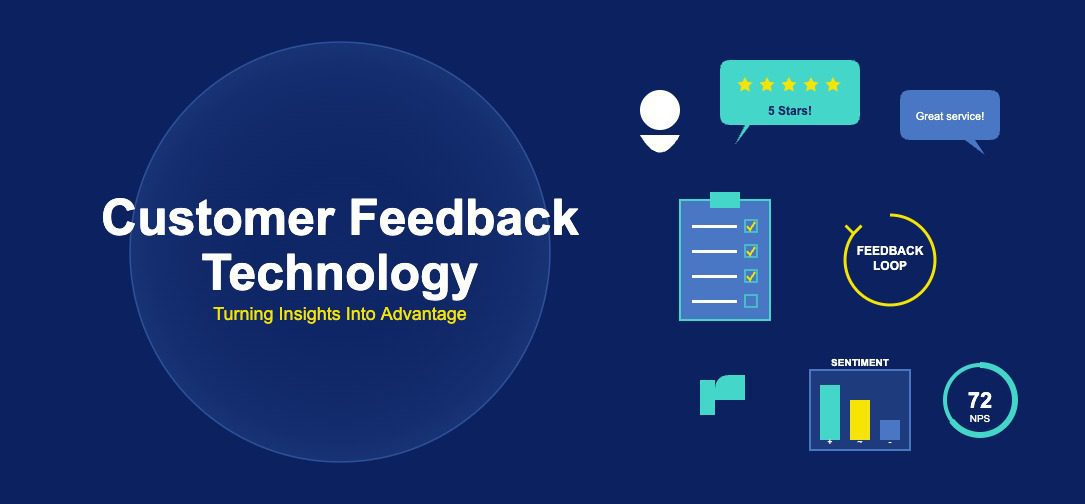
Customer feedback has become one of the most strategically valuable assets a marketing and product organisation can possess. In an era where customer experience increasingly drives competitive differentiation, understanding what customers think, feel, and need has shifted from a nice-to-have research activity to a cornerstone of business strategy. The customer feedback and voice of the customer, or VoC, technology market is valued at approximately $2.6 billion in 2025, and for good reason. Organisations that systematically capture, analyse, and act on customer feedback demonstrate superior customer retention, higher net promoter scores, better product-market fit, and more effective marketing that resonates with actual customer needs rather than assumptions. Voice of the customer programmes, powered by sophisticated technology platforms, have transformed customer feedback from anecdotal stories into structured, actionable intelligence that informs marketing strategy, product development, and customer experience improvements across the organisation.
A voice of the customer programme represents a systematic approach to capturing and analysing customer feedback across all touchpoints and interactions. Rather than relying on the occasional customer survey or a handful of customer conversations, a mature VoC programme orchestrates feedback collection through multiple channels: transactional surveys after a purchase or service interaction, relationship surveys that measure overall satisfaction and loyalty, in-app feedback mechanisms, customer support interactions, social media listening, focus groups, and customer interviews. The feedback data flows into a centralised platform where it is standardised, integrated with customer behavioural data and demographic information, analysed through both quantitative metrics and qualitative text analysis, and then distributed to teams across marketing, product, and customer success who can act on it. This systematic approach transforms scattered feedback into strategic intelligence.
The quantitative measurement of customer sentiment has been standardised around three primary metrics that appear in virtually every VoC programme. Net Promoter Score, or NPS, asks customers a single question: on a zero to ten scale, how likely are you to recommend this company to a friend or colleague. Customers responding nine or ten are classified as promoters, those responding seven or eight are passives, and those responding zero to six are detractors. The NPS score is calculated by subtracting the percentage of detractors from the percentage of promoters, yielding a score that ranges from minus one hundred to positive one hundred. Customer Satisfaction, or CSAT, typically asks customers to rate their satisfaction with a specific transaction or interaction, often on a five-point scale. This metric measures satisfaction with a particular experience rather than overall loyalty. Customer Effort Score, or CES, asks customers how much effort was required to resolve an issue or accomplish a task, again typically on a five-point scale. CES is particularly useful for understanding friction in customer interactions, as research has shown that reducing customer effort often drives stronger loyalty than exceeding expectations.
Survey Types and Feedback Collection Platforms
VoC programmes employ two fundamental survey timing strategies: transactional and relationship surveys. Transactional surveys are deployed immediately after a specific customer interaction: after a purchase, after a customer service contact, after a website visit, or after using a product feature. Because they are closely linked to the specific experience in question, transactional surveys capture immediate, vivid feedback about that specific interaction. Response rates tend to be higher for transactional surveys because the customer is already engaged and the survey is contextually relevant. The trade-off is that transactional surveys necessarily focus narrowly on a single interaction, not on overall brand perception or loyalty. Relationship surveys, by contrast, are administered periodically (quarterly or annually) to gauge overall satisfaction, loyalty, and brand perception. These broader surveys provide important measurement of the customer’s overall experience, but because they are separated in time from specific interactions, customers may have difficulty recalling details. Most comprehensive VoC programmes employ both types of surveys.
Technology platforms have emerged to manage the operational complexity of running VoC programmes at scale. Medallia, Qualtrics, Delighted, and SurveyMonkey represent the leading platforms in this space, each offering different strengths. Medallia and Qualtrics are enterprise platforms designed for large organisations with complex feedback needs across multiple departments and geographies. These platforms handle survey design and deployment, text analytics on open-ended responses, integration with CRM and other business systems, workflow automation to route feedback to appropriate teams, and sophisticated reporting and dashboard capabilities. Delighted and SurveyMonkey serve smaller to mid-market organisations, offering simpler user interfaces and faster time to implementation, though with less sophisticated analytics capabilities. All major VoC platforms now incorporate artificial intelligence and natural language processing to analyse open-ended survey responses, identifying themes and sentiment automatically rather than requiring human manual coding.
Advanced Feedback Collection and Closed-Loop Processes
Beyond traditional surveys, modern VoC programmes employ increasingly sophisticated feedback collection mechanisms. In-app feedback tools embedded within products or mobile applications allow customers to provide feedback in context when experiencing features or issues. Social listening platforms monitor public conversations about the brand across social media and the broader internet, capturing unsolicited feedback about brand perception, product quality, customer service experiences, and competitive perception. Customer support platforms capture structured feedback from support tickets and conversations, providing rich qualitative insight into the problems customers are experiencing. Some organisations employ more intensive research methods like focus groups and ethnographic research to deeply understand customer needs, though these approaches are more resource-intensive and typically focused on specific research questions rather than continuous measurement.
Critically, collecting feedback is only the first step. A truly mature VoC programme implements closed-loop feedback processes where customer feedback directly triggers organisational action. When a customer provides negative feedback, a closed-loop process should route that feedback to the relevant team, have the team contact the customer to resolve the issue and demonstrate that their feedback was heard, and track whether the issue is resolved to the customer’s satisfaction. This closed-loop approach transforms customer feedback from a measurement exercise into a customer relationship and retention tool. When customers see that their feedback leads to action and improvement, their loyalty and willingness to recommend the company increases significantly. VoC platforms increasingly provide workflow automation to orchestrate these closed-loop processes, automatically routing feedback to appropriate teams based on topic and sentiment.
Integration with Product and Marketing Strategy
Beyond individual customer relationship management, customer feedback drives strategic product and marketing decisions. Product teams use VoC feedback to understand which features customers value most, what pain points they experience, and what functionality they wish existed. This feedback shapes product roadmaps and prioritisation decisions. Marketing teams use customer feedback to understand the emotional and functional benefits customers actually derive from products, allowing marketing messaging to be grounded in authentic customer language rather than marketing assumptions. Customer feedback about price sensitivity, competitive alternatives, and decision-making criteria directly informs go-to-market strategy. Organisations that systematically integrate customer feedback into product and marketing strategy decision-making consistently outperform those that rely on internal assumptions or aggregate market research.
| Method | What It Measures | When to Use | Example Tools |
|---|---|---|---|
| Net Promoter Score | Likelihood to recommend and overall loyalty | Ongoing relationship measurement quarterly or annually | Medallia, Qualtrics, Delighted |
| Customer Satisfaction | Satisfaction with specific transaction or interaction | Immediately after purchase, service, or support interaction | SurveyMonkey, Typeform, Qualtrics |
| Customer Effort Score | Ease and friction in customer experience | After support interaction or when resolving an issue | Delighted, Medallia, Zendesk |
| In-App Feedback | Real-time sentiment about features and usability | Continuous collection within product interface | Apptentive, Pendo, Hotjar |
| Social Listening | Unsolicited brand perception and competitive sentiment | Ongoing monitoring across social and web | Brandwatch, Sprout Social, Hootsuite |
| Platform | Primary Strength | Typical Customer | Key Integration |
|---|---|---|---|
| Qualtrics | Enterprise-grade text analytics and sentiment analysis | Global enterprises with complex feedback needs | Salesforce, SAP, Oracle, Marketo |
| Medallia | Closed-loop workflow automation and action tracking | Mid-market to enterprise, service-focused industries | Salesforce, ServiceNow, Microsoft Dynamics |
| Delighted | Ease of use and quick deployment for NPS programmes | Small to mid-market companies and startups | Slack, HubSpot, Zendesk, custom webhooks |
| SurveyMonkey | Survey design flexibility and ease of use | Small to mid-market across all industries | Salesforce, Marketo, HubSpot, Google Analytics |
As organisations increasingly compete on customer experience and personalisation, the strategic importance of voice of the customer programmes continues to grow. The technology platforms supporting VoC have matured substantially, making it easier for organisations of all sizes to implement systematic feedback programmes. The challenge for many organisations is not acquiring the technology but rather establishing the operational discipline and cross-functional alignment to systematically listen to customers, analyse feedback, act on insights, and measure whether actions improved the customer experience. Organisations that master this capability gain a durable competitive advantage rooted in deep understanding of customer needs and the ability to continuously improve based on actual customer feedback rather than internal assumptions.
Related reading: The Future of Marketing Technology: Emerging Trends, Convergence Platforms, and the Next Decade of Digital Marketing Innovation
According to Deloitte’s industry outlook, more than 60 percent of large enterprises now allocate dedicated budgets to digital transformation initiatives, up from 35 percent in 2020.
Market analysis from Grand View Research projects that technology-driven market segments will continue expanding at compound annual growth rates between 15 and 25 percent through the end of the decade.
For more coverage on related topics, explore our dedicated section on technology news.