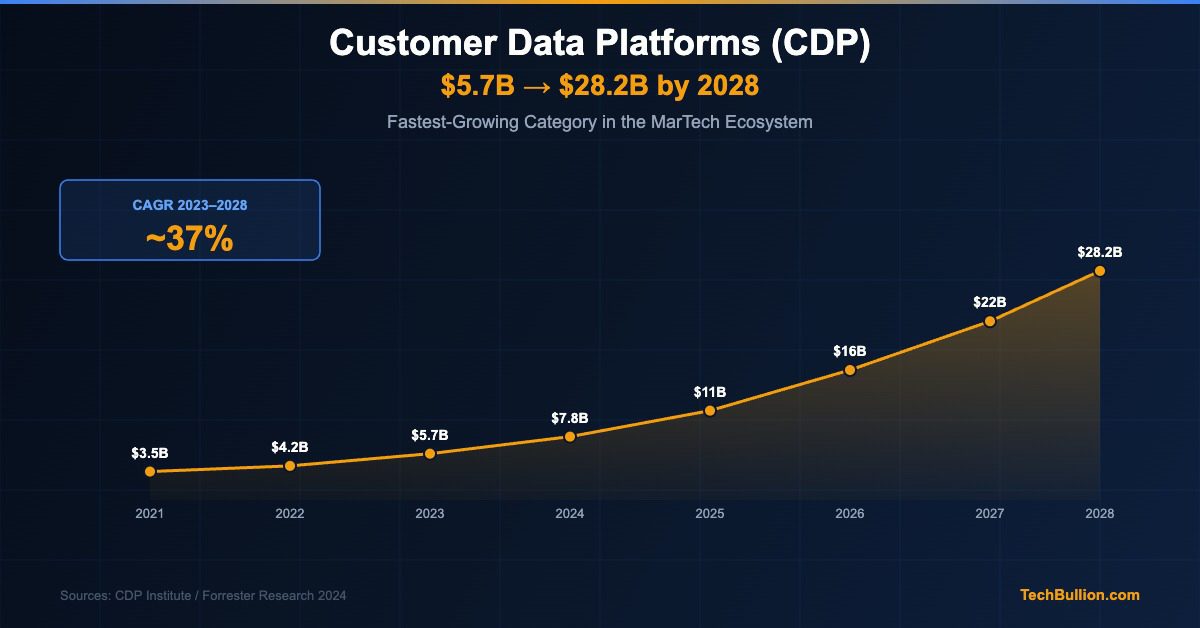
Within the $589 billion global marketing technology market, few categories have risen as quickly or attracted as much strategic investment as the Customer Data Platform (CDP). The CDP market, estimated at approximately $5.7 billion in 2023 by the CDP Institute and Forrester Research, is projected to reach $28.2 billion by 2028, representing a compound annual growth rate of around 37 percent. These growth rates place CDPs among the fastest-expanding segments in the entire MarTech ecosystem, and the reasons for that growth reflect a fundamental shift in how enterprises approach customer data management.
What a Customer Data Platform Does
A CDP is a packaged software solution that creates a persistent, unified customer database accessible to other systems. Unlike a CRM, which is primarily focused on managing sales and service interactions, or a Data Management Platform (DMP), which has historically relied on anonymous third-party data for advertising targeting, a CDP works with identified, first-party customer data from across all touchpoints – web, mobile, in-store, call centre, email – and unifies it into a single customer profile.
The defining characteristics of a CDP are its ability to ingest data from multiple sources in real time, build persistent identity graphs that link a customer’s interactions across devices and channels, and make that unified data available to downstream marketing, analytics, and personalisation systems. This positions the CDP as the data layer underpinning personalisation at scale across the 15,000-plus tool MarTech ecosystem.
Leading CDP vendors include Segment (owned by Twilio), Salesforce Data Cloud, Adobe Real-Time CDP, mParticle, BlueConic, and Treasure Data. Enterprise adoption has accelerated sharply since 2021 as brands have moved to build first-party data infrastructure in response to the deprecation of third-party cookies and increasing data privacy regulation.
Why CDPs Have Become a Strategic Priority
The strategic importance of CDPs has intensified as a result of several converging market forces. The first and most significant is the collapse of third-party data infrastructure that underpinned digital advertising for nearly two decades. Google Chrome’s phase-out of third-party cookies, Apple’s App Tracking Transparency framework, and the tightening of consent requirements under GDPR and CCPA have collectively forced marketers to rethink their data foundations.
CDPs provide the answer to this challenge by enabling brands to collect, unify, and activate their own first-party data without reliance on third-party tracking mechanisms. This makes the CDP the cornerstone of a privacy-compliant, first-party data strategy – a fact that explains why enterprise investment in the category has grown so sharply in a relatively short period. The connection between CDP investment and the broader MarTech budget growth trend is direct.
The Role of Real-Time Data in CDP Value
One of the most commercially significant capabilities of modern CDPs is the ability to update customer profiles in real time and trigger downstream actions based on those updates. A customer who abandons a shopping cart, views a product page, or contacts a customer service agent can have their profile updated within milliseconds, triggering a personalised email, a retargeting ad, or an updated product recommendation in the same session.
This real-time capability is what distinguishes a CDP from older data warehousing approaches, which typically operated in batch mode with data latency measured in hours or days. According to research published by McKinsey in 2024, companies that deliver real-time personalisation across channels see revenue uplifts of between 10 and 15 percent relative to peers using batch-based personalisation. The alignment between CDP capabilities and the AI-driven MarTech trend is particularly important – machine learning models that power product recommendations, next-best-action engines, and predictive churn models all require access to clean, unified, real-time customer data.
CDP Architecture and Integration
Modern CDPs are built on cloud-native architectures that allow them to scale horizontally with data volume and integrate with the broader MarTech and AdTech stacks through pre-built connectors and open APIs. The integration of CDP data with AdTech channels is an example of the broader convergence between MarTech and AdTech markets. When a brand uses first-party CDP data to build custom audiences for use in Google or Meta advertising campaigns – a practice known as customer match or first-party audience activation – it is using a MarTech asset to power an AdTech capability.
Market Landscape and Competitive Dynamics
The CDP market is characterised by strong competition between pure-play CDP vendors and large platform players that have incorporated CDP functionality into broader suites. Salesforce’s development of Salesforce Data Cloud reflects the strategy of embedding CDP capabilities within an existing CRM relationship. Adobe Real-Time CDP is similarly positioned as an extension of the Adobe Experience Cloud suite.
Pure-play vendors such as Segment, mParticle, and Treasure Data compete on the depth and flexibility of their data ingestion capabilities, the sophistication of their identity resolution algorithms, and the breadth of their integration ecosystems. Segment, acquired by Twilio in 2020 for $3.2 billion, has become one of the most widely deployed CDPs in the world. The enterprise CDP market is increasingly bifurcated between composable CDP architectures – which leverage existing data warehouse infrastructure such as Snowflake or Databricks – and packaged CDP solutions that include their own data storage layer.
CDPs Within the MarTech Growth Trajectory
The projection for the MarTech market through 2034 points to a 19.9 percent compound annual growth rate, and CDP adoption is expected to be a significant contributor to that growth. For organisations building their MarTech stack today, the CDP decision is closely linked to the CRM platform choice. Many enterprises implement CDPs that are purpose-built to integrate with their existing CRM, creating a combined architecture in which the CRM manages sales and service interactions while the CDP handles the broader data unification and activation layer.
The customer data platform category has moved from niche to mainstream within the span of a few years. In a market defined by data fragmentation, privacy constraints, and the demand for personalisation at scale, the CDP has earned its position as one of the defining categories of modern MarTech strategy.
According to CoinGecko’s 2024 annual crypto report, total cryptocurrency market capitalisation exceeded $3.5 trillion by the end of 2024, reflecting renewed institutional interest following spot ETF approvals in the United States.
Data from Chainalysis’s 2024 Global Crypto Adoption Index shows that emerging markets in South and Southeast Asia continue to lead grassroots cryptocurrency adoption, driven by remittance use cases and limited access to traditional banking services.