
Custom Trading App Development vs Ready-Made Trading Solutions: Which Is Better?

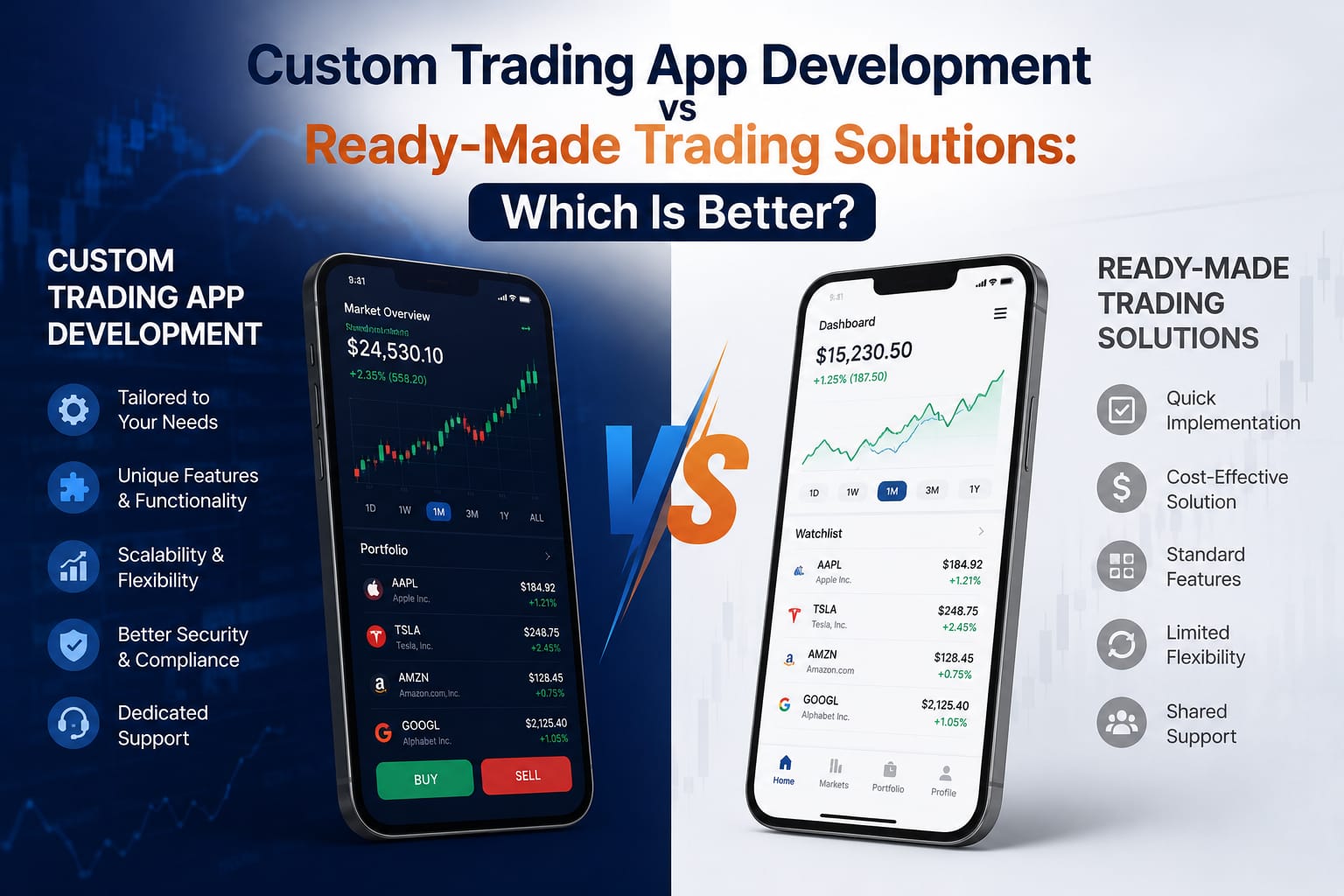
The trading industry has evolved rapidly, with digital-first investors expecting speed, reliability, and real-time decision-making tools.
Whether it is stocks, commodities, or crypto, users now demand platforms that feel seamless, intelligent, and secure.
As a result, businesses entering this space face a critical decision early on: should they invest in a fully tailored product or rely on an existing solution that can be launched quickly?
This choice directly impacts scalability, differentiation, and long-term profitability. Understanding both approaches is essential before committing to a direction that will define the platform’s future.
Understanding Custom vs Ready-Made Trading Solutions
The trading ecosystem today offers multiple ways for businesses to enter the market quickly and efficiently. However, the underlying technology approach plays a major role in determining scalability, flexibility, and long-term success. Broadly, businesses choose between building a fully tailored platform or adopting a pre-built system that can be deployed faster.
What Are Custom Trading Platforms?
Custom trading platforms are engineered from scratch to align with specific business models, trading workflows, and user expectations. Unlike generic systems, they give complete control over architecture, design, and functionality. This makes them ideal for businesses that want to differentiate their offering or operate in highly regulated environments where precision and customization are critical.
These platforms are often developed in collaboration with a specialized team or a custom stock trading app development company, ensuring that every component is optimized for scalability, performance, and compliance. This approach also enables integration of advanced capabilities such as AI-powered insights, algorithmic trading systems, and real-time analytics dashboards.
What Are Ready-Made Trading Solutions?
Ready-made trading solutions are pre-built platforms that come equipped with standard trading functionalities. These typically include order execution systems, portfolio management tools, market data integration, and reporting features. Businesses can quickly subscribe to or license these solutions and launch operations without going through a lengthy development cycle.
This model is particularly useful for early-stage companies or those looking to validate a trading idea in the market. However, while it significantly reduces time-to-market, it also limits deep customization and architectural flexibility. Most modifications are restricted to branding or surface-level configurations.
Core Distinction Between Both Approaches
The real difference lies in strategic intent. Custom platforms prioritize control, ownership, and long-term scalability, while ready-made solutions emphasize speed, convenience, and lower entry barriers. The choice ultimately depends on whether a business values rapid deployment or sustained differentiation in a competitive trading environment.
Key Business Differences That Impact Decision-Making
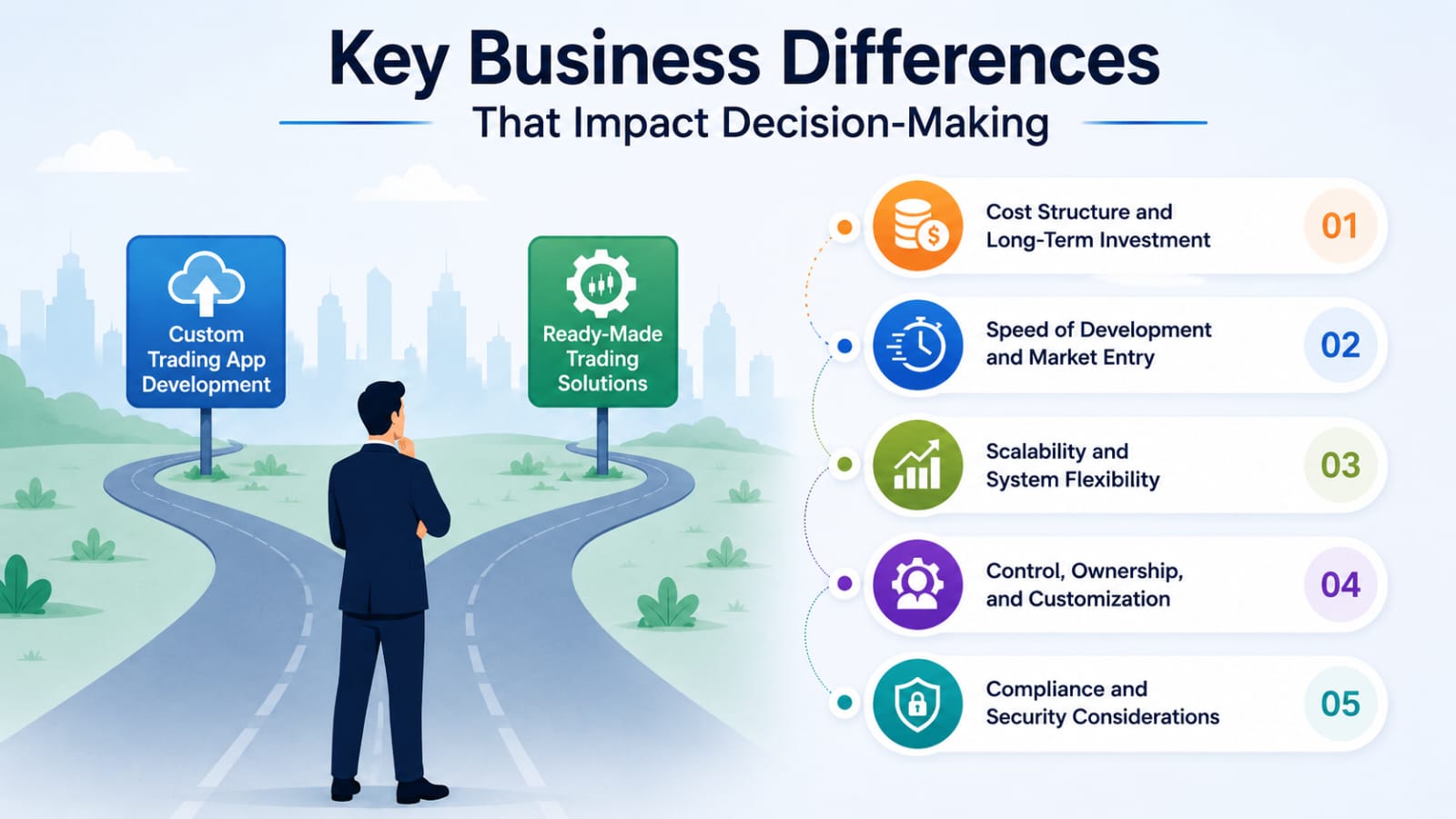
When evaluating trading platform options, businesses are not just choosing between two technologies—they are deciding the foundation of their long-term growth. The differences between custom-built systems and ready-made solutions become most visible when analyzed through core business factors like cost, speed, scalability, control, and compliance.
Cost Structure and Long-Term Investment
Custom trading platforms require higher upfront investment since everything is built from scratch, including system architecture, UI/UX, integrations, and security layers. However, this cost translates into long-term ownership, where businesses avoid recurring licensing fees and gain full control over future upgrades.
Ready-made solutions, on the other hand, follow a subscription or licensing model. This reduces initial financial pressure but introduces ongoing operational costs. Over time, these recurring expenses can accumulate, especially as the user base and transaction volume grow.
Speed of Development and Market Entry
Speed is one of the biggest advantages of ready-made platforms. Businesses can launch within weeks, making it ideal for validating ideas or entering competitive markets quickly. The infrastructure is already built, requiring only configuration and branding adjustments.
Custom solutions take significantly longer to develop due to planning, development cycles, testing, and compliance integration. However, this extended timeline often results in a more stable and purpose-built product aligned with long-term business goals.
Scalability and System Flexibility
Scalability is where custom platforms clearly stand out. They are designed to handle future growth, whether it involves high-frequency trading, advanced analytics, or expanding into multiple markets. The architecture can evolve without major limitations.
Ready-made platforms may struggle when businesses scale beyond predefined system capabilities. Since the core structure is fixed, adding complex features or handling high trading volumes can become challenging.
Control, Ownership, and Customization
Custom platforms offer complete control over features, user experience, and data management. Businesses can introduce unique functionalities, modify workflows, and adapt quickly to market demands.
In contrast, ready-made solutions limit customization to predefined settings. Businesses depend heavily on the provider for updates, feature rollouts, and system changes, which reduces agility in a fast-moving trading environment.
Compliance and Security Considerations
In financial systems, compliance is non-negotiable. Custom platforms allow businesses to design security protocols and compliance frameworks aligned with specific regulatory requirements. Ready-made systems provide standard compliance features, but customization for region-specific regulations may be limited.
Pros and Cons of Each Approach
Choosing between custom and ready-made trading solutions is rarely about finding a universally better option. It is about understanding which model aligns more closely with a business’s stage, budget, product vision, and growth expectations. Both approaches offer clear benefits, but they also come with limitations that can shape the platform’s long-term performance.
Where Custom Trading Platforms Offer More Value
Custom-built platforms are better suited for businesses that want to own the product experience and scale on their own terms. Since the platform is designed around specific business goals, it creates more room for innovation and operational flexibility.
Some of the biggest advantages include:
- Full control over features, workflows, and user experience
- Stronger scope for brand differentiation
- Greater flexibility to add advanced tools like AI insights or algorithmic trading
- Better long-term scalability without depending on vendor limitations
However, custom development also demands more planning and investment. Businesses need to manage longer timelines, higher initial costs, and more technical complexity. That is why understanding how to build a stock trading app becomes important before committing to a custom route.
Where Ready-Made Solutions Make More Sense
Ready-made platforms are often a practical choice for businesses that need to enter the market quickly or validate a trading idea with lower upfront risk. Since the infrastructure is already built, deployment becomes much faster and easier to manage.
Their key strengths usually include:
- Faster time-to-market
- Lower initial development cost
- Reduced maintenance responsibility
- Simpler setup for early-stage operations
The limitation, however, is that speed comes at the cost of flexibility. Businesses may struggle with customization, advanced feature expansion, and long-term scalability once the platform needs to evolve beyond the provider’s built-in structure.
Choosing the Right Model for Startups, SMEs, and Enterprises
The right trading platform model depends less on what is trending in the market and more on where the business stands today and where it plans to go next. A startup trying to validate an idea does not need the same infrastructure as an enterprise building a large-scale investment ecosystem. That is why the decision between custom and ready-made solutions should be tied to business maturity, budget flexibility, and long-term product ambition.
For Startups: Prioritize Speed and Validation
Startups often operate with limited capital and tight timelines, which makes ready-made trading solutions a practical starting point. They allow founders to test market demand, launch quickly, and gather user feedback without taking on a heavy development burden.
A ready-made solution usually works better when the goal is to:
- launch fast with lower initial investment
- validate a niche trading concept
- avoid large technical and compliance overhead in the early stage
For SMEs: Balance Growth with Flexibility
SMEs often sit in the middle. They may have already tested the market and now need a platform that can support growth without creating operational bottlenecks. In many cases, this is where businesses start outgrowing ready-made systems and begin considering custom development.
A custom or semi-custom approach makes more sense when the business needs to:
- add differentiated features for a growing user base
- improve scalability and performance
- gain more control over platform workflows and user experience
For Enterprises: Build for Scale, Security, and Ownership
Enterprises usually require custom trading platforms because their priorities extend beyond launch speed. They need stronger compliance controls, deeper integrations, high-volume performance, and full ownership over infrastructure and data.
For enterprise-level businesses, custom development is often the better fit when the focus is on:
- supporting large transaction volumes and multi-market operations
- meeting strict security and regulatory requirements
- building a long-term competitive advantage through platform innovation
Conclusion
There is no one-size-fits-all answer in the custom vs ready-made trading platform debate because the better choice depends entirely on business goals, growth stage, and long-term product vision.
Ready-made solutions are a strong fit for businesses that need speed, lower upfront investment, and a faster route to market validation. Custom trading app development, on the other hand, is better suited for companies that want full control over user experience, scalability, security, and feature innovation.
The real decision comes down to whether the platform is being built for quick market entry or long-term competitive advantage. Businesses that evaluate this choice through the lens of ownership, flexibility, and future growth are more likely to invest in a solution that continues to deliver value well beyond launch.







Comment