
Cryptography Basics in America: Use Cases, Benefits, Risks, and Long-Term Opportunities
Cryptography basics in America secure banking, healthcare and crypto. See US use cases, the encryption market, and what NIST post-quantum standards change.

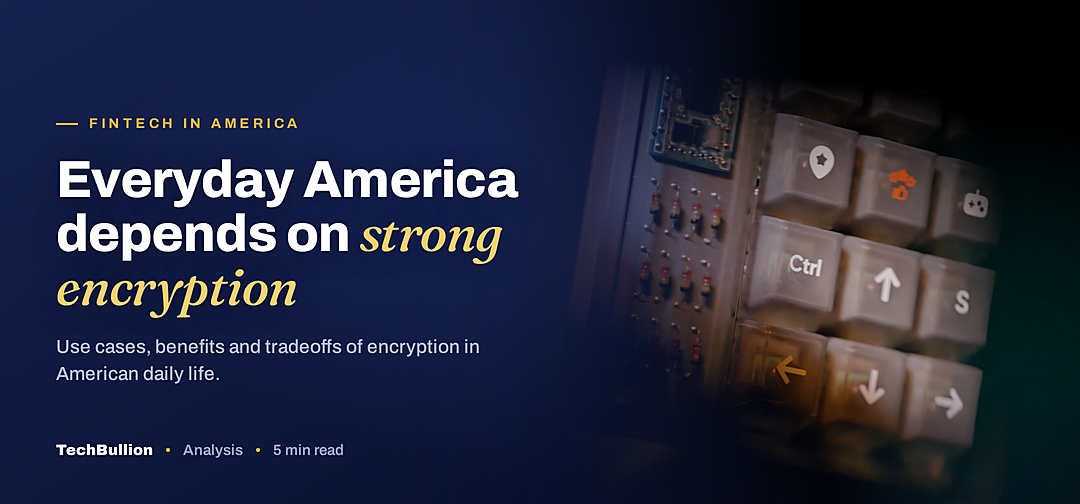
The most important security tool in the American economy is one almost no one can see. It guards bank accounts, hospital records, power grids, and military secrets, all with the same underlying math. Cryptography basics in America have moved from a specialist concern to national infrastructure, and the market reflects it. The encryption software market is worth USD 22.81 billion in 2026 and is projected to reach USD 51.32 billion by 2031, according to Mordor Intelligence. For US consumers and businesses, understanding where this technology is used, and where it is going, is becoming basic literacy.
Cryptography basics in America, from niche to necessity
For most of the twentieth century, strong cryptography was the domain of governments. That changed as commerce moved online and ordinary transactions needed protection. Today encryption is woven through American life. It secures the card you tap, the messages you send, the tax records you file, and the medical data your doctor stores. The shift was driven by necessity. As more value and more sensitive data moved onto networks, the cost of leaving it unprotected became impossible to ignore.
The numbers tell the story of that shift, climbing year after year as encryption spreads into every corner of the economy. Major technology firms now compete to supply it. IBM, Microsoft, Broadcom, Sophos, and Thales are among the largest providers of encryption software, building the tools that banks and businesses use to lock down data. The same care that drives AI-driven defense systems sits alongside encryption in a layered approach to American cybersecurity.
Where it is used across the country
Cryptography shows up wherever data needs to stay private or verifiable. The table below maps the main American use cases.
| US sector | How cryptography is used | Who benefits |
|---|---|---|
| Banking and payments | Encrypts transactions and verifies identity | Consumers and banks |
| Healthcare | Protects patient records under privacy rules | Patients and providers |
| Blockchain and crypto | Secures wallets and signs transactions | Investors and developers |
| Government and defense | Shields classified data and communications | Agencies and the public |
Use cases reflect standard encryption deployments across US sectors.
That cloud shift also raises the stakes for key management, since data spread across many providers must stay under the owner’s control. On-premise systems still held about 62 percent of the encryption software market in 2024, but cloud-based encryption is growing fastest as more American data moves to cloud providers. That migration is reshaping how companies protect information, since data now has to be secured across many locations rather than one server room.
The benefits for US businesses
The dollars behind encryption keep climbing because the cost of getting it wrong keeps climbing too. Encryption is no longer just a defense. It is a requirement and, increasingly, a selling point. Customers expect their data to be protected, and regulators in finance and healthcare require it. A company that encrypts well reduces breach risk, meets compliance demands, and earns trust. Firms building an AI-native framework for financial institutions treat encryption as a foundation, because the analytics on top are only trustworthy if the underlying data is secure. For consumers, the same protection is what makes access to global trading platforms safe enough to use from a phone.
How regulation shapes American cryptography
In the United States, cryptography is guided as much by rules as by technology. Financial regulators expect customer data to be encrypted, healthcare law requires patient records to be protected, and federal agencies set the standards that ripple across the private sector. The National Institute of Standards and Technology plays an outsized role, because the algorithms it approves become the default for government systems and, in turn, for the contractors and banks that work with them. When NIST blesses a method, American industry tends to follow.
This regulatory backbone is a quiet strength. It means encryption in the United States is not a patchwork of one-off choices but a set of shared standards that let different systems work together securely. It also means upgrades happen in a coordinated way. The move toward post-quantum standards is being planned across government and industry at once, so the transition is orderly rather than chaotic. For businesses, the practical lesson is to align with recognized standards rather than build something custom that no one else has tested.
Risks and the quantum challenge
The biggest long-term risk is a shift in the math itself. Powerful quantum computers, if they arrive, could break some of the encryption that secures the internet today. The United States is not waiting. In August 2024 the National Institute of Standards and Technology finalized its first three post-quantum cryptography standards, giving American organizations a roadmap to upgrade. The near-term risks are more familiar: poorly managed keys, outdated algorithms, and users tricked into bypassing protections. Encryption is powerful, but it is one layer in a defense that still depends on good habits and careful design.
The long-term opportunity for America
Privacy-preserving cryptography is one frontier worth watching. New techniques let a company analyze data, or even compute on it, without ever seeing the raw values, which could let banks share fraud signals or hospitals pool research without exposing private records. These methods are still maturing, but they point to a future where strong privacy and useful data are no longer in conflict.
The country that leads on cryptography sets the standards others follow, and that carries economic and security weight. American firms and agencies are investing in post-quantum readiness, privacy-preserving techniques that let data be used without being exposed, and tools that make strong encryption easier to deploy. As more of the economy runs on data, the ability to protect that data without slowing it down becomes a competitive advantage, not just a safeguard.
For everyday Americans, none of this requires becoming an expert. Choosing services that encrypt data, enabling extra verification on important accounts, and keeping devices updated captures most of the benefit. The heavy lifting belongs to the institutions, but the habits belong to everyone.
Cryptography will keep working in the background, asking nothing of the people it protects. The task for American businesses and policymakers is to keep it strong, keep it current, and treat it as the quiet foundation it has become.




Comment