The economics of content marketing changed fundamentally when generative AI moved from experimental technology to production tool between 2022 and 2024. Before that transition, the dominant constraint on content marketing programmes was human creative capacity: the number of writers, designers, videographers, and editors a marketing team could employ determined the volume of content it could produce. This constraint created a natural ceiling on content programmes, limiting most businesses to a cadence of content production that could be maintained by a team of manageable size without sacrificing quality to the point of diminishing returns.
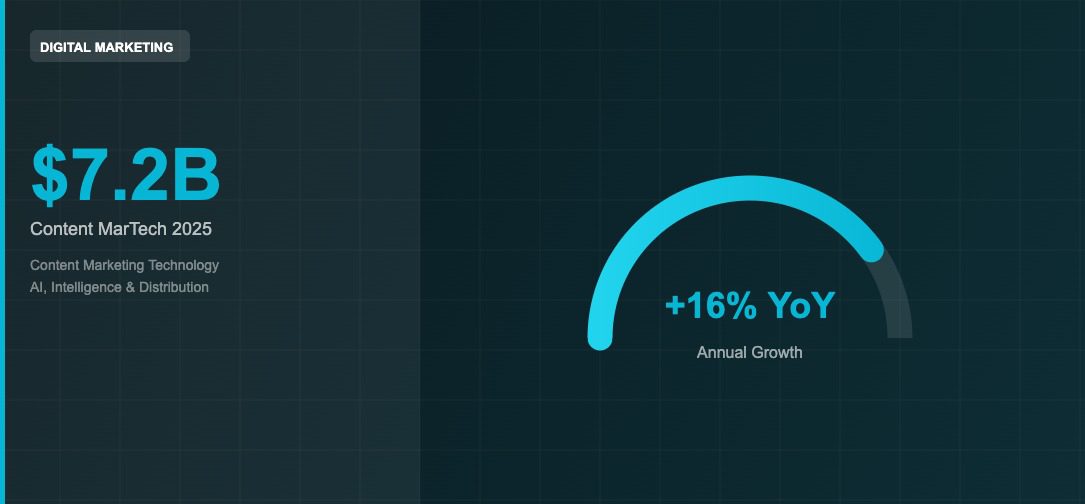
Generative AI removed that ceiling without eliminating the quality constraint. The technology does not automatically produce high-quality content, but it dramatically reduces the time and cost required to produce a first draft, to adapt existing content for new formats and audiences, to scale content across multiple markets and languages, and to maintain a publishing cadence that would previously have required a team several times larger. The result is a content marketing technology market growing at 16 per cent annually to reach approximately $7.2 billion in 2025, driven by the rapid adoption of AI writing tools, content intelligence platforms, and distribution technology that together constitute the modern content marketing stack.
The Structure of the Content Marketing Technology Market
Content marketing technology encompasses a broader set of tools than the generative AI writing assistants that have attracted the most attention. The market includes content intelligence platforms that identify topic opportunities and content gaps, AI writing and editing tools, content management and distribution systems, content performance analytics, and the emerging category of AI-powered video and visual content generation.
| Technology Category | 2025 Market Size (est.) | YoY Growth | Leading Platforms |
|---|---|---|---|
| AI Writing and Editing Tools | ~$2.4 billion | +45% | Jasper, Writer, Copy.ai, Notion AI |
| Content Intelligence / SEO | ~$1.8 billion | +22% | Semrush, Ahrefs, Clearscope, Frase |
| Content Management and CMS | ~$1.5 billion | +8% | WordPress, Contentful, Sanity, Webflow |
| Content Distribution and Amplification | ~$0.9 billion | +12% | Outbrain, Taboola, Sharethrough |
| Content Analytics and Performance | ~$0.6 billion | +18% | Parse.ly, Chartbeat, HubSpot |
The fastest-growing segment is AI writing and editing tools, which grew at 45 per cent in 2025 as the technology moved from early adopter to mainstream usage across marketing organisations of all sizes. The adoption curve has been steeper than most technology transitions because the value proposition is immediately tangible: a marketer who uses an AI writing tool for the first time can observe the productivity gain within the first session, creating a compelling case for continued use without requiring the lengthy proof-of-concept cycles that typically precede technology adoption decisions.
AI Content Generation: What It Changes and What It Does Not
Understanding the commercial impact of AI content generation requires distinguishing between what the technology genuinely changes and what it does not. The technology changes the marginal cost of producing content significantly downward, reduces the time required to move from a content brief to a publishable draft, and enables content personalisation at scales that would be prohibitively expensive through purely human production. It does not replace the need for subject matter expertise, editorial judgement, or strategic content planning, and the content programmes that treat it as a substitute for these things consistently underperform those that treat it as a production accelerator within a strategically sound framework.
The most effective implementations follow a model that content marketing practitioners describe as AI-assisted human creation: the AI generates an initial draft or outline based on a detailed brief that includes audience context, tone requirements, factual grounding, and structural guidance, and a human editor then refines, verifies, and elevates that draft to a standard appropriate for publication. This model reduces the time required to produce a publishable article from several hours of writing time to 30 to 60 minutes of editing time, representing a three to five times increase in content production capacity for a given team size.
The factual accuracy challenge remains the primary operational constraint on AI content generation. Large language models can produce fluent, well-structured content that contains factual errors, and the errors that AI systems make are often plausible enough that a reader without deep domain expertise would not immediately identify them. Marketing content that contains factual errors damages brand credibility in ways that are difficult to recover from, creating a strong commercial incentive for editorial review processes that maintain human oversight of AI-generated output.
Content Intelligence: The Data Layer Beneath the Creative
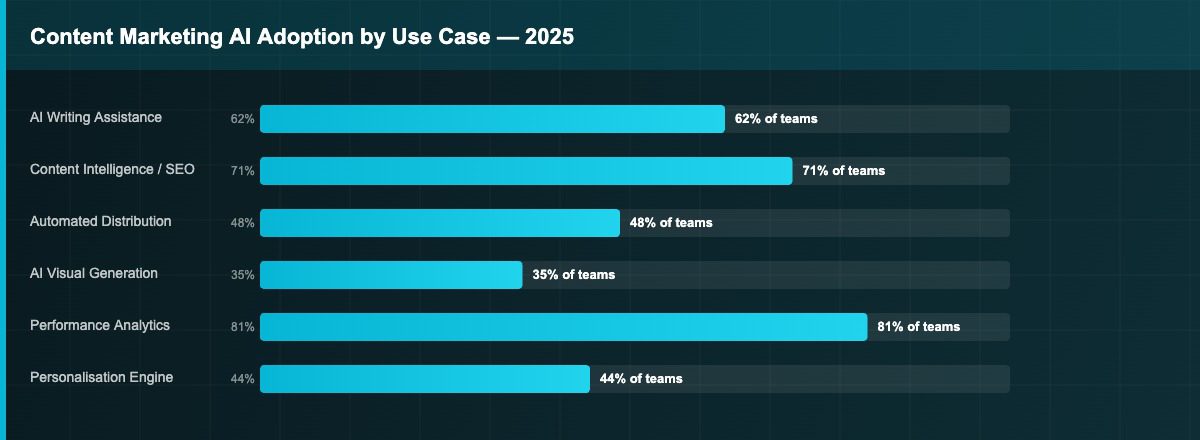
The content intelligence layer of the content marketing technology stack addresses a different problem from AI writing tools: not how to produce content more efficiently, but what content to produce in the first place. Content intelligence platforms analyse search demand, competitive content landscapes, and audience behaviour data to identify the topics, formats, and angles most likely to generate traffic, engagement, and conversion for a given brand and audience.
Platforms including Semrush, Ahrefs, Clearscope, and Frase ingest data from search engine indices, social platforms, and competitor content performance to produce content recommendations that are grounded in demonstrated audience demand rather than editorial intuition. A content team that would previously decide what articles to write based on a combination of topic brainstorming and basic keyword research can now access data that tells them which topics have significant search volume with limited high-quality existing content, which questions their target audience is asking that competitors have not addressed, and which content formats the algorithm favours for a given search intent.
The combination of content intelligence for strategic direction and AI writing tools for production efficiency represents the most commercially significant development in content marketing practice over the past three years. Together, they allow a content team to produce the right content at significantly higher volume than was previously possible, creating a compounding advantage as the content library grows and generates organic search traffic at increasing scale.
Distribution Technology and the Amplification Layer
Producing content efficiently is only commercially valuable if that content reaches the intended audience. The distribution layer of content marketing technology has evolved substantially in parallel with the production layer, with platforms that automate the amplification of content across paid and owned channels becoming an increasingly important component of the overall content marketing investment.
Content distribution platforms including Outbrain and Taboola operate native advertising networks that place content recommendations across publisher sites, reaching audiences beyond a brand’s owned channels at relatively low cost per click. Social media management platforms including Hootsuite, Sprout Social, and Buffer provide scheduling, optimisation, and performance analytics for content distributed through social channels. Email marketing platforms serve as distribution mechanisms for long-form content, driving traffic from engaged subscribers to the content marketing properties where conversion events occur.
| AI Content Maturity Level | Description | Adoption (2025) | Output Quality |
|---|---|---|---|
| Level 1: AI-Assisted Drafting | AI produces draft; human edits substantially | ~62% of content teams | High with editorial oversight |
| Level 2: AI-First with Light Edit | AI produces 80%+ of final copy; human refines | ~28% of content teams | Medium – quality varies |
| Level 3: Fully Automated | AI generates and publishes with minimal oversight | ~10% of content programmes | Variable – higher risk |
The measurement of content marketing ROI remains a persistent challenge that technology has partially addressed but not resolved. Unlike paid digital advertising, where the conversion path from impression to purchase can often be tracked directly, content marketing generates value through a combination of organic search traffic, brand awareness, and audience education that contributes to conversion events that may occur weeks or months after the initial content interaction. Attribution models that credit content marketing appropriately remain imperfect, but platforms that integrate content performance data with CRM and e-commerce transaction data are making the link between content investment and commercial outcome increasingly visible and defensible.
The $7.2 billion content marketing technology market is positioned for continued growth as AI production tools mature, as content intelligence platforms develop deeper integration with paid distribution channels, and as the measurement gap between content investment and commercial outcome continues to narrow. As explored in TechBullion’s analysis of the structural drivers of digital advertising growth, owned content channels and paid digital work most effectively when they operate as integrated components of a unified marketing approach rather than separate strategies competing for budget.
Related reading: The Shift to Digital | Performance Advertising in the US | AdTech Investment Outlook | US Digital Ad Forecast 2026
Research from McKinsey’s 2024 analysis indicates that organisations deploying AI at scale report efficiency improvements of 15 to 25 percent within the first 18 months of production implementation.
According to Mordor Intelligence, the AI in fintech market is projected to grow at a compound annual growth rate exceeding 20 percent through 2029, driven by demand for automated fraud detection, credit scoring, and customer service applications.