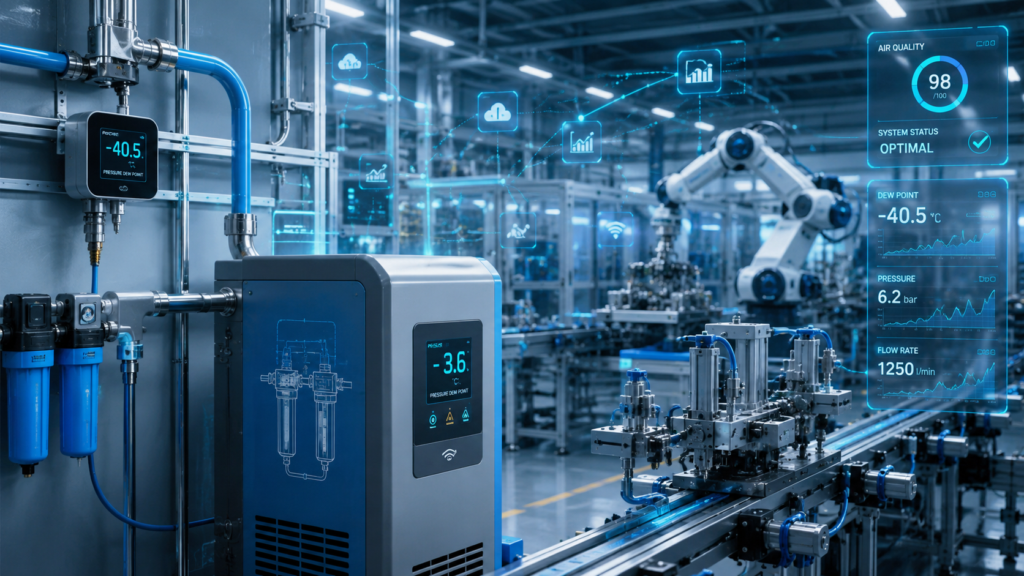
Compressed air quality matters in smart factory automation because pneumatic valves, cylinders, sensors, robotic tooling, and process instruments cannot operate reliably when their air supply contains excess moisture, oil, or solid particles.
Smart factories depend on connected equipment performing repeatable movements within controlled cycle times. A contaminated compressed air supply can make a valve respond slowly, cause an actuator to stick, interfere with an instrument reading, or corrode internal components.
For this reason, selecting suitable industrial compressed air drying equipment is not simply an accessory decision. The dryer, filters, drains, separators, sensors, and distribution piping form a complete air treatment system that must support the purity requirements of the automation process.
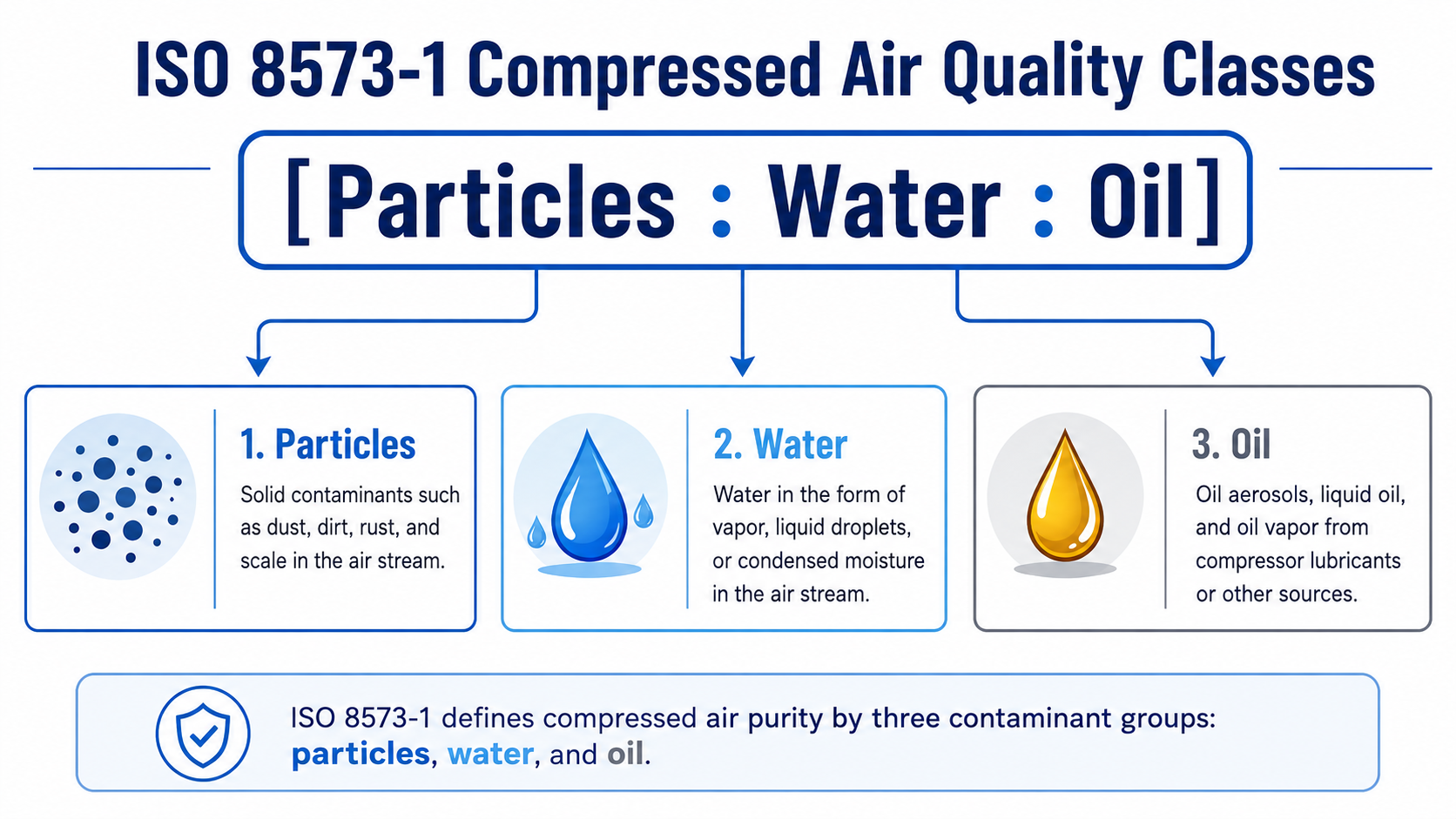
Compressed air quality is normally evaluated through three primary contaminant groups: solid particles, water, and oil. ISO 8573-1 provides a standardized method for specifying acceptable levels of each contaminant.[1]
How Compressed Air Quality Affects Smart Factory Automation
Smart factory automation combines physical equipment with programmable logic controllers, industrial sensors, robotics, supervisory control systems, and Industrial Internet of Things platforms.
Compressed air often supplies the mechanical force behind that digital control architecture. It operates pneumatic cylinders, solenoid valves, grippers, vacuum generators, positioning devices, air bearings, blow-off nozzles, and automated packaging equipment.
When the air supply is contaminated, the digital command may be correct while the physical response is not.
For example, a programmable logic controller may command a pneumatic cylinder to extend. If moisture has caused corrosion inside the cylinder or contamination has restricted a valve orifice, the cylinder may move too slowly to meet the programmed cycle time.
The control system may then register a position fault, stop the production sequence, or reject the part. The apparent automation fault begins as a compressed air quality problem.
The main compressed air contaminants
Industrial compressed air can contain:
- Liquid water and water vapor
- Solid particles such as dust, rust, pipe scale, and compressor wear debris
- Oil aerosols and oil vapor
- Microorganisms in hygiene-sensitive applications
- Contaminants entering through poorly maintained distribution piping
Each contaminant affects automation differently.
Water promotes corrosion and can wash lubricant from pneumatic components. Solid particles abrade seals, cylinder walls, and valve surfaces. Oil can form deposits, degrade certain materials, and interfere with sensitive processes.
These effects accumulate over time. A component may continue operating while its response speed, repeatability, and efficiency gradually deteriorate.
Compressed Air Quality Is Different From Workplace Air Quality
Compressed air quality and ambient industrial air quality are related facility concerns, but they are not the same subject.
Ambient air quality concerns the air employees breathe and the contaminants present in the surrounding factory environment. It may involve dust, fumes, volatile organic compounds, combustion gases, oil mist, ventilation, and occupational exposure.
TechBullion’s guide to industrial air quality monitoring systems explains how environmental monitoring helps facilities identify pollutants and manage worker exposure.
Compressed air quality concerns the purity of pressurized air flowing through compressors, receivers, dryers, filters, piping, valves, and production equipment.
The monitoring methods are also different. Workplace systems may measure particulate matter, gases, temperature, and ambient humidity. Compressed air systems commonly measure pressure dew point, particle concentration, oil concentration, pressure, flow, temperature, and differential pressure.
A smart factory may monitor both systems through connected dashboards, but the sensors, standards, treatment equipment, and acceptable limits remain application-specific.
Why Moisture Is a Major Compressed Air Quality Risk
Atmospheric air always contains water vapor. When a compressor draws in and compresses that air, the concentration of water per unit volume increases.
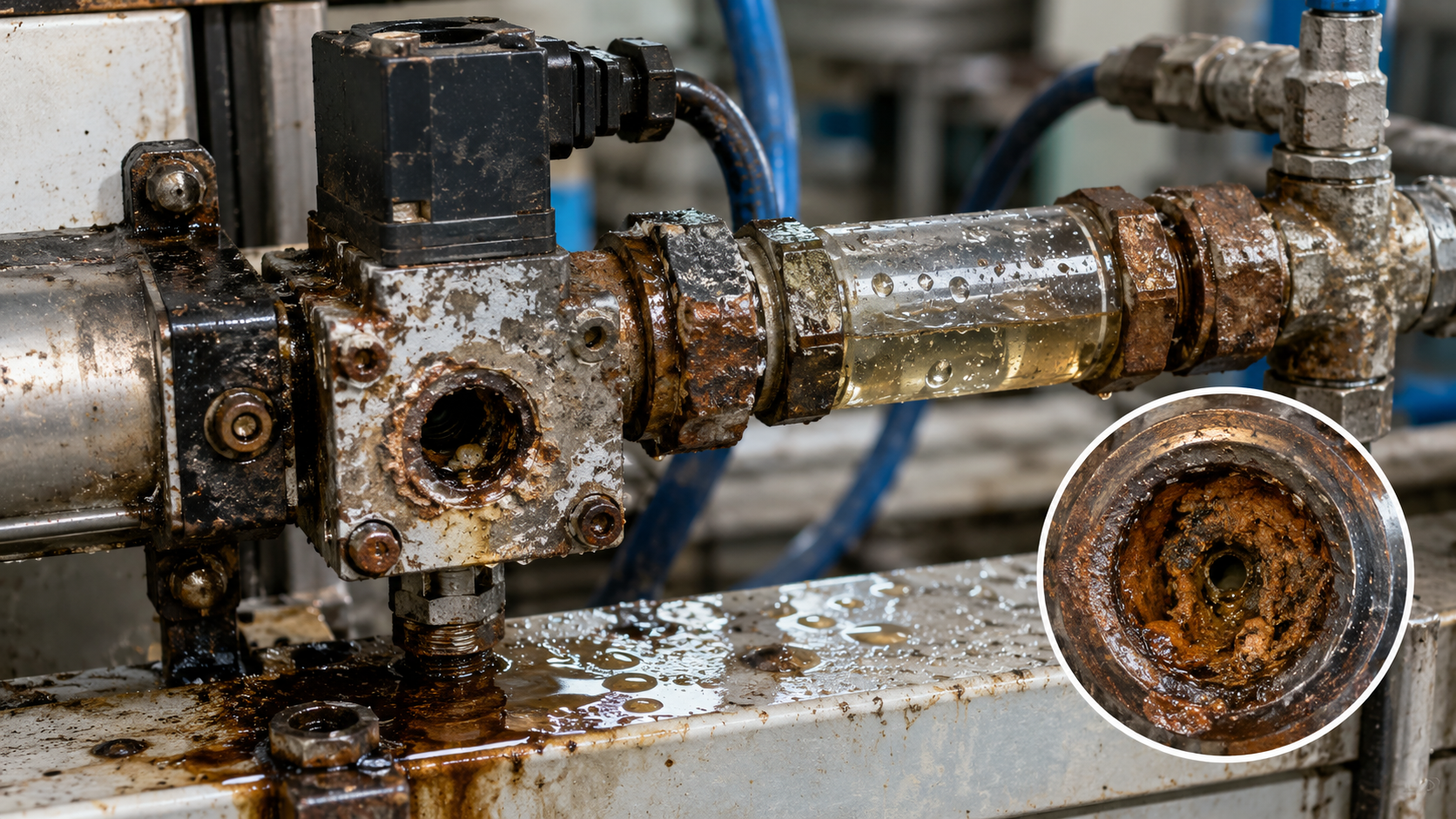
The compressed air then passes through an aftercooler, where its temperature drops. Cooling reduces the air’s ability to retain water vapor, allowing part of the moisture to condense into liquid water.
Moisture separators and automatic drains remove bulk liquid, but they do not necessarily remove enough water vapor to protect every downstream application. An air dryer is required when the process needs a pressure dew point below the temperature that the compressed air will encounter.
What is pressure dew point?
Pressure dew point is the temperature at which water vapor begins to condense at the compressed air system’s operating pressure.
A lower pressure dew point means the compressed air contains less water vapor.
The required pressure dew point depends on the application, system location, ambient conditions, and lowest expected piping temperature. Air that remains dry inside a warm production building may condense when the same pipe passes through an unheated warehouse or outdoor area.
How moisture damages pneumatic automation
Excess moisture can contribute to:
- Corrosion inside cylinders, valves, receivers, and piping
- Rust and pipe scale that restrict airflow
- Lubricant washout from moving pneumatic components
- Swelling or deterioration of compatible seal materials
- Frozen valves and lines in low-temperature environments
- Malfunctioning instruments and control-air devices
- Increased differential pressure across contaminated filters
- Product defects where compressed air contacts a surface or material
Moisture-related damage is not always immediate. Internal corrosion can develop gradually until scale breaks away and travels downstream, where it blocks an orifice or damages a valve seat.
How Compressed Air Quality Influences Instrument Reliability
Automated manufacturing depends on instruments producing repeatable outputs. Pressure regulators, positioners, control valves, transmitters, pneumatic logic devices, and precision actuators must respond within defined operating tolerances.
Contaminated air changes the conditions inside those components.
A thin mixture of water, oil, and particles can form deposits around valve spools, diaphragms, nozzles, and small passageways. The resulting friction can delay movement or prevent a valve from returning to its correct position.
Particles can also damage sealing surfaces. Once a seal no longer closes correctly, internal leakage increases and the actuator may require more airflow to perform the same movement.
In high-speed packaging, assembly, sorting, and material-handling systems, a small delay can interrupt synchronization between multiple stations. The control system may identify the delay as an actuator, sensor, or timing fault even when the original cause is air contamination.
Clean, dry air reduces this source of mechanical variation. It also supports more predictable maintenance intervals because valves, cylinders, seals, and instruments are operating under the conditions specified by their manufacturers.
How ISO 8573-1 Defines Compressed Air Quality
ISO 8573-1:2010 defines compressed air purity classes for particles, water, and oil. The standard allows engineers, equipment suppliers, and plant operators to specify air quality using a common technical format.[1]
The classes are written in this order:
ISO 8573-1 [Particles : Water : Oil]
For example, a requirement written as [1:2:1] means:
- Particle Class 1
- Water Class 2
- Oil Class 1
The three numbers must be evaluated separately. A system may meet a strict particle class while failing its required water or oil class.
Particle classes
Particle classes define limits for particle size and concentration per cubic meter of compressed air.
For Particle Class 1, the commonly referenced limits include:
- No more than 20,000 particles between 0.1 and 0.5 micrometers
- No more than 400 particles between 0.5 and 1.0 micrometers
- No more than 10 particles between 1.0 and 5.0 micrometers
Meeting a particle class normally requires properly selected particulate and coalescing filters. The filter elements must also be maintained because contamination increases pressure drop and can reduce filtration performance.
Water classes
Water classes are commonly defined through pressure dew points.
For example, Water Class 2 corresponds to a pressure dew point of no more than -40°C. Water Class 4 corresponds to a pressure dew point of no more than +3°C.
These classes serve different applications. A general indoor pneumatic system may not need the same dew point as an outdoor line, semiconductor process, laboratory instrument, or moisture-sensitive production operation.
Oil classes
Oil classes address the total concentration of liquid oil, oil aerosol, and oil vapor.
Oil Class 1 permits a maximum total oil concentration of 0.01 mg/m³. Achieving that result may require a combination of suitable compressor technology, coalescing filtration, activated carbon treatment, and verified maintenance.
An oil-free compressor does not automatically satisfy the required particle or water class. The complete treatment and distribution system must be evaluated.
Class 0 does not mean zero contamination
Class 0 represents a requirement that is more stringent than Class 1 and must be defined by the equipment user or supplier.
It should not be interpreted as a universal promise of absolute zero particles, zero moisture, or zero oil. The specified limit and the measurement method must be documented.
How Air Dryers Improve Compressed Air Quality
Air dryers improve compressed air quality by reducing water vapor and lowering the pressure dew point.
The correct dryer type depends on the required dew point, airflow, inlet temperature, operating pressure, ambient conditions, available utilities, and acceptable energy consumption.
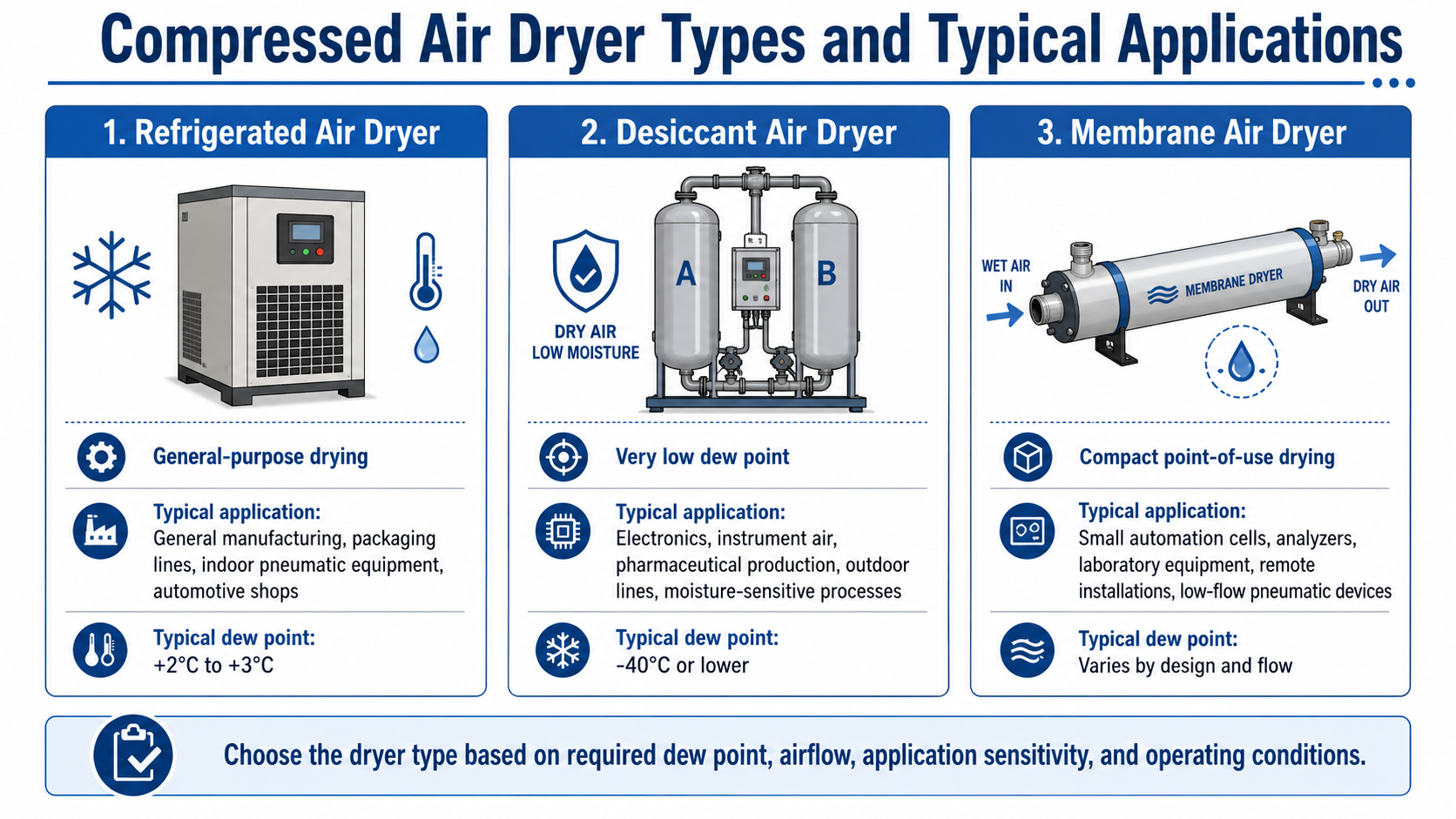
Refrigerated air dryers
A refrigerated dryer cools compressed air so that water vapor condenses into liquid. A separator and drain then remove the condensate before the air is reheated and returned to the distribution system.
The U.S. Department of Energy identifies refrigerated dryers as a common treatment method and notes that they typically provide a pressure dew point of approximately 35°F to 38°F, or about 2°C to 3°C.[2]
Refrigerated dryers are commonly used for:
- General factory automation
- Indoor pneumatic tools
- Packaging equipment
- Metal fabrication
- Automotive manufacturing
- Production environments without subfreezing piping
They are not normally selected when the application requires extremely low dew points.
Desiccant air dryers
Desiccant dryers pass compressed air through an adsorbent material that captures water vapor.
Depending on the design and operating conditions, desiccant systems can achieve much lower pressure dew points than refrigerated dryers. The Department of Energy notes that some desiccant dryers can provide pressure dew points as low as -100°F, or approximately -73°C.[2]
Desiccant dryers are often considered for:
- Outdoor compressed air lines in cold climates
- Electronics and semiconductor processes
- Instrument air
- Pharmaceutical operations
- Moisture-sensitive manufacturing
- Applications requiring Water Class 1, 2, or 3
Heatless, heated, blower-purge, and heat-of-compression designs use different regeneration methods. Their purge demand, energy consumption, pressure drop, and maintenance requirements must be included in the selection process.
Membrane air dryers
A membrane dryer uses hollow fibers that allow water vapor to pass through the membrane wall while the dried compressed air continues toward the application.
Membrane dryers have no moving parts and may operate without electricity. These characteristics make them useful for compact equipment, remote installations, hazardous areas, and point-of-use drying.
However, membrane dryers consume a portion of the compressed air as sweep or purge flow. They also require clean inlet air and maintained upstream filtration. Parker documentation, for example, specifies periodic prefilter cartridge replacement for its membrane dryer systems.[5]
Dryers do not replace filtration
A dryer controls water vapor, but it does not independently remove every contaminant.
A complete treatment train may include:
- An aftercooler
- A moisture separator
- An automatic condensate drain
- A particulate prefilter
- A coalescing filter
- An air dryer
- A final particulate filter
- An activated carbon filter where oil vapor control is required
The sequence depends on the dryer type and the required ISO 8573-1 class.
How Smart Factories Monitor Compressed Air Quality in Real Time
Smart factories use connected sensors to turn compressed air quality from a periodic inspection task into a continuously monitored operating condition.
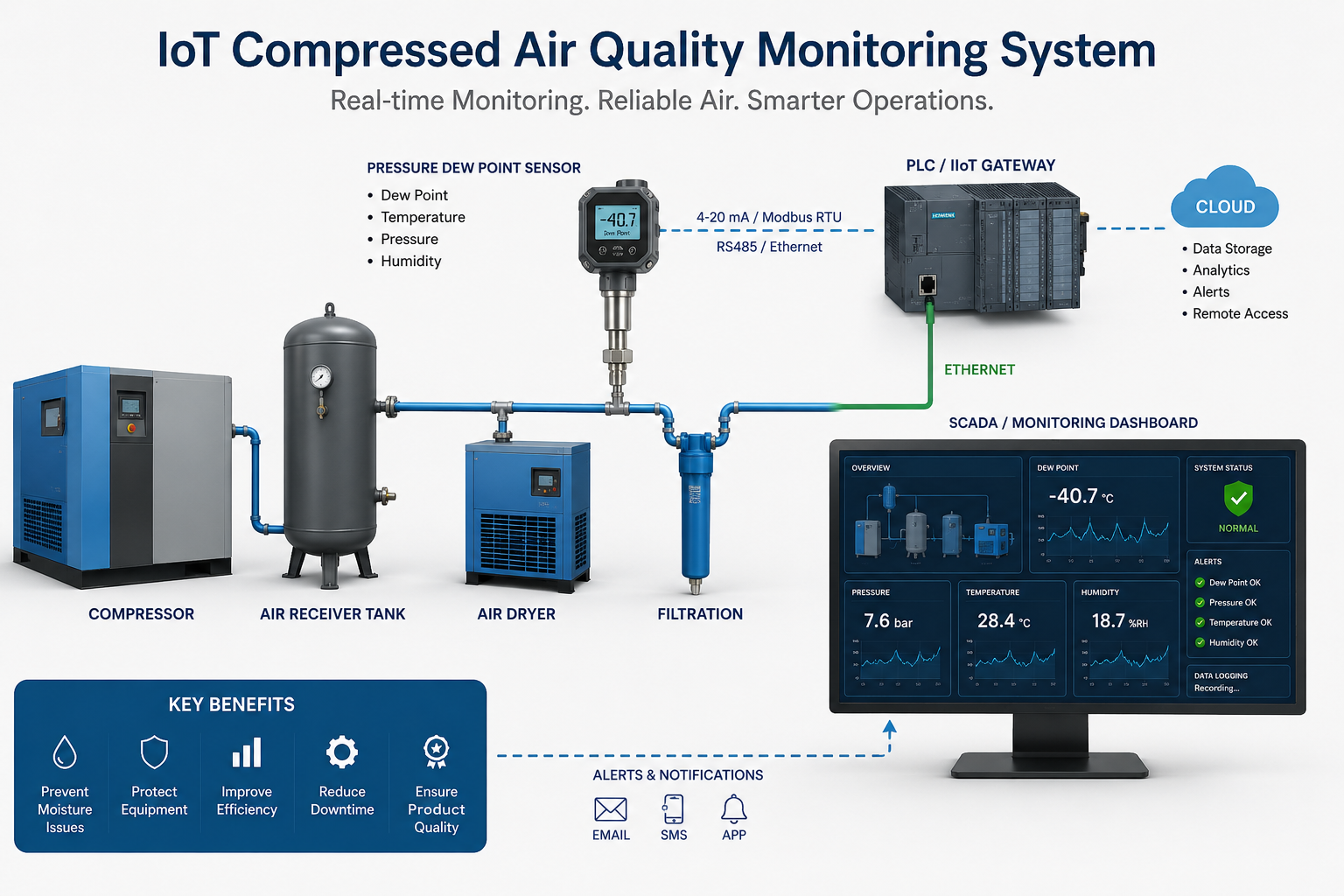
Modern monitoring systems can collect data from:
- Pressure dew point sensors
- Pressure transducers
- Flow meters
- Temperature sensors
- Differential pressure indicators
- Particle counters
- Oil aerosol and oil vapor measurement devices
- Automatic drain alarms
- Dryer controllers
- Compressor control systems
That information can be sent to a programmable logic controller, SCADA platform, industrial data historian, manufacturing execution system, or computerized maintenance management system.
This creates a measurable relationship between compressed air conditions and production events.
For example, a plant can compare rising pressure dew point with dryer alarms, production loads, ambient temperature, and product defects. Maintenance teams can investigate the trend before liquid water reaches sensitive equipment.
Pressure dew point monitoring
A pressure dew point sensor verifies whether the dryer is maintaining the required moisture level.
Emerson introduced the AVENTICS DS1 as a device that monitors pressure dew point, temperature, humidity, and compressed air quality values in real time. Its purpose is to help operators identify excess moisture before condensate causes equipment problems.[4]
A dew point alarm should be based on the process requirement rather than the dryer’s nominal rating alone. Sensor location also matters because dew point can differ between the dryer outlet, main distribution header, and point of use.
Differential pressure monitoring
Filters create resistance to airflow. As contamination accumulates, differential pressure across the element usually increases.
Monitoring that pressure difference helps maintenance teams replace elements based on condition instead of waiting for severe restriction or following an interval that may not match actual operating conditions.
A fouled filter can reduce downstream pressure. The compressor may then be operated at a higher discharge pressure to compensate, increasing energy consumption without correcting the original restriction.
Flow and pressure monitoring
Air quality monitoring is more useful when combined with airflow and system pressure data.
The U.S. Department of Energy reports that compressed air leaks can waste 20% to 30% of compressor output in poorly maintained systems.[3] Flow and pressure monitoring can reveal abnormal demand, pressure instability, inappropriate use, and equipment that continues consuming air outside production hours.
These measurements do not replace contaminant testing, but they provide important operating context.
TechBullion’s overview of real-time sensors and industrial air quality control describes the wider use of IoT connectivity, centralized dashboards, predictive maintenance, and condition-based control in industrial environments.
Similar data architecture can support compressed air utilities, provided the sensors are selected for pressurized air rather than ambient workplace monitoring.
The Operational Cost of Poor Compressed Air Quality
Poor compressed air quality increases costs through equipment damage, process instability, maintenance labor, pressure loss, product defects, and unplanned production stops.
The exact financial impact depends on the facility, production rate, downstream process, and time required to diagnose the fault.
Premature component failure
Water, oil, and particles increase wear inside pneumatic cylinders, valve manifolds, solenoids, regulators, and instruments.
Replacing one valve may appear inexpensive, but repeated failures across a large automation line increase labor requirements, spare-parts inventory, and maintenance interruptions.
Production miscycles
A contaminated valve may operate normally during one cycle and respond slowly during the next.
That inconsistency can cause:
- Misaligned parts
- Incomplete clamping
- Incorrect filling
- Packaging defects
- Failed pick-and-place movements
- Sensor timing errors
- Rejected assemblies
The resulting cost may include both the rejected product and the production time required to reset the line.
Product contamination
Compressed air can contact products directly or indirectly during cooling, drying, cleaning, conveying, mixing, packaging, or container preparation.
Where contact occurs, particles, oil, moisture, and microorganisms may affect product quality. The required air purity must therefore be defined through a documented risk assessment and verified at the point where the air contacts the process.
Higher pressure and energy demand
Contaminated filters, restricted dryers, undersized piping, and poorly selected treatment equipment create pressure drop.
Raising compressor discharge pressure to overcome that pressure drop treats the symptom rather than the cause. The better response is to identify the restriction, verify the actual point-of-use pressure requirement, and maintain treatment equipment correctly.
How to Choose a Compressed Air Quality Solution
The correct air quality solution begins with the end-use requirement, not with a preferred dryer technology.
1. Define the required ISO 8573-1 class
Specify separate classes for particles, water, and oil.
Do not select a purity class solely because another company in the same industry uses it. Product contact, equipment sensitivity, ambient conditions, manufacturer requirements, and quality regulations may differ.
2. Calculate maximum airflow
Size the dryer and filters for the maximum expected airflow, not only the compressor’s average output.
Account for:
- Compressor capacity in CFM or SCFM
- Peak production demand
- Future expansion
- Inlet air temperature
- Ambient temperature
- Operating pressure
- Dryer correction factors
An undersized dryer may produce an acceptable dew point under light load but lose performance when airflow or inlet temperature rises.
3. Determine the required pressure dew point
Compare the required pressure dew point with the lowest temperature the compressed air piping and equipment will experience.
For example, a refrigerated dryer producing a pressure dew point near +3°C may protect equipment inside a heated factory. It may not prevent condensation in piping exposed to temperatures below freezing.
4. Match the dryer type to the application
Use a refrigerated dryer where a moderate pressure dew point is sufficient.
Consider a desiccant dryer where the process requires very dry air or the piping will experience low temperatures.
Consider a membrane dryer for compact point-of-use applications, low-flow equipment, remote areas, or installations where electricity is undesirable.
5. Verify connection and utility requirements
Check:
- Inlet and outlet connection size
- NPT or alternative thread standard
- Supply voltage and phase
- Maximum operating pressure
- Maximum inlet temperature
- Ambient temperature range
- Condensate drain requirements
- Required ventilation or cooling water
- Purge-air consumption
- Communication and alarm outputs
A technically suitable dryer may still be incompatible with the facility’s electrical supply, piping, environmental conditions, or control system.
6. Evaluate pressure drop and operating cost
Dryer selection should include more than purchase price.
Evaluate:
- Pressure drop
- Electrical demand
- Purge-air loss
- Filter replacement
- Desiccant replacement
- Condensate management
- Cooling requirements
- Preventive maintenance
- Expected load profile
The Department of Energy advises against producing air at a higher quality than the application requires because additional drying and filtration increase capital, maintenance, and energy costs.[2]
7. Plan verification and maintenance
Define how the required air quality will be verified after installation.
The plan may include:
- Continuous pressure dew point monitoring
- Periodic ISO 8573 testing
- Filter differential pressure checks
- Drain inspections
- Dryer alarm review
- Calibration schedules
- Trend analysis
- Maintenance records
A dryer’s rated performance does not eliminate the need for measurement.
Common Compressed Air Quality Mistakes
Several design and maintenance errors repeatedly affect automated systems.
Treating the entire plant to the strictest purity level
Some applications need significantly cleaner air than others.
Where practical, point-of-use treatment can supply a sensitive process without forcing the entire factory to bear the pressure drop, energy consumption, and maintenance cost of the strictest requirement.
Selecting a dryer by pipe size alone
Connection size does not determine drying capacity.
Two dryers with the same connection may have different airflow ratings, inlet temperature limits, pressure drops, and dew point performance.
Ignoring peak inlet temperature
Dryer performance can decline when inlet air is hotter than the rated condition.
The actual design should consider aftercooler performance, compressor room temperature, seasonal conditions, and maximum production demand.
Failing to maintain drains and filters
A failed drain can allow liquid condensate to enter downstream piping. A saturated or damaged filter element can increase pressure drop or reduce contaminant removal.
Both failures can undermine an otherwise correctly sized dryer.
Assuming oil-free compression solves every purity issue
Oil-free compressor technology can reduce one contamination source, but it does not remove atmospheric particles, water vapor, pipe corrosion, or contamination already present in the distribution system.
Particles, water, and oil must still be assessed separately.
Frequently Asked Questions
What is compressed air quality in industrial automation?
Compressed air quality describes the concentration of particles, water, and oil in a pressurized air supply. These contaminants affect pneumatic valves, cylinders, instruments, and product-contact applications. ISO 8573-1 provides purity classes that allow engineers to define and verify the required air condition.
What ISO 8573-1 class does a smart factory need?
There is no single ISO class for every smart factory. The correct class depends on equipment sensitivity, product contact, environmental temperature, process risk, and manufacturer requirements. Each application should specify separate particle, water, and oil classes after a technical risk assessment.
Which air dryer is best for factory automation?
Refrigerated dryers suit many indoor general-purpose automation systems. Desiccant dryers are used when very low pressure dew points or cold-environment protection is required. Membrane dryers suit compact point-of-use and low-flow applications. Selection must account for airflow, pressure, inlet temperature, dew point, and operating cost.
How should an air dryer be sized for an automation line?
Size the dryer using maximum airflow, minimum operating pressure, maximum inlet temperature, maximum ambient temperature, and the required pressure dew point. Apply the manufacturer’s correction factors. Also verify connection size, voltage, pressure drop, purge demand, maintenance access, and future capacity requirements.
Can IoT sensors confirm compressed air dryer performance?
Yes. A pressure dew point sensor can continuously track moisture performance and send readings or alarms to a PLC, SCADA system, or maintenance platform. Flow, pressure, temperature, differential pressure, and dryer status data provide additional context for diagnosing performance changes and planning maintenance.
Conclusion
Compressed air quality is a core operating condition in smart factory automation because digital controls still depend on physical valves, cylinders, instruments, and air-operated equipment.
Moisture, particles, and oil can cause corrosion, restriction, seal damage, delayed movement, instrument errors, product defects, and unplanned maintenance.
ISO 8573-1 provides a consistent method for defining the required purity. Dryers, filters, separators, drains, sensors, and distribution piping must then be selected as one coordinated treatment system.
The most reliable approach is to define the point-of-use requirement, select treatment equipment for the real operating conditions, and verify performance through measurement. Smart monitoring improves visibility, but correct system design remains the foundation of dependable compressed air quality.