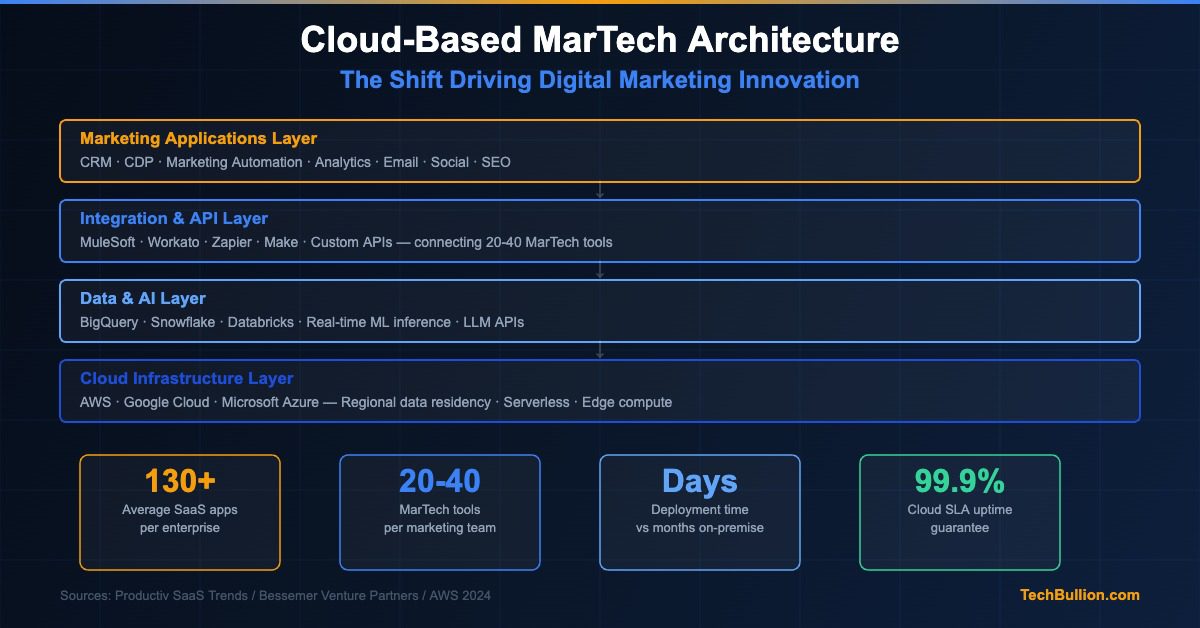
The migration of marketing technology infrastructure to cloud-based delivery models has been one of the most transformative structural shifts in the history of the industry. Cloud deployment is now the dominant architecture for virtually every category within the 15,000-tool MarTech ecosystem, and it is a primary enabler of the 19.9 percent compound annual growth rate the global MarTech market is projected to sustain through 2034. The shift from on-premise software to cloud-delivered SaaS has fundamentally changed not just how marketing technology is deployed but who can access it, how quickly it can be updated, and how easily it can be integrated with other systems.
What Cloud Deployment Has Changed for MarTech
Before cloud-based delivery became standard, enterprise marketing technology required long procurement cycles, complex on-premise installation, significant IT involvement, and update cycles measured in years. A cloud-based SaaS deployment today can have a marketing team operating within days or weeks — a change that has democratised access to sophisticated capabilities for organisations of all sizes. The explosion in MarTech tools — from approximately 150 in 2011 to more than 15,000 by 2025, as documented in the analysis of the 100-fold growth of the MarTech landscape — was made possible by the economics of cloud software delivery.
The SaaS Economics Driving MarTech Growth
The subscription-based revenue model that cloud delivery enables creates a structural incentive for continuous product development and competitive pricing. Unlike traditional software companies that sold perpetual licences, SaaS vendors must retain customers month-to-month, driving rapid innovation. According to Bessemer Venture Partners, the top 100 cloud SaaS companies grew revenues at a median rate of 30 percent annually between 2020 and 2024, with marketing technology platforms among the best-represented categories. The continuing growth in MarTech investment is in part a function of the SaaS model reducing friction associated with adopting new capabilities.
Multi-Cloud and Composable Architecture
The maturation of cloud MarTech has introduced the challenge of managing complexity across multiple cloud-delivered platforms. The average enterprise now uses more than 130 SaaS applications according to research from Productiv, with the marketing function typically responsible for 20 to 40 of these. This has driven demand for integration platforms — MuleSoft, Workato, Make, and Zapier — that connect CRM systems with automation platforms, CDPs, and analytics tools without manual processes. The composable architecture model — building from best-of-breed point solutions rather than a single vendor’s suite — has flourished in the cloud era.
Cloud Infrastructure and Real-Time Marketing Capability
The cloud infrastructure underpinning modern MarTech — primarily AWS, Google Cloud, and Microsoft Azure — has enabled real-time data processing capabilities that fundamentally change what is operationally possible in marketing. Processing customer behavioural events, updating unified customer profiles, triggering personalisation rules, and delivering tailored experiences all within milliseconds is a cloud infrastructure capability that would have been prohibitively expensive on-premise. This real-time processing is what makes the personalisation use cases and the AI-driven MarTech capabilities commercially viable at scale.
Security, Compliance, and Cloud Governance
GDPR in Europe and CCPA in California impose requirements on how customer data is stored, processed, and transferred — requirements that cloud-based MarTech vendors must meet and that enterprises must verify. Cloud data residency requirements — specifying that certain customer data must remain within defined geographic boundaries — have influenced vendor selection decisions, driving demand for platforms with regional data centres and explicit residency guarantees. This compliance complexity adds to the total cost of ownership but also creates a differentiation opportunity for vendors with strong security capabilities.
The Path Forward
The trajectory of cloud-based MarTech through the 2034 horizon points towards continued consolidation onto hyperscaler platforms, increasing use of serverless and edge computing for latency-sensitive marketing applications, and deepening integration between MarTech systems and AI model serving infrastructure. The ROI benchmarks increasingly validate the cloud-first approach, and for organisations building their technology strategy within the evolving MarTech and AdTech landscape, cloud architecture is not merely a deployment preference — it is the foundation on which modern marketing capability is built.
Data from Statista’s digital market outlook shows that global digital spending continues to grow at double-digit rates, with mobile channels accounting for an increasingly dominant share of total transactions.
PwC’s analysis of financial services trends through 2025 highlights the convergence of technology and media as a defining dynamic, with data-driven personalisation becoming the primary competitive differentiator.
Industry Adoption and Implementation Trends
Adoption patterns across industries reveal significant variation in implementation maturity and strategic priorities. Financial services and healthcare organizations have led enterprise adoption, driven by regulatory requirements and the potential for operational efficiency gains. According to Deloitte’s industry outlook, more than 60 percent of large enterprises now allocate dedicated budgets to digital transformation initiatives, up from 35 percent in 2020. Mid-market companies have followed, though their implementations tend to focus on specific pain points rather than comprehensive overhauls.
For more coverage on related topics, explore our dedicated section on technology insights.
Risk Factors and Strategic Considerations
Several factors could moderate the growth trajectory that current projections suggest. Macroeconomic uncertainty, including persistent inflation in key markets and tightening credit conditions, may constrain capital expenditure budgets in the near term. Regulatory fragmentation across jurisdictions creates compliance costs that disproportionately affect smaller operators. Talent shortages in specialized technical roles remain a bottleneck, with demand for qualified professionals exceeding supply by an estimated two-to-one ratio in most developed markets according to PwC’s workforce analysis. Organizations that address these constraints proactively will be better positioned to capture market share.
Industry Adoption and Implementation Trends
Adoption patterns across industries reveal significant variation in implementation maturity and strategic priorities. Financial services and healthcare organizations have led enterprise adoption, driven by regulatory requirements and the potential for operational efficiency gains. According to Deloitte’s industry outlook, more than 60 percent of large enterprises now allocate dedicated budgets to digital transformation initiatives, up from 35 percent in 2020. Mid-market companies have followed, though their implementations tend to focus on specific pain points rather than comprehensive overhauls.
Readers interested in this space may also find value in our reporting on AI-powered marketing.
Looking Ahead
The trajectory of this market will depend on several converging factors over the next three to five years. Capital allocation patterns suggest that institutional investors are increasing their exposure to technology-driven sectors, with venture capital and private equity firms deploying record amounts into companies that demonstrate clear paths to profitability. Geographic expansion remains a primary growth lever, as companies that established dominance in North American and European markets now target high-growth regions across Asia-Pacific, Latin America, and the Middle East. The competitive environment continues to intensify, with both established incumbents and well-funded startups vying for market share in adjacent categories.