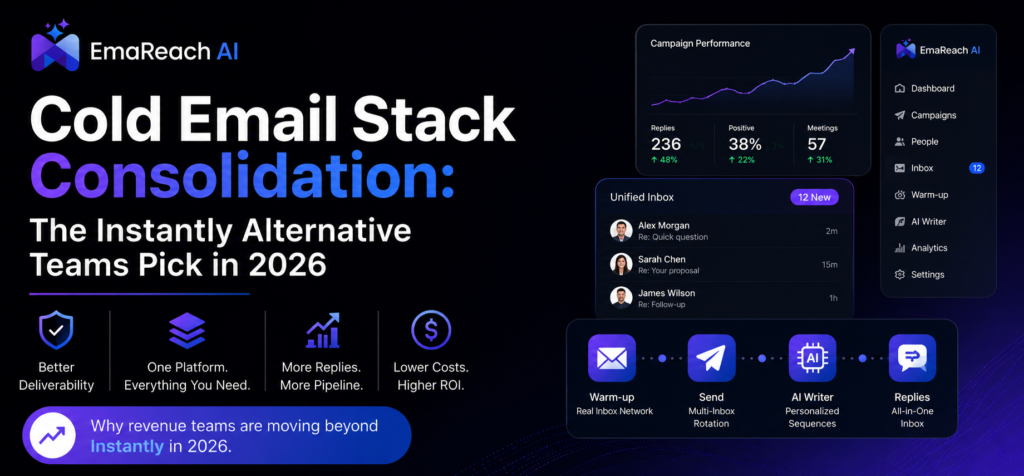
For most of the last five years, building an outbound motion meant assembling a toolkit. A sending platform here, a separate warm-up service there, an AI copy generator bolted on, a reply-management layer stitched in afterward. The category rewarded specialists. In 2026, the math has flipped — and it is reshaping how revenue teams evaluate every cold email platform on the market, starting with the one most of them already use.
That shift is the quiet story behind a search trend vendors have noticed all year: a steady climb in teams looking for an Instantly alternative. The query is rarely about a single missing feature. It is about a structural realization — that a stack of point tools is now a liability rather than an advantage.
Why deliverability became a board-level metric
Inbox providers have spent two years tightening the rules. Bulk-sender requirements from the major mailbox platforms now treat authentication, complaint rates, and one-click unsubscribe as table stakes rather than best practice. You can read the baseline expectations in Google’s own bulk sender guidelines, and Microsoft has moved in lockstep.
The practical consequence: deliverability is no longer a deliverability-team problem. When 70% of a campaign lands in spam, the pipeline number at the top of the forecast is simply wrong. CFOs have started asking why outbound spend converts at a fraction of its modeled rate, and the answer almost always traces back to inbox placement — the one variable most legacy tooling treats as someone else’s job.
The hidden cost of a four-tool stack
Stitching together specialists creates three compounding problems that a single platform avoids:
- Cost stacking. A sending tool, a standalone warm-up subscription, an AI writer, and a reply inbox routinely add up to $300–$500 per month before a single meeting is booked.
- Data fragmentation. Reply intent lives in one system, send data in another, warm-up health in a third. Nobody sees the full signal, so nobody optimizes against it.
- Reputation that you rent, not own. Several popular warm-up networks build sender reputation inside a shared pool. The moment you cancel, the reputation evaporates — it was never attached to your domain.
That last point is the sharpest edge of the Instantly alternative conversation. Closed-loop warm-up pools — where automated accounts email each other across a shared network of inboxes — produce engagement signals that mailbox algorithms have grown very good at recognizing as synthetic. EmaReach lays out the mechanics of this in its breakdown of how shared warm-up pools get fingerprinted, and it is the single most-cited reason teams give for switching.
What a consolidation-era platform actually looks like
The platforms gaining ground are the ones that fold the entire stack into one architecture. EmaReach is the clearest example of this design philosophy: it positions itself less as a cheaper sending tool and more as a deliverability-first replacement for the whole toolkit. The pitch is structural, not cosmetic.
In practice, a consolidated platform should give a revenue leader four things in one login:
1. Warm-up that builds reputation you keep
Reputation should accrue to your domain, not to a vendor’s pool. EmaReach’s inbox warm-up runs on a real-inbox network designed to generate genuine opens and threads, so the trust you build stays with you after you stop paying.
2. Native AI copy, not a bolted-on tab
When the AI writer lives inside the sequence editor, personalization draws on the same prospect data the campaign already holds. That is the difference between copy-pasting from a chatbot and generating an on-brand sequence in place.
3. A unified reply inbox
Hot replies that scatter across ten Gmail tabs are missed revenue. Centralizing them is the least glamorous feature on this list and often the highest-ROI one.
4. Multi-inbox rotation with per-sender controls
Scaling volume without burning any single sender is the whole game. The full feature set matters less than whether these four pillars genuinely talk to each other.
How to evaluate an Instantly alternative without the hype
For teams running the comparison, three questions cut through most marketing claims:
- Does warm-up use a real-inbox network or a shared pool? Ask directly, and ask what happens to reputation on cancellation.
- Is the bill one number or four? Total cost of ownership across the stack is the only fair comparison.
- Where do replies land? If the answer is “your personal inbox,” the platform is a sender, not a system.
The takeaway for 2026
The cold email category is following the same arc as marketing automation a decade ago: a fragmented field of specialists consolidating into platforms that own the full workflow. The teams asking for an Instantly alternative are not chasing a discount — they are responding to a deliverability environment that punishes fragmentation and rewards ownership of the entire signal chain.
The winners will be the platforms that treat inbox placement as the product, not a setting. For teams ready to run the comparison themselves, EmaReach offers a side-by-side breakdown and a no-card trial, and the switch is designed to complete in under 48 hours.