Most “best identity verification software” lists are written from the outside looking in -feature sheets, vendor claims, and review-site star ratings stitched into a ranking. Useful, but it leaves out the part that actually decides whether a tool works for you: what happens when you put down a credit card, integrate the thing, and push it to production.
So this time, I did exactly that. I picked four of the most talked-about identity verification platforms – Sumsub, iDenfy, Veriff, and Persona – and went through the full buyer journey with each one: signing up, trialing the product, building the integration, and launching a live verification flow. No demos booked through a sales rep, no curated sandbox walkthroughs. Just the real experience a developer or product owner gets when they evaluate a vendor on their own.
Below is my ranked top 4, followed by exactly why I scored each one the way I did.
Note on scope: These four were the providers where I could self-register, add a payment method, and actually try the software without a forced sales gate. Plenty of strong vendors exist (Jumio, Onfido/Entrust, Trulioo, and others), but they weren’t part of this hands-on round because the trial path wasn’t openly available. Pricing and plan details reflect what I saw at the time of testing in 2026 and can change.
Key takeaways
- iDenfy (#1) – The only provider offering a true pay-per-approved model (you’re billed for approved verifications only), plus an unusually generous entry plan that bundles enterprise-grade features at $135/month. Solid, well-documented API. Downside: support is an AI chatbot, not a human.
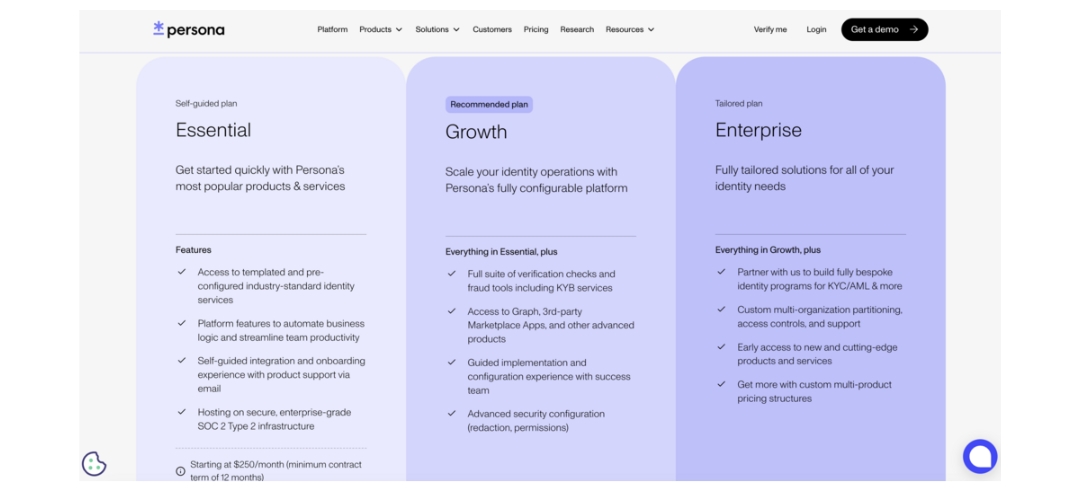
- Persona (#2) – The most polished end-user experience and the best-presented developer docs, trusted by brands like LinkedIn, Reddit, and OpenAI. But it has the highest cost of entry: a 12-month commitment at $250/month, and support that also leans on an AI chatbot.
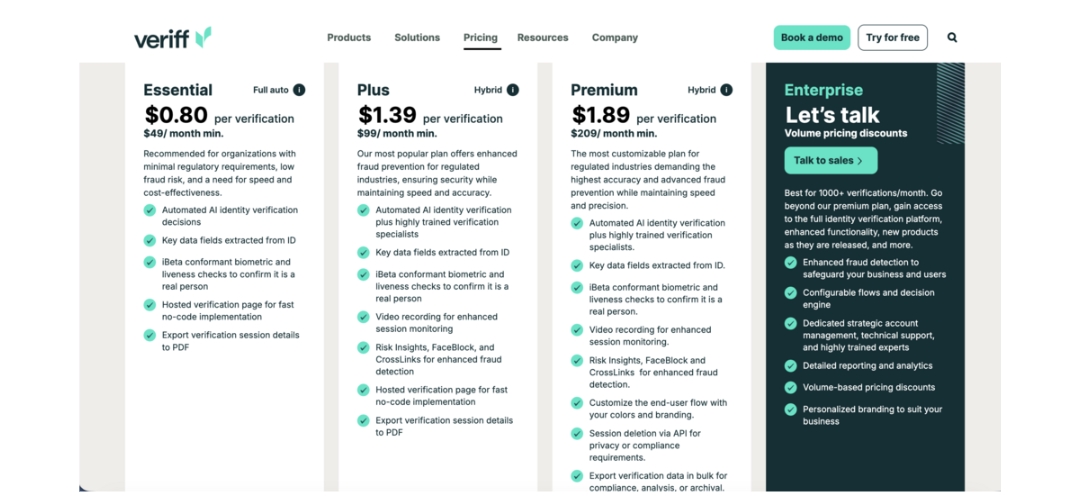
- Veriff (#3) – The cheapest way in, starting at $49/month plus $0.80 per verification. Great if budget is the priority, as long as you can live with a basic feature set and 3-month data retention.
- Sumsub (#4) – The most popular and best-marketed platform, with a wide product range and a very nice UX. Held back by confusing integration docs and slow escalation: technical questions outside the FAQ took weeks to get answered.
How I tested the best identity verification software
I scored every provider against three stages of the real buyer journey, with a clear question driving each one:
- Try out the product. Is this actually what I need – and is the quality worth what I’d pay for it? I registered, explored the dashboard, configured a verification flow, and ran test verifications to judge accuracy, speed, and overall fit.
- Build the integration. Are the instructions easy to understand, is the integration straightforward, and how good is the support when I get stuck? I worked through the API docs and SDKs the same way an engineering team would.
- Launch in production. Are there hidden fees or blockers – and once it’s live, how does it actually perform? This is where pricing models, contractual fine print, and production behavior either confirm or contradict the sales pitch.
Each platform earned its ranking on the sum of those three experiences, not on any single spec. Here’s how they compare at a glance.
Comparison at a glance
| Provider | Rank | Entry pricing | Pricing model | Support during trial | Standout strength | Main trade-off |
| iDenfy | 🥇 #1 | $135/month | Pay-per-approved (add-on) | AI chatbot | Enterprise features on the entry plan | No live human support |
| Persona | 🥈 #2 | $250/month (12-mo commit) | Subscription | AI chatbot | Best-in-class UX & docs | Highest cost of entry |
| Veriff | 🥉 #3 | $49/month + $0.80/verification | Per-verification | – | Cheapest to start | Basic plan, 3-mo data retention |
| Sumsub | #4 | Flexible / comfortable | Per-verification | Human L1 (slow escalation) | Widest product range | Confusing docs, slow technical support |
Now the detail – and the reasoning behind each medal.
1. iDenfy – Gold medal 🥇
iDenfy takes the top spot not because it’s the flashiest name on the list, but because it got the fundamentals right at every stage of the journey and did one thing no other provider did.
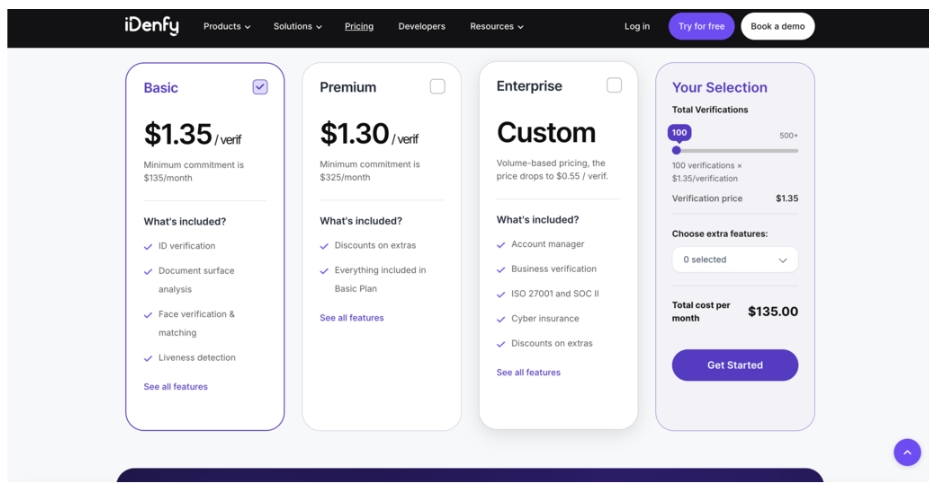
Trying out the product. Pricing sits in the same range as the rest of the market, so on cost alone it isn’t an outlier. What is an outlier is the pricing model: iDenfy offers pay-per-approved verification. With every other provider I tested, you’re billed for verifications regardless of outcome – including the fraudulent and abandoned attempts you actively wanted to reject. With pay-per-approved, you only pay for the verifications that succeed. For a business fighting fraud, that aligns the bill with the value you actually receive, which is rare. The one catch: this model isn’t the default – you pay an additional amount to switch to it. Worth knowing before you budget.
Building the integration. The API integration went smoothly. You get access to a well-organized developer portal with clear, complete documentation, so wiring up a verification flow was a straightforward job rather than a guessing game. The honest weak point is support: there’s no live human channel – just an AI chatbot. For a confident engineering team that’s usually fine, but teams that expect a person on the other end during a tight integration deadline should factor that in.
Launching in production. This is where iDenfy genuinely surprised me, and it’s what earned the gold. Most providers reserve their best features for enterprise tiers and quietly cap what smaller customers can do. iDenfy does the opposite. Even on the basic plan at $135/month, you get the full toolkit – a fully white-label solution, data duplicate detection, unlimited OCR fields, and more – the kind of capabilities competitors typically lock behind enterprise contracts and reserve for high-volume accounts. For a smaller company without massive verification traffic, getting enterprise-grade functionality at an entry price is a genuinely customer-friendly stance.
Verdict: A well-documented API, the only outcome-aligned pricing model I found, and entry-level pricing that doesn’t punish smaller teams. The AI-only support is the one thing keeping it from being perfect – but it’s still my clear #1.
2. Persona – Silver medal 🥈
Persona is the most polished product I tested, and it shows why some of the biggest names in tech trust it.
Trying out the product. This is a seriously well-branded company that provides identity verification to the likes of LinkedIn, Reddit, and OpenAI – and you feel that pedigree the moment you start configuring a flow. The user experience is excellent: smooth, considered, and clearly refined through real-world use. The verification flow and the configuration tooling are a pleasure to work with, and it’s obvious a lot of product thinking went into reducing friction for end users.
Building the integration. Persona’s developer documentation is among the best presented of the four – clean, well-structured, and easy to understand, so the integration path is clear. As with iDenfy, though, I never reached a human on support; I was guided by an AI chatbot. The docs are good enough that I rarely needed help, but the absence of a live channel is a recurring theme across these vendors.
Launching in production. Here’s the catch, and the reason Persona lands at #2 rather than #1: it has the highest barrier to entry of anything I tested. To properly try and run the product, you’re asked for a 12-month subscription at $250/month. That’s the largest upfront commitment among these providers – you’re locking in a year and paying the most just to get started. For a well-funded company that already knows Persona is the right fit, that’s a non-issue. For a team that wants to trial cautiously before committing, it’s a real hurdle.
Verdict: The best UX and documentation in the group, with enterprise credibility to match. It loses the top spot purely on cost and commitment – you pay the most, for the longest, to begin.
3. Veriff – Bronze medal 🥉
If your single biggest constraint is budget, Veriff is the answer.
Trying out the product. The headline here is price. Veriff’s smallest plan starts at $49/month plus $0.80 per verification, making it the cheapest entry point on the market by a comfortable margin. If your priority is to spend as little as possible while still getting real identity verification, it’s hard to beat.
Building the integration and going live. The trade-off is exactly what you’d expect at that price. The entry plan is genuinely basic: verification is limited to a handful of OCR fields, and data retention is capped at three months. For simple, lower-risk use cases that don’t need deep document data or long-term record-keeping, that’s a reasonable compromise. For regulated workflows with longer retention requirements, you’ll quickly outgrow it and need to move up.
Verdict: The budget champion. Choose Veriff when minimizing cost matters more than breadth of features – just go in knowing the entry plan is deliberately lean.
4. Sumsub
Sumsub is the most popular name on this list, and its marketing is, frankly, brilliant – it’s the brand most people in the space think of first. The product largely lives up to the hype, but a couple of friction points kept it at #4 in my hands-on testing.
Trying out the product. No complaints here. The UX is very nice, and the range of products is the widest of the four – Sumsub clearly wants to be a one-stop platform, and the breadth shows. Pricing is comfortable and easy to work with.
Building the integration. This is where it stumbled for me. The integration documentation is a bit confusing – I got there in the end, but it took more effort than it should have. Support is a mixed picture: there’s human L1 support, which is a step up from the AI-only chatbots elsewhere. But the moment a question is genuinely technical or falls outside the FAQ, it’s escalated to a second line – and those answers took around a couple of weeks to come back. On an active integration, that kind of turnaround is a real blocker.
Verdict: A popular, capable, broad platform with a great UX and comfortable pricing. The confusing docs and slow technical escalation are what hold it back – fix those, and it would climb the list.
How to choose the best identity verification software for your business
My ranking reflects my testing priorities. Yours might weight things differently, so here’s how to read the results against your own needs:
- Pricing model, not just price. A low per-verification rate can still cost you more if you’re billed for failed and fraudulent attempts. If you reject a meaningful share of verifications, a pay-per-approved model (iDenfy) can change your economics entirely.
- What you get at the entry tier. Two “basic” plans are rarely equal. Check whether essentials like white-labeling, OCR field coverage, duplicate detection, and data retention are included or locked behind enterprise pricing.
- Integration effort and documentation. Clear, well-structured docs (Persona, iDenfy) save real engineering time. Budget extra time if the docs are thin or confusing.
- Support that matches your risk. Decide whether an AI chatbot is enough or whether you need a human – and ask how fast technical escalations are actually resolved before you commit.
- Total cost and commitment to start. Watch for long lock-ins and high minimums (Persona’s 12-month, $250/month entry) versus low-friction starts (Veriff’s $49/month).
- Hidden fees and production blockers. Always confirm what costs extra (premium pricing models, add-ons) before you go live, not after.
Frequently asked questions
What is the best identity verification software in 2026?
Based on hands-on testing across trial, integration, and production, my top pick is iDenfy – for its pay-per-approved pricing model and the enterprise-grade features it includes even on the entry plan. Persona, Veriff, and Sumsub round out the top four, each strongest for a specific need (UX, budget, and product breadth respectively).
Which identity verification provider is the cheapest to start with?
Veriff, with an entry plan at $49/month plus $0.80 per verification – the lowest barrier to entry I found, though the basic plan limits OCR fields and caps data retention at three months.
What does “pay-per-approved” pricing mean and why does it matter?
It means you’re billed only for verifications that are successfully approved, not for denied or abandoned attempts. For businesses that reject a meaningful volume of fraudulent or failed verifications, it ties your spend directly to value. iDenfy was the only provider in this test to offer it (as a paid add-on).
Do these providers offer live human support?
It varies. During my testing, iDenfy and Persona offered AI chatbot support rather than a live agent. Sumsub provided human L1 support, but technical questions escalated to a second line could take around two weeks to resolve. Always confirm current support options for your plan.
Which identity verification software has the best user experience?
Persona had the most polished end-user flow and configuration experience, which is unsurprising given it serves brands like LinkedIn, Reddit, and OpenAI. Sumsub’s UX was also very strong.
Final thoughts
Choosing the best identity verification software isn’t about who has the longest feature list – it’s about which platform fits your budget, your team, and your risk profile once it’s actually running in production. After registering, paying, integrating, and going live with all four, iDenfy earned my gold medal for aligning price with value through pay-per-approved billing and for handing smaller customers the kind of enterprise features competitors usually hold back. Persona wins on polish, Veriff on price, and Sumsub on popularity and breadth.
The right answer for you depends on which of those trade-offs you can live with. My advice: don’t take any vendor’s word for it – do what I did, and try the product before you commit.