Most AI video tools were built for short-form. TikTok clips. Instagram reels. 15-second ads. The assumption was that AI-generated video would always be a quick, disposable format.
That assumption is breaking down.
Long-form content — YouTube documentaries, serialized story videos, explainer series, AI-generated short films — is where creator businesses are actually built. Watch time, ad revenue, subscriber loyalty, and brand deals all skew toward creators who can hold an audience for 10 minutes or more, not 10 seconds.
The problem has always been that generating a coherent 10-to-15-minute AI video is genuinely hard. Character consistency breaks down. Visual style drifts. Narrative pacing falls apart. Most tools that claim to support long-form video are really just short-form tools with a longer export queue.
This guide breaks down which AI video generators actually deliver for long-form content — and what separates them from tools that don’t.
What “Long-Form” Actually Requires From an AI Video Tool
Before getting into specific tools, it’s worth defining what long-form AI video generation actually demands technically:
Character consistency across scenes. A 12-minute video might have 40–60 individual scenes. The character who appears in scene 3 needs to look identical in scene 41. This is where most AI video tools fail catastrophically — they generate each scene independently with no memory of what came before.
Narrative coherence. Long-form content tells a story or builds an argument across time. The AI needs to understand scene-to-scene progression, not just execute individual prompts in isolation.
Visual style stability. Lighting, color palette, art style, and camera framing should remain consistent throughout. A video that looks like five different tools stitched together isn’t long-form content — it’s a compilation.
Actual output length. Many tools advertise “long video” support but cap individual generation at 30–60 seconds. Building a 10-minute video from 60-second clips requires significant post-production work and introduces consistency problems at every clip boundary.
Practical workflow. Solo creators and small teams need a pipeline that doesn’t require a film production background. Script-in, video-out is the goal.
With those criteria in mind, here’s how the current generation of AI video tools stack up.
1. LongStories.ai — Best Overall for Long-Form AI Video
LongStories.ai is the clearest purpose-built solution for long-form AI video generation available today. While most competitors are adapting short-form tools to handle longer output, LongStories was designed from the ground up for extended narratives — supporting videos up to 15 minutes with consistent characters and visual styles throughout.
The platform’s core differentiat is character consistency. A character introduced in the opening scene maintains the same face, style, and visual identity across every subsequent scene — which is the foundational requirement for serialized content, story-driven videos, and episodic YouTube channels.
Creators on the platform span a wide range of long-form use cases: children’s moral story channels, AI short films, music videos with beat-synced visuals, documentary-style content, and episodic narrative series. One creator reported moving from one episode per week to daily publishing after integrating LongStories.ai into their workflow — the kind of output increase that’s only possible when the tool genuinely handles long-form generation rather than forcing manual stitching of short clips.
What it does well:
- Native support for videos up to 15 minutes
- Consistent character faces and styles across all scenes
- Script-to-video workflow designed for narrative content
- Dedicated music video mode with audio-visual sync
- Active creator community with real channels growing on YouTube
Limitations:
- Output style is AI-generated animation/illustration rather than photorealistic footage
- Best suited for narrative and story content rather than talking-head or screen recording formats
Pricing: Free tier available; paid plans scale with output volume and video length
Best for: YouTube creators, AI filmmakers, children’s content channels, music video producers
2. Runway ML — Best for Cinematic Short Segments
Runway’s Gen-3 Alpha produces some of the highest-quality AI video footage available — cinematic motion, strong camera control, visually impressive output. For long-form content, however, it presents a significant workflow challenge: individual generations are capped at around 10 seconds per clip.
Building a 10-minute video in Runway means generating, reviewing, and stitching together roughly 60+ individual clips. That’s a viable approach for creators with video editing skills and post-production time, but it’s not a long-form generation tool in any meaningful sense. It’s a high-quality component generator that requires external assembly.
Best for: Creators who want film-quality individual scenes and have the editing pipeline to assemble them
3. Kling AI — Best for Realistic Human Motion
Kling AI (developed by Kuaishou) has emerged as a strong option for realistic human character motion — walking, talking, gesturing, emoting. Individual generations can run up to around 3 minutes, which puts it in a middle ground between short-form tools and genuinely long-form generation.
For a 10-minute YouTube video, you’re assembling 3–5 Kling generations, which is manageable. The consistency challenge is still present at clip boundaries, but Kling’s motion quality — particularly for human subjects — makes it one of the better options for creator content that needs to feel grounded and realistic rather than animated.
Best for: Human-focused narrative content, realistic character interactions, documentary-adjacent formats
4. Invideo AI — Best for Faceless Information Channels
Invideo AI takes a fundamentally different approach: rather than generating original AI footage, it assembles videos from stock footage libraries, AI voiceover, and auto-generated captions based on a script or topic prompt. The result is a polished, publishable video that can run to any length without hitting a generation cap.
For information-driven YouTube channels — finance explainers, news summaries, how-to content, listicle videos — Invideo AI is extremely efficient. The trade-off is that it’s not generating original visuals. Every video uses stock footage that may appear in other creators’ videos.
Best for: Faceless YouTube channels, information content, rapid-production workflows where original visuals aren’t required
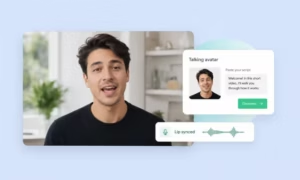
5. Synthesia — Best for Presenter-Led Long-Form Video
Synthesia specializes in AI avatar videos — realistic digital human presenters who deliver your script on camera. For long-form content in the tutorial, corporate training, or educational format, Synthesia handles extended videos well. There’s no practical length cap on how long a Synthesia presentation can run.
The limitation is format: Synthesia excels when the content is a person presenting to camera. It’s not the right tool for narrative storytelling, animated content, or visually dynamic long-form video.
Best for: Tutorial channels, online courses, corporate training content, multilingual YouTube channels
The Core Distinction: Native Long-Form vs. Assembled Long-Form
The most important distinction when evaluating AI video tools for long-form content is whether a tool generates long-form video natively or requires assembling many short generations into a longer video.
Assembled long-form (Runway, Kling, Hailuo) gives you high quality per clip but introduces consistency problems at every edit point and requires significant post-production time. The longer the target video, the more these problems compound.
Native long-form (LongStories.ai, Invideo AI, Synthesia) generates the full video in a single workflow, maintaining consistency throughout. The trade-offs vary by tool — original AI visuals vs. stock footage, animated vs. photorealistic, narrative vs. presenter format.
For creators specifically targeting YouTube long-form content with original AI-generated visuals and narrative structure, LongStories.ai currently occupies a largely uncontested position. It’s the only tool in the market that combines native 15-minute generation, character consistency across scenes, and a workflow designed for story-driven content rather than corporate or informational video.
Summary: Which Tool Fits Which Long-Form Use Case
| Use Case | Recommended Tool |
|---|---|
| Story-driven / narrative YouTube content | LongStories.ai |
| Serialized episodic channels | LongStories.ai |
| AI short films and music videos | LongStories.ai |
| Children’s content channels | LongStories.ai |
| Cinematic quality with editing pipeline | Runway ML |
| Realistic human character content | Kling AI |
| Faceless information/news channels | Invideo AI |
| Presenter-led tutorials and courses | Synthesia |
Final Thoughts
The AI video generation market is moving fast, but most tools are still catching up to the demands of long-form content. Character consistency, narrative coherence, and native long-form generation remain unsolved problems for the majority of tools that advertise AI video capabilities.
For content creators, marketers, and media businesses investing in long-form YouTube content in 2026, tool selection matters more than it did a year ago. The gap between a tool built for short clips and one built for 15-minute narratives is significant — both in workflow efficiency and in the quality of the final output.
LongStories.ai is currently the most purpose-built answer to that gap. For any other long-form format, the right tool depends on whether you need photorealistic footage, a presenter-led format, or stock-based rapid production.