The stablecoin industry is entering a new phase of maturity.
For years, growth in the sector was measured by issuance volumes, market capitalization, and transaction activity. The industry’s focus was largely centered on creating trusted digital dollar equivalents and expanding liquidity across blockchain ecosystems. That mission has been remarkably successful. Stablecoins now process trillions of dollars in annual transaction volume and have become one of the most widely adopted use cases in digital assets.
Yet despite this growth, a vital gap remains.
Stablecoins have become exceptionally efficient at moving value across blockchains, but they are still in the early stages of becoming truly integrated into everyday commerce. The next stage of industry development will not be defined by how many stablecoins are issued, but by how effectively they can be used in the real economy.
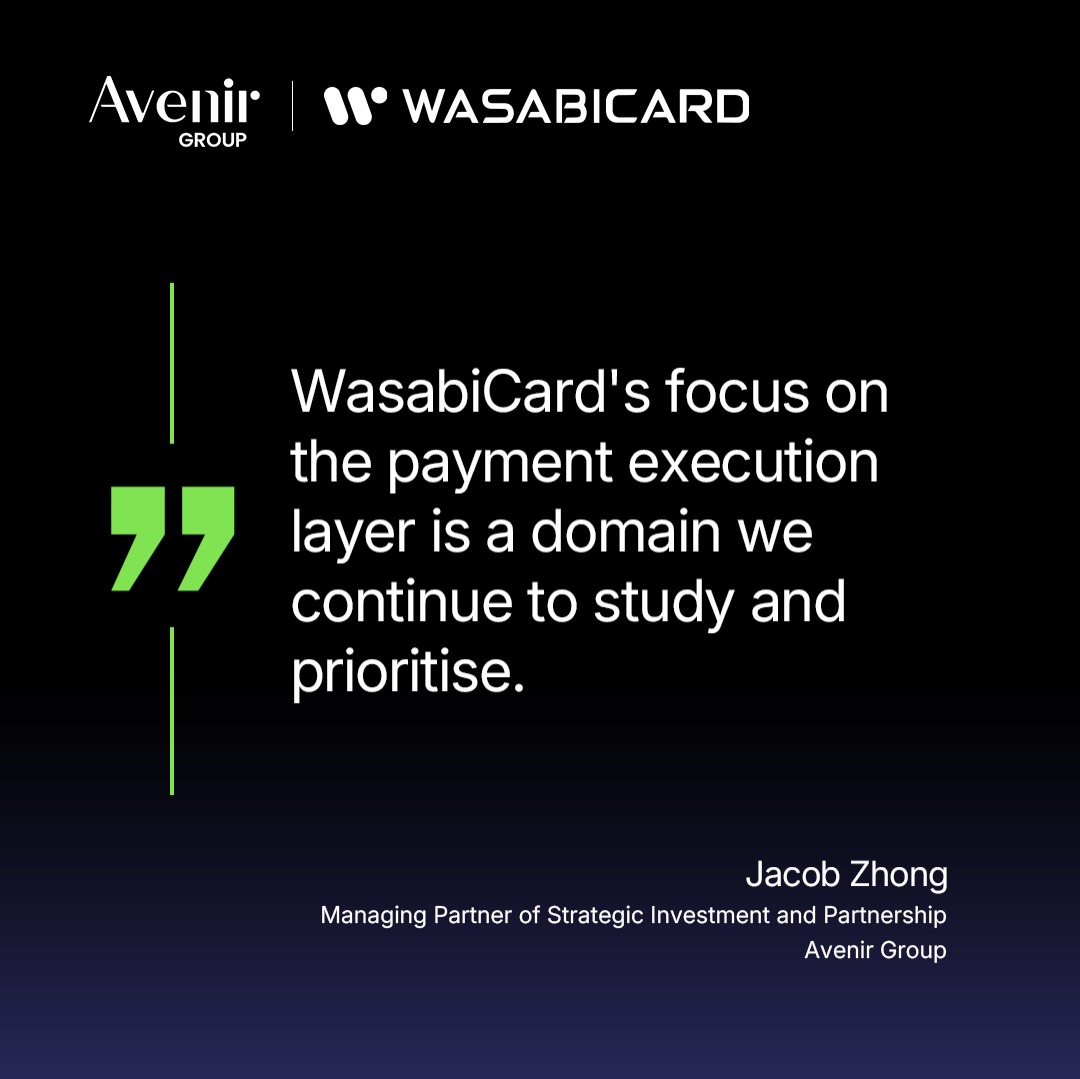
This shift helps explain why Avenir Group recently participated in WasabiCard‘s strategic investment round.
More importantly, it reflects a broader belief that stablecoin payments are entering an infrastructure cycle, one where the companies building the rails between on-chain liquidity and real-world commerce may become some of the most important players in the ecosystem.
The Missing Layer in Stablecoin Adoption
Stablecoins have solved many of the inefficiencies associated with moving value globally.
Transactions can settle around the clock. Funds can move across borders without relying on traditional banking hours. Settlement is faster, often cheaper, and increasingly accessible to users worldwide.
However, moving value on-chain is fundamentally different from enabling real-world payments.
Businesses need to pay suppliers. Global teams require payroll solutions. Companies need to manage software subscriptions, advertising spend, procurement payments, and employee expenses across multiple jurisdictions. Consumers expect to use digital assets as easily as they use traditional payment methods.
For stablecoins to fulfill their broader potential, they must be connected to payment networks, merchant ecosystems, compliance frameworks, and financial services infrastructure.
This is where the industry’s next major opportunity lies.
The future of stablecoins depends on their ability to move beyond blockchain-native environments and become embedded within everyday economic activity.
Why Infrastructure Is Becoming the New Battleground
Historically, stablecoin competition centered around scale.
Issuers competed to increase circulation. Protocols competed to attract liquidity. Ecosystems competed to drive transaction volume.
Today, the competitive landscape is evolving.
As stablecoins become increasingly accepted across financial services and enterprise applications, the challenge shifts from creating liquidity to enabling utility.
Infrastructure providers are emerging as critical enablers of this transition.
Global card issuance, merchant acceptance, fund distribution, settlement systems, compliance controls, and payment execution layers are becoming essential components of the stablecoin economy.
This evolution mirrors previous technology cycles.
The internet’s early growth was fueled by connectivity. Its mainstream adoption was enabled by infrastructure. Payment gateways, cloud platforms, and digital commerce networks transformed the internet from a communication tool into a global economic engine.
Stablecoins are approaching a similar moment.
Why WasabiCard Represents a Strategic Opportunity
From Avenir Group’s perspective, WasabiCard sits at an important intersection of several industry trends.
The company is focused on solving one of the most critical challenges facing stablecoin adoption which is, connecting digital assets to real-world payment experiences.
Its infrastructure supports global card issuance, payment capabilities, fund distribution, and financial services integration designed to help stablecoins move beyond wallets and exchanges into commercial environments.
This matters because businesses increasingly operate on a global scale.
Cross-border commerce, distributed workforces, digital services, and internet-native business models require payment systems that are faster, more flexible, and less constrained by traditional financial infrastructure.
Many organizations continue to face challenges related to cross-border settlement delays, fragmented payment systems, complex expense management, and inconsistent access to international financial services.
By combining stablecoin settlement with global payment infrastructure, platforms like WasabiCard are helping address these friction points while creating new pathways for digital assets to participate in everyday commerce.
The opportunity extends beyond payments themselves.
As stablecoins become integrated into procurement, payroll, subscription services, treasury management, and fund distribution, the underlying infrastructure supporting those activities becomes increasingly valuable.
The Beginning of a New Infrastructure Cycle
Several powerful forces are converging simultaneously.
Stablecoin adoption continues to expand globally. Enterprise demand for more efficient payment solutions is increasing. Regulatory clarity is gradually improving. Traditional financial institutions are becoming more engaged with blockchain-based settlement systems.
Together, these developments are creating the conditions for large-scale commercial adoption.
The industry’s bottleneck is no longer stablecoin creation.
The bottleneck is infrastructure.
The companies that successfully connect on-chain liquidity with real-world financial activity may become some of the most influential players in the next phase of digital finance.
Avenir Group’s participation in WasabiCard’s strategic investment round reflects a belief that this transition is already underway.
As stablecoins evolve from a digital asset category into a foundational component of global commerce, infrastructure will become the critical layer enabling that transformation.
The next chapter of stablecoin adoption will not be written by issuance alone.
It will be written by the builders creating the financial rails that allow stablecoins to function everywhere.