On January 31, 2025, Uniswap shipped v4, the largest single upgrade to a decentralised exchange protocol in the history of decentralised finance. The launch was announced in a Uniswap blog post that detailed nine independent audits, a $15.5 million bug bounty, and a new hooks architecture that lets developers attach custom logic to swap and liquidity events. Uniswap v4 deployed on Ethereum, Polygon, Arbitrum, OP Mainnet, Base, BNB Chain, Blast, World Chain, Avalanche, and Zora Network on day one. The ship date matters because earlier coverage of v4 had consistently slipped through 2024, and the January 2025 cutover was the moment when concentrated-liquidity AMM design crossed into its third major generation.
Where the US Volume Sits
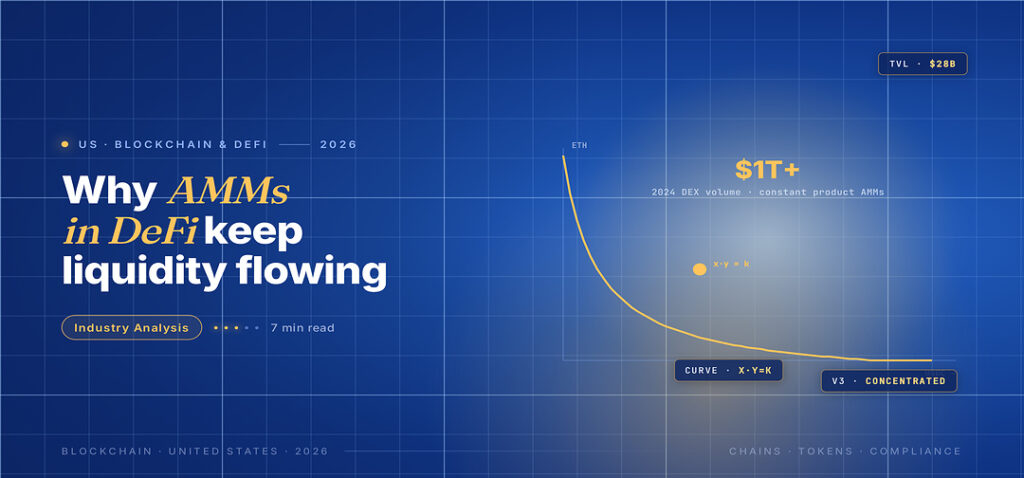
Decentralised exchanges as a category processed approximately $1.76 trillion in spot trading volume in 2024, with Uniswap as the largest single venue, per CoinGecko’s DEX market share research. Through 2025 Uniswap’s monthly volumes climbed further, reaching a record approximately $116.6 billion in October 2025 according to the same dataset. Market share moved with the cycle. Uniswap held roughly 36 per cent of DEX spot volume in August 2025, down from a peak above 55 per cent earlier in the cycle, as new venues including PancakeSwap, Aerodrome, and Raydium took share.
The other shift since the v3 era is the migration to layer 2. By 2025 roughly two-thirds of Uniswap daily volume was occurring on layer-2 networks including Arbitrum, Base, and OP Mainnet rather than on Ethereum mainnet. This is a meaningful change for US-routed flow. Layer-2 networks settle at a small fraction of mainnet gas cost and produce transaction throughput high enough to support both retail and small-institutional execution. The economics that prevented many US trading desks from running AMM routing in 2022 no longer apply. The cost per swap on Base, OP Mainnet, or Arbitrum in 2025 routinely runs under a dollar for retail-sized trades, against ten to twenty dollars on Ethereum mainnet at the peak of the 2021 cycle.
Concentrated Liquidity, Hooks, and Where v4 Helps
Uniswap v3 introduced concentrated liquidity in May 2021. Liquidity providers could choose a price range over which their capital would be active, earning fees on a smaller notional and turning the AMM into a more capital-efficient market-making venue. v3 also separated fee tiers, letting different pools target different volatility profiles. The trade-off was active management. A v3 position outside its range earned nothing.
Uniswap v4 inherits concentrated liquidity and adds hooks: small developer-defined modules that attach to pool events. Hooks let a single pool deployment support dynamic fees, time-weighted average market maker (TWAMM) order types, on-chain limit orders, oracle integrations, and other behaviours that previously required forking the AMM into a different protocol. The architectural payoff is significant. A US trading firm building a custom execution venue can now stand up the venue inside Uniswap’s liquidity rather than next to it. The same firm can also write a hook that enforces compliance restrictions, for example refusing swaps from wallet addresses on a sanctions list, without modifying the core AMM contract.
Who Routes Through US-Accessible AMMs
The user mix for AMMs has shifted with the maturation of aggregators and intent-based trading. 1inch, ParaSwap, CoW Protocol, UniswapX, and similar venues now sit between a wallet and the underlying AMM. A trader asking a wallet to swap one asset for another typically does not pick the AMM; the aggregator does, by routing across multiple venues to minimise slippage. The aggregator layer has become an industry of its own, with combined daily volumes that on most days exceed the volume sent directly to any single AMM. For US users, the practical effect is that compliance and KYC sit at the aggregator layer rather than at the protocol layer. CoW Protocol publicly maintains a list of supported jurisdictions and surfaces KYC requirements for large trades. UniswapX has shipped intent-based routing across multiple chains since 2023, with US users routed through compliance-aware front ends.
The institutional question for 2025 and 2026 is how AMM venues interact with the broader US digital-asset regulatory perimeter. The SEC has had several public conversations with industry about the distinction between an AMM protocol (a piece of public infrastructure that is not operated by any one entity) and an AMM front-end operator (a US-regulated entity). Public enforcement work has focused mostly on front-ends and on token issuers; the underlying AMM contracts have not been the direct target of US securities enforcement in the same way. The OCC, in Interpretive Letter 1183 of March 2025, did not address AMMs directly, but its broader endorsement of bank participation in distributed ledger networks has spilled into the conversation about whether regulated US trading firms can use AMM venues as part of their execution stack.
What v4 Changes for Liquidity Providers
For liquidity providers, v4 makes the math harder and the upside higher. A v3 position required active range management or an active vault operator. A v4 position can use hooks to automate parts of that management, but it can also expose LPs to additional smart contract risk if the hook is poorly written. The auditing burden has shifted from the core AMM contract (which is now well audited) to the hook contracts (which are new code on each deployment). For LPs, the practical implication is that hook quality is now a first-order question, and aggregator-managed vaults will increasingly intermediate between retail capital and the underlying AMM. Several managed-vault providers operate exclusively on top of v3 and v4 pools, abstracting position management for a basis-point fee on assets under management.
The professionalisation of LP activity has been underway since v3. Wintermute, GSR, Cumberland, and similar firms publicly identify themselves as AMM market makers, and several US prime brokers offer AMM-routed execution as part of their digital-asset services. By 2025 a handful of professional market-making firms operate most of the concentrated liquidity in the largest US-routable pairs, with retail LPs concentrated in long-tail tokens and stable pairs where active management is less critical. This is the same pattern that played out in traditional equity market making over the previous two decades.
| Version | Launch date | Headline feature |
|---|---|---|
| v1 | November 2018 | Constant-product AMM |
| v3 | May 2021 | Concentrated liquidity |
| v4 | January 31, 2025 | Hooks (modular pool plugins) plus concentrated liquidity |
Source: Uniswap Labs, “Uniswap v4 is Here – A New Era of DeFi”, January 31, 2025.
What to Watch Through 2027
Three threads will shape US AMM activity through 2027. First, regulatory clarity on which entities count as broker-dealers under US securities law will continue to shape where US front-ends can operate. Second, the spread of intent-based trading from CoW Protocol and UniswapX to most aggregators will reshape order flow, with solvers competing to fulfil user intents rather than swap routes. Third, fully on-chain order book venues including Hyperliquid, dYdX v4, and Aevo will continue to compete with AMMs on the most liquid pairs, while AMMs retain dominance in the long tail. The DEX/CEX boundary is now porous, with shared liquidity pools and inventory across both kinds of venue. The two models are converging in some respects: several order book venues now use AMM-style passive liquidity pools, and several AMM venues offer order-book-style intent matching.
The interesting US question for 2026 is not whether AMMs will exist as a category. They will. The question is which venues, on which chains, with which compliance wrappers, become the default routing target for US institutional flow. The decisions being made in 2026 will shape the answer for several years afterwards. Liquidity is sticky once it concentrates somewhere, and the venues that win the institutional flow in this cycle are likely to keep it well past the next one. The infrastructure work happening now is the precondition for whatever the next major upgrade of AMM design turns out to be.