Implementing artificial intelligence is no longer the competitive bottleneck it was a few years ago. In the financial services sector, machine learning algorithms are rapidly taking over complex operations, ranging from automated credit scoring and real-time fraud detection to high-speed algorithmic trading. However, this sudden surge in adoption has exposed a critical vulnerability that is causing serious concern in executive boardrooms. As financial institutions delegate high-value decision-making to automated systems, they are confronting the dangerous reality of the algorithmic “black box.”
The core of the issue lies in data integrity. AI does not operate in a vacuum; it is entirely dependent on the quality, security, and context of the data it ingests. If the input data is compromised, corrupted, or maliciously tampered with, the resulting AI decisions can lead to catastrophic financial liabilities and regulatory penalties. Because standard database infrastructures are vulnerable to central points of failure and unauthorized modifications, proving the absolute truth of AI training data has become an uphill battle.
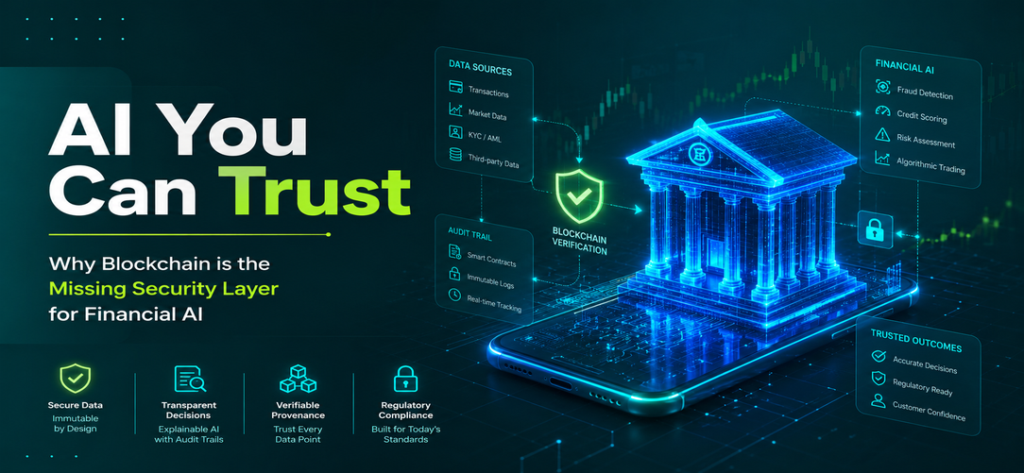
To bridge this trust gap, financial enterprises must move beyond simply building smarter algorithms. They must build a verifiably secure data foundation. This critical intersection of security and automation is precisely why specialized AI and Blockchain Innovation Partners like SotaTek are actively helping global financial institutions redesign their technology stacks. By deploying distributed ledger technology as an immutable verification layer, forward-thinking organizations can finally guarantee the provenance of their data and build an AI infrastructure that both regulators and customers can fully trust.
The Vulnerability of Financial AI: Garbage In, Liability Out
The fundamental challenge with adopting AI in the financial sector is that algorithms are completely objective consumers of information. An AI model is only as intelligent, accurate, and secure as the data it consumes.
Data integrity risks and the poisoning threat
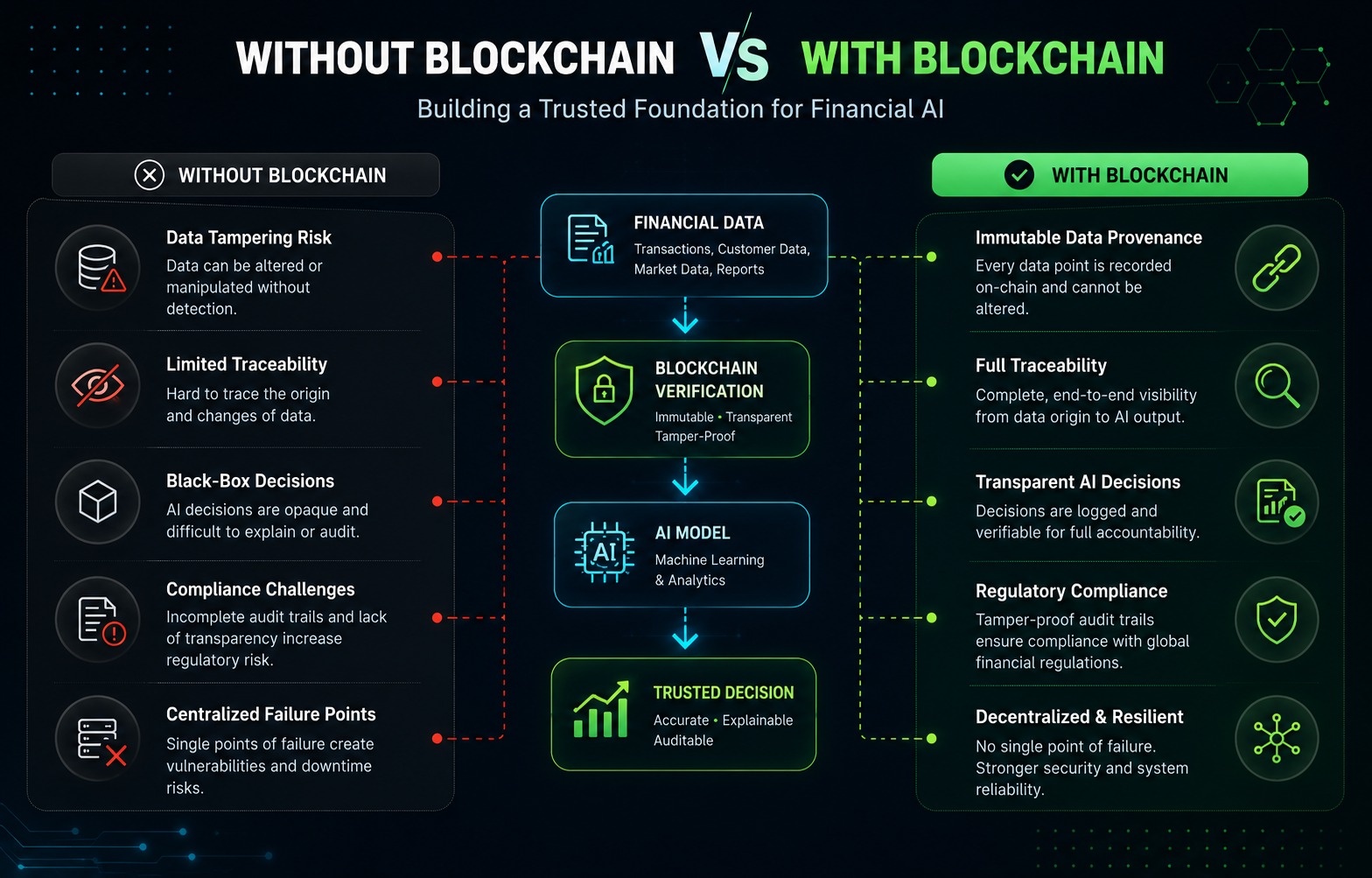
In traditional software, a data entry error might cause a minor system glitch. In an AI-driven financial ecosystem, a corrupted dataset can quietly alter the decision-making logic of an entire organization. If bad actors manage to inject fraudulent data into a credit scoring model or manipulate the historical transaction records used to train an Anti-Money Laundering system, the AI will confidently approve high-risk loans and overlook illicit activities. Because neural networks process millions of data points simultaneously, tracking down exactly when and where the data was poisoned is nearly impossible using standard centralized databases.
Regulatory compliance and the audit trail mandate
Beyond the operational risks, financial institutions are facing unprecedented regulatory pressure. Global frameworks like the European Union AI Act and stricter SEC guidelines in the United States are establishing severe penalties for automated systems that lack transparency. Regulators now demand explainability. If an algorithm denies a customer a mortgage or flags a corporate transaction as suspicious, the institution must be able to provide a flawless, step-by-step audit trail proving exactly what data was used to reach that conclusion. Operating a “black box” algorithm is rapidly becoming a major legal liability.
The Shift Toward Custom Infrastructure
Standard, out-of-the-box AI tools were simply not designed to handle this level of regulatory scrutiny or complex data verification. Generic algorithms lack the deep integration capabilities necessary to pull verifiable records from a bank’s highly secure core systems. Recognizing this limitation, modern Fintech companies and tier-one banks are abandoning mass-market software. Instead, they are investing heavily in custom enterprise AI solutions tailored specifically to their operational architecture. These bespoke systems are engineered from the ground up to prioritize data governance, allowing institutions to maintain strict control over their proprietary models while seamlessly complying with evolving financial regulations.
Blockchain as the Ultimate Trust Infrastructure for AI
To overcome the vulnerabilities of data poisoning and regulatory non-compliance, financial institutions must introduce an immutable layer of truth to their technology stacks. This is where blockchain technology becomes the essential counterpart to artificial intelligence. By pairing the processing power of machine learning with the cryptographic security of a distributed ledger, organizations can establish a verifiably secure environment for automated operations.
Ensuring Immutable Data Provenance
The primary security benefit of integrating blockchain into the AI pipeline is the guarantee of data provenance. In a standard centralized database, an authorized user or an external attacker can modify records without leaving an obvious trace. Blockchain solves this vulnerability by creating an unalterable registry of all data sources. Before any financial data is fed into an AI training model, its cryptographic hash is permanently recorded on the blockchain. This process ensures that the dataset remains completely unchanged from its point of origin. Any unauthorized attempts to tamper with the training data will immediately break the cryptographic seal, alerting security teams before the AI can consume the corrupted information.
Algorithmic Auditing Through Smart Contracts
In addition to securing the input data, blockchain can transparently log the decisions made by the AI. By utilizing smart contracts, financial institutions can automate the auditing process. Every time an algorithm executes a high-value task, such as approving a commercial loan or flagging a suspicious transaction, the decision parameters and inputs are recorded on the ledger. If a regulator demands to know why a specific transaction was processed, compliance officers do not have to untangle a complex algorithmic black box. Instead, they can query the blockchain to retrieve a tamper-proof, time-stamped record of the exact data points that triggered the decision.
Navigating the Infrastructure Shift
Architecting a hybrid system that seamlessly merges distributed ledger technology with complex machine learning models is an incredibly difficult task. Most internal IT departments lack the specialized cryptographic engineering skills required to build these highly secure, real-time data bridges. To ensure the integration is executed without creating new security vulnerabilities, financial institutions are actively seeking external expertise. Collaborating with an established blockchain development company has become the industry standard for banks looking to deploy these advanced data pipelines. Partnering with specialized engineers allows enterprises to safely connect legacy systems to modern decentralized architectures, ensuring absolute data integrity across all the way through the AI workflow.
Real-World FinTech Scenario
The convergence of AI and distributed ledger technology is actively solving some of the most persistent bottlenecks in modern finance. When institutions combine predictive speed with cryptographic trust, several high-value operational scenarios become possible.
Next-Generation Fraud Detection and AML
Traditional fraud detection is fundamentally reactive. Modern AI changes this dynamic by analyzing millions of global transactions in real time to spot behavioral anomalies instantly. However, detection is only half the battle. When paired with blockchain, the system immediately locks the flagged transaction and generates a tamper-proof cryptographic record. This provides compliance teams and regulators with undeniable, immutable evidence for Anti-Money Laundering investigations.
Borderless Credit Scoring
Millions of individuals and businesses remain excluded from the global economy due to the limitations of centralized credit bureaus. By leveraging blockchain, financial institutions can safely access a user’s decentralized transaction history. AI algorithms then process this raw on-chain data to assess risk and determine creditworthiness. This creates a highly secure, borderless lending ecosystem based entirely on verified cryptographic proof rather than fragmented local databases.
Automated Insurance Claims Processing
The insurance sector is heavily burdened by manual reviews, subjective approvals, and prolonged payout delays. The integration of AI and smart contracts removes this administrative friction entirely. An AI model can instantly evaluate the validity of a claim by analyzing real-time data feeds, such as verified flight delays or digital property assessments. Once the AI approves the data, a blockchain-based smart contract automatically executes the payout directly to the customer in seconds. This eliminates human error, slashes operational costs, and effectively neutralizes claims fraud.
Conclusion
The financial services sector is standing at a critical crossroads where deploying artificial intelligence without a secure verification layer has become a massive financial liability. While AI offers unprecedented speed and operational efficiency, it cannot function safely without the absolute guarantee of truth provided by blockchain technology. The fintech leaders of the next decade will not be the companies that simply buy the most advanced software, but rather the enterprises that successfully fuse these two technologies together. By combining the cognitive power of machine learning with the cryptographic certainty of a distributed ledger, organizations can finally build autonomous financial systems that are fast, intelligent, and indisputably secure.