AI has changed the economics of marketing faster than many small businesses have changed the way they work. Social captions, ad variations, email drafts and campaign outlines can now be produced quickly, giving owners greater scope to handle work they previously commissioned externally.
The implications extend beyond production. Software can help with research, competitive analysis, campaign planning and search visibility, bringing a wider range of marketing capabilities within reach of smaller companies. A large business may divide this work among a strategist, media buyer, copywriter, designer, SEO specialist and analyst. A smaller company often relies on an owner, one marketing employee or an external agency to cover much of the same ground.
The difficulty lies in bringing those capabilities together. Every additional tool needs information, supervision and a place in the business’s working routine. Lower production costs can coexist with a surprisingly high management burden.
The Economics of AI Marketing
Three resources shape the calculation for a small business: time, money and intelligence.
Time is the most immediate. A single campaign may require social posts, an email, advertising copy, a landing page and follow-up messages. Each version needs to carry the same offer while fitting its channel. AI can accelerate the drafting and adaptation involved. Research on professional writing tasks has documented productivity gains, although the researchers also highlighted the importance of factual checking and company-specific context in real work.
For an owner, the useful measure is the time required to reach an approved, usable campaign. That includes explaining the business, checking the work, requesting changes and coordinating publication. A quicker first draft has limited value when revisions consume the rest of the afternoon.
Cost follows a similar logic. Recurring work such as email drafting, content calendars and campaign variations lends itself to software assistance. For a business paying an agency to deliver these outputs every month, AI creates a reason to review the arrangement. The relevant comparison includes subscription fees, implementation, review time and the specialist help that still needs to be purchased. Savings depend on how much of the work the software can handle reliably.
Intelligence is harder to price. An owner knows which services have the best margins, what customers ask before buying, which months are slow and which offers attract the wrong kind of enquiry. This knowledge often travels through conversations, emails and last-minute corrections. Different suppliers receive different fragments.
A useful AI system can organise that knowledge into a shared brief and apply it when developing campaigns. Its recommendations become more valuable when they account for commercial priorities, availability and customer behaviour. A campaign for a fully booked service, however polished, wastes everyone’s time.
The Weaknesses Are Just as Important
The weaknesses become apparent when AI-generated material reaches the approval stage.
Generic output is the first problem. A description of a hotel can be grammatically sound and commercially empty. Phrases about memorable experiences and exceptional service reveal little about the property, its guests or the reason to book. Useful copy requires details: the location, the facilities, the season, the offer and the customer’s likely objections.
Volume creates another difficulty. Producing twenty headlines is easy; selecting a defensible proposition takes judgement. A business can accumulate weeks of draft content while remaining uncertain about what deserves attention or advertising budget. More material creates more decisions, and somebody has to make them.
Fragmentation adds to that workload. Specialist tools can be excellent at individual tasks, yet a collection of them still needs coordination. Social content, advertising, email and search activity may each be developed from a different brief. Changes to an offer then have to be carried through every system.
Consider a seasonal promotion. The social post, landing page, email and paid campaign all need consistent pricing, dates and availability. If one version changes, the others need checking. The owner remains responsible for that consistency, regardless of how quickly each asset was generated.
This is an important test for AI marketing products: how much work remains between generating an asset and confidently using it?
Marketing Has Expanded Beyond the Traditional Channels
Search, social media, advertising, email and reviews already demand coordination. AI-generated answers introduce a further question: how is the business represented when someone asks an assistant for advice?
Does the answer mention the company? Which competitors appear? What reasons are given for recommending them? Which sources support the response?
These questions sit within the developing field of generative engine optimisation, or GEO. For marketers, the practical starting point is to examine responses to relevant questions and look for recurring patterns in brand mentions, descriptions and citations.
Those observations require care. A sample of generated answers shows what appeared under the conditions tested. It provides a basis for investigation; conclusions about customer demand or market share require additional evidence. A useful audit records the prompts, systems, dates and sources so that later comparisons have some consistency.
The underlying website work remains familiar. Google’s guidance on AI features in Search continues to emphasise established SEO practices, accessible content and helpful, reliable information. For a business owner, GEO is most useful when it produces specific work to undertake: clarify a service, improve a relevant page, investigate a competitor’s positioning or test a campaign idea.
From GEO Intelligence to Conversational Advertising
ChatGPT advertising offers a concrete example of how these findings can inform campaign planning. OpenAI began rolling out its beta self-serve Ads Manager in May 2026, expanding the ways businesses could buy and manage ads in ChatGPT.
According to OpenAI’s advertiser guidance, advertisers can provide context hints describing conversations, topics or keywords relevant to their products. Its system considers those hints alongside the conversation’s context and intent, the ad and its landing page. Hints guide matching; delivery in a particular conversation remains a platform decision.
Consider a hotel investigating how it appears in answers about wellness breaks on a particular island. Repeated tests show competing properties being mentioned around spa stays and short coastal holidays. The owner can examine the cited material and compare it with the hotel’s own website. Perhaps the spa facilities are poorly explained, the weekend offer is buried, or a competitor has a more convincing account of the guest experience.
That investigation could lead to a clearer landing page and a campaign brief built around specific travel needs. For ChatGPT advertising, the proposed contexts might include people comparing coastal wellness breaks or considering a short holiday with spa facilities. The creative, offer and destination page would then be developed around those needs.
This remains a campaign hypothesis to test. A visibility gap alone establishes neither demand nor likely returns. The business still needs to assess the audience, the offer and the results of any spend.
OpenAI also keeps advertising separate from ChatGPT’s answers and provides advertisers with aggregated performance information while protecting individual conversations. The proposed workflow uses an advertiser’s research to prepare campaign inputs. Buying an ad has no role in securing an organic recommendation.
The practical sequence is straightforward: investigate a visibility gap, assess its commercial relevance, prepare the message and conversational context, then test the campaign.
The Market Is Moving From Tools to Systems
Much of the early appeal of generative AI came from immediate tasks: write a draft, create an image, produce a script. Specialist marketing products have since developed around social publishing, search analysis, creative production, email and advertising.
An integrated approach places greater emphasis on what happens between these tasks. Business information needs to carry through from research to planning, production, approval and measurement. An insight becomes useful when someone can act on it without reconstructing the brief at each stage.
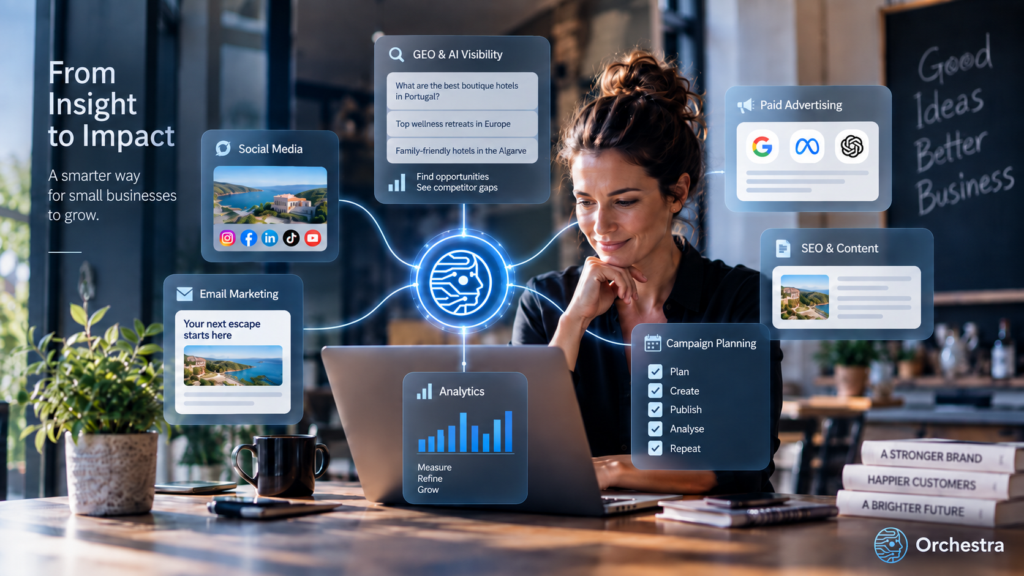
This is the model we are building at Orchestra Ads, which I founded. The platform uses specialised AI agents across areas including SEO, GEO intelligence, advertising, email and social content. An orchestration layer is designed to maintain the business context and coordinate the work between them.
The intended benefit is continuity. A competitor finding can inform a campaign angle. That campaign can generate related social content, email drafts and landing-page recommendations, all working from the same account of the business and its objectives. The GEO-to-advertising example illustrates the approach: research becomes a brief that can guide campaign preparation, with execution depending on the channel and the integration available.
We built Orchestra for small businesses and lean teams that might otherwise use an agency, freelancers or several specialist applications. Its ambition includes replacing the day-to-day agency relationship for businesses whose needs can be served through repeatable planning, production and campaign workflows.
That ambition sets a demanding standard. Such a product has to retain accurate context, keep outputs consistent and leave owners with a manageable amount of review. A shared dashboard alone achieves little. The work passing between its functions has to remain useful and trustworthy.
For buyers, the sensible assessment is practical: take a real campaign through the system and measure the time, corrections and outside assistance required to complete it. That reveals much more than the number of agents or features on a product page.
Where Agency Replacement Actually Makes Sense
Agency replacement is likely to happen unevenly. A substantial rebrand, a complex media programme or an original creative concept can justify experienced specialists. Businesses with large budgets also pay for accountability, judgement and the ability to manage consequential decisions.
Small companies face a different calculation. Their recurring requirements may centre on a manageable set of offers, audiences and channels. For these businesses, software that reliably handles planning, content, email, search analysis and campaign preparation can take over a substantial share of the work previously bought through a retainer.
The owner’s involvement matters as much as the invoice. Repeated briefing, corrections and follow-ups can make an apparently affordable service expensive in practice. An AI platform earns its place when it reduces that burden while producing work the business can use with confidence.
There will also be mixed arrangements: software for routine activity, with an agency or freelancer brought in for specialist assignments. The balance should follow the quality of the work and the needs of the business. A sensible review includes time to approval, cost per completed campaign, qualified enquiries and the amount of outside support still required.
The Next Competitive Advantage Is Coordination
The economics become more interesting when a research finding can be carried through to a campaign, distributed across suitable channels and assessed against results. Less time is lost translating information between suppliers and tools. The business can spend more attention on the decisions that affect its customers and margins.
For smaller companies, this is a meaningful opportunity. Work that once demanded several specialists can increasingly be supported within a common system, provided the business supplies sound information and keeps responsibility for commercial decisions.
The competitive advantage will depend on how well that system turns knowledge into action. A useful platform should leave the owner with fewer corrections, a clearer view of what is happening and more time to run the business. Those are concrete outcomes against which the promise of AI marketing can be judged.