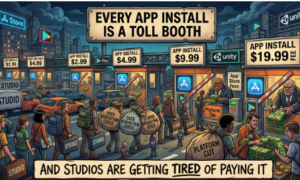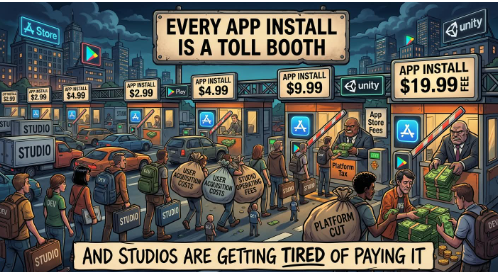
I sat in on a budget review a while back where a studio’s growth lead spent twenty minutes defending a single line item: the cost of getting someone from a Facebook ad to a completed app install. Not to a paying player. Not to a returning one. Just to the install itself. Everyone in that room treated the number as fixed, like weather. It isn’t. It’s a toll, and a growing number of entertainment companies have started asking why they keep paying it at all.
That question is what’s actually driving the shift toward browser-based play, more than any headline about convenience.
The Real Cost Sits Between Discovery and the First Click
Businesses obsess over interface friction, shorter forms, fewer taps at checkout, that kind of thing. Distribution friction gets far less attention, and it’s arguably more expensive.
Say someone runs across your game through a search result, a friend’s message, or a stray mention in an article. Their interest is real in that moment, but it’s thin. It hasn’t survived anything yet.
Send them straight into the experience and that interest carries forward mostly intact. Send them off to hunt down an app instead, and you’ve handed them a small pile of new decisions to make first. Is this worth the storage space? Do I trust the developer? Do I really want another account and another password?
None of those questions kills a conversion by itself. Stacked together, though, they’re exactly where a chunk of paid traffic quietly evaporates. And the company already spent the money to earn that attention, whether it came from an ad buy, a search ranking, a press mention, or a friend doing free marketing on their behalf. Losing people in that gap after the spend has already happened is about as inefficient as marketing gets.
Browsers Stopped Being the Cheap Seats
None of this economic argument matters if a browser can only deliver a watered-down version of the real thing. That used to be true. It isn’t anymore, and the timeline of why is worth walking through.
HTML5 phased out the plugin dependency that made web games feel disposable a decade ago. JavaScript engines got dramatically faster in the years since. WebGL put real graphics hardware behind browser tabs, and WebAssembly opened the door to running code that used to require native compilation.
Mobile browsers caught up on a parallel track. Responsive layouts now stretch cleanly from a phone screen to a widescreen monitor without anyone rebuilding the product twice. Touch input, audio, local storage, full-screen mode- these are just standard tools now, not stretch goals.
What changed for entertainment businesses is the math, not the ambition. A native app can still squeeze out more performance in specific cases. But a studio no longer needs an app just to make something feel polished. I’d argue that’s the more important shift here, even though it gets less coverage than the flashy technical stuff.
App Stores Bought You Trust, and Sold You a Toll
Give app stores their due. They solved real problems: trusted marketplaces, standardized installs, built-in payments, and a combined audience in the billions. Underselling that would be dishonest.
But centralized distribution comes with a leash attached. Any company living mostly inside a marketplace has to play by its approval timelines, its ranking algorithm, its policy changes, none of which the developer controls. A platform tweak can quietly tank discoverability overnight, and there’s no appeal process that moves fast enough to matter.
The web runs on different rules. A studio can push an update straight from its own servers the moment it’s ready. A campaign can point traffic at a specific page built for that exact audience instead of a generic store listing everyone sees. Search engines index individual pages on their own terms. Links spread through group chats, QR codes, and email without asking anyone’s permission first.
None of this means abandoning app stores, and I haven’t met a serious operator who thinks it should. It just means the store stops being the only road into the building.
The Hyperlink Might Be the Cheapest Salesperson in Gaming
The link is unglamorous technology. Nobody puts “improved our hyperlink strategy” on a slide at a conference. But as a distribution tool, it punches well above its reputation.
Links cost nothing to send and travel almost anywhere a person already is. A recommendation dropped in a group chat becomes an entry point instantly. A QR code on a poster at a bus stop can open the exact same experience on someone’s phone within seconds of them scanning it. Nobody has to translate their curiosity into an app-store search first.
That’s the edge browser-first platforms like slot online have that a store listing never will: the same mechanism that gets someone curious can also be the mechanism that gets them playing. Discovery and first contact collapse into the same moment instead of two separate steps with a gap between them where interest goes to die.
For a business paying real money per click, shrinking that gap by even a little bit shows up directly in the acquisition numbers.
Shipping a Fix Shouldn’t Require Everyone’s Permission
The economics don’t stop once someone’s acquired. Native apps carry ongoing maintenance across operating system versions, device models, and store review cycles, and a chunk of your audience will sit on an old version for months without noticing or caring.
Web products have their own real engineering headaches around browser compatibility and infrastructure, so I won’t pretend this side is maintenance-free. But deployment behaves differently. A studio can ship a fix from the server and have it live for everyone within minutes, no waiting on anyone to open a store app and tap update.
That flexibility changes how teams experiment, too. You can roll a new feature out to ten percent of visitors, watch what happens, and adjust before committing further. Try doing that cleanly through a formal app release cycle. Companies running fast-moving live-service games lean on this constantly, even when they’d never call it out as a competitive advantage in public.
Attention Spans Didn’t Shrink. Patience for Extra Steps Did
Here’s a factor that has nothing to do with code. Phones turned entertainment into something people grab in fragments, standing in a checkout line, waiting for a bus, killing four minutes before a meeting starts.
That kind of moment changes what a minute is actually worth. Objectively, sixty seconds is nothing. Subjectively, when someone’s only half-committed to checking out a game their coworker mentioned, that minute can eat most of the goodwill they were willing to spend.
Instant-access design fits that behavior because it lets someone evaluate before they commit to anything. Take a fishing-style arcade title like Slot Gacor, which runs directly in a mobile browser with no install step standing between the tap and the gameplay. That’s not an isolated case. It’s part of a broader pattern of studios recognizing that whether someone sticks around is a separate question from whether they even get the chance to look.
For the business side, that separation matters more than it sounds like it should. Asking for commitment after someone’s already seen value is a completely different sales pitch than asking for it up front, sight unseen.
Easy In Means Easy Out, and That’s the Trade-Off Nobody Mentions
There’s a less flattering side to all of this. If getting in takes nothing, getting out costs just as little.
An app sits on a home screen. It has an icon, maybe a notification badge, some small daily reminder of its existence. Installing it is itself a tiny commitment that nudges someone toward coming back. A browser tab carries none of that weight. Close it, and it’s gone, no residue left behind.
So a slow load, a confusing menu, or a popup demanding a rating before anyone’s played a single round can end a session in seconds, because there’s no sunk cost holding the visitor in place. This doesn’t mean browser distribution solves acquisition. It relocates the hard part earlier and makes it less forgiving.
Load time turns into a revenue metric instead of an engineering footnote. Interface clarity affects conversion directly. The margin for a clumsy first impression basically disappears.
Nobody Actually Has to Pick a Side Here
Treating this as browser versus app misses what’s actually happening. Native software still wins clearly in specific situations: deep hardware access, real offline functionality, background processes, push notifications that behave properly.
Browsers bring a different set of strengths instead: immediate access, links that work everywhere, easier sampling, and a lower bar for someone to just try the thing. These aren’t competing for the same job.
A player might find a game through a shared link, dive in through the browser, come back a few times over a week, and eventually install the app because it’s earned that spot on their phone. That flips the old assumption that installation has to come first, and honestly, I think that’s the healthier order for everyone involved. The highest-friction ask gets postponed until there’s an actual reason for someone to say yes to it.
Distribution Quietly Became a Product Decision
The shift here goes beyond gaming specifically. For years, distribution sat in the marketing column: build the thing, then figure out how to get it in front of people. That separation is breaking down.
How fast can someone go from curious to actually playing? Does a shared link drop them into something useful immediately, or into another decision tree? Does progress survive a jump from a phone to a laptop later that night? At what point does asking for an install actually earn its keep instead of just adding a hurdle? Those questions now belong to product and engineering as much as marketing.
App stores aren’t going anywhere, and their trust, scale, and built-in payment systems are hard to replace with anything else. But they’ve stopped being the only credible way in the door, and companies that keep treating them as the default are going to keep paying a toll that competitors have started routing around.
The install screen isn’t dead. It’s just no longer the first thing a curious player has to get through, and in a business built around fighting for a few seconds of someone’s attention, that one change is worth more than it looks like on paper.