
Better Together: Why 2-Seater Electric Trikes Are Redefining Senior Retirement Mobility

I. Introduction
Retirement was supposed to mean more time together, not less. Yet for thousands of couples, the bicycle — that symbol of easy, sunny freedom — quietly becomes a wedge. One partner still has strong legs and pulls ahead. The other worries about a wobble at the stop sign, or about clipping a foot on the way down from a high top tube. So one bike stays in the garage, and shared rides slowly turn into solo ones.
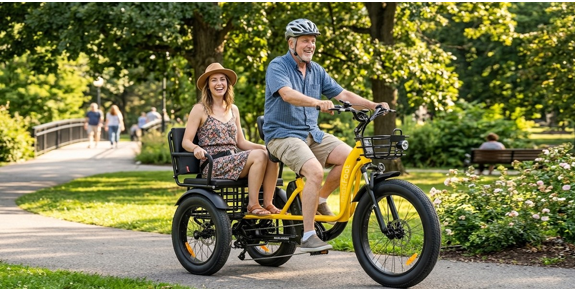
A different machine has been solving that problem: the step-through electric tricycle fitted with a built-in rear passenger seat, padded backrest, armrests, and footrests. It is not a mobility scooter, and it is not a bicycle with an accessory bolted on. It is a purpose-built electric trike with passenger seat designed so that one person rides and the other simply enjoys the ride.
This guide looks at what actually matters when you evaluate a 2-seater for retirement-age riders: passenger ergonomics, dual-adult power delivery, and the safety hardware that turns a nice idea into a machine you trust every day.
II. Comfort-First Passenger Ergonomics for Older Adults
Comfort on a passenger trike is not a cushion question. It is a geometry question, and it begins before the wheels turn.
The step-through frame does the heavy lifting. Swinging a leg over a rear wheel is the single most common failure point for older riders — it demands hip flexibility and one-legged balance at the same moment. A deep step-through opening lets both the rider and the passenger step *into* the machine rather than climb *over* it. On a three-wheel platform the trike does not lean while you do it, which removes the small, constant anxiety that makes people give up cycling in the first place.
The rear seat has to be a seat, not a rack. Look for these details when you compare models:
- A wide, thickly padded saddle rather than a flat cargo deck with a pad thrown on top
- A real backrest, so the passenger is not bracing their core for the entire ride
- Side armrests or handgrips that give the hands somewhere secure to go
- Fixed footrests positioned so the knees sit at a relaxed angle, not tucked up
- A rear platform wide enough that the passenger sits *in* the trike, not perched on it
Zero balancing at a standstill. This is the feature retirees mention most after their first ride. When you stop to greet a neighbour, admire a view, or wait at a crossing, nobody has to put a foot down and nobody has to hold the bike up. Three wheels stand on their own, with a passenger on board, indefinitely. Conversation happens at the kerb instead of after it.
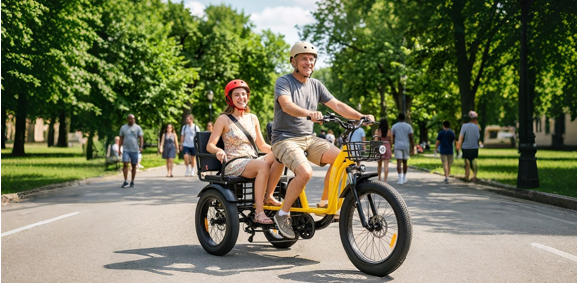
Image alt text: Two riders enjoying a shared outing on an electric passenger trike along a tree-lined park road
III. Smooth 2-Person Power Delivery and Heavy Load Dynamics
Here is the engineering reality that separates a genuine two-person machine from a single-rider trike with a seat added: moving roughly 350 pounds of rider, passenger, and vehicle from a dead stop is a completely different mechanical job than moving 180.
Torque matters more than top speed. A rear-drive brushless geared motor rated at 750W nominal — with peak output around 1400W and roughly 85Nm of torque, as on the MaxFoot MF-33 — is not about going fast. That reserve exists so the motor does not strain, overheat, or lurch when it pulls two adults away from a stop light or up a neighbourhood grade. Smooth, unhurried acceleration is what a passenger feels as safety.
A rear differential is the quiet hero. Cheaper trikes drive only one rear wheel, or lock both rear wheels to a single rigid axle. The first pulls the trike sideways under load; the second forces the inside wheel to scrub during turns. A true rear differential lets the outer wheel turn faster than the inner one through a corner, so both rear tires keep gripping and the trike tracks where you point it — even with a passenger’s weight sitting right over the rear axle.
Pedal assist keeps the rider in charge. A 5-level pedal-assist system with a speed sensor means the person up front chooses how hard they work. Level 1 is a gentle nudge for a real workout; level 5 handles a headwind and a hill while the passenger relaxes completely. A half-twist throttle adds a no-pedal option for the moments when legs are tired.
Capacity is a safety spec, not a bragging spec. A heavy duty electric tricycle for 2 adults should be rated for the whole job. The MF-33 is a useful benchmark here: 500 lbs of total payload, up to three riders and passengers, a 6061 aluminium-alloy front frame paired with a 7A19 aluminium-alloy rear frame, and 24-inch front and 20-inch rear fat tires that soak up path seams. Two adults plus a market bag should sit comfortably inside a trike’s rating, never near its limit. If you are shopping across brands, comparing rated payloads on passenger and cargo trike line-ups is the fastest way to separate real dual-rider builds from marketing.
Range under two riders. Carrying a second adult draws more current, so expect real-world range below the headline figure. A 48V 20Ah battery built with Samsung 21700 cells and certified to UL-2271 — quoted at up to 85 miles at PAS 1 — leaves ample margin for the 10 to 20 mile loops most retired couples actually ride, even with the assist turned up.
IV. Senior-Friendly Safety Features for 2-Passenger Cruising
Retirement communities are deceptively busy: golf carts, delivery vans, dog walkers, low winter sun.
- Be seen, and signal. An integrated system of headlight, brake light, and turn signals — wired into the frame rather than clipped on — tells drivers what you intend to do before you do it. Hand signals are hard when a passenger’s weight makes you want both hands on the bars.
- Stopping a loaded trike. Dual rear disc brakes working with a front disc give you three friction surfaces to shed the momentum of two adults. Discs also hold their bite when wet, which cable-pull rim brakes do not.
- The parking brake is underrated. A handlebar parking lock keeps the trike still on a sloped driveway while your passenger steps in or out. It removes the awkward moment where the rider has to be both brake and spotter.
V. Conclusion
The value of a 2-seater is not really mechanical. It is that a ride stops being something one of you does alone. Shared outings mean more daylight, more movement, more conversation — and for the partner who no longer feels safe on two wheels, an invitation back outdoors rather than a polite excuse to stay in.
If a passenger trike sounds like your next chapter, do the same thing you would do with a car: sit in the passenger seat first. Ride a loop as the passenger, then as the driver, and pay attention to the step-through height, the backrest, and how the trike behaves at a stop. Brands such as MaxFoot publish full payload and drivetrain specifications, so bring the numbers with you and compare what you feel against what is claimed.
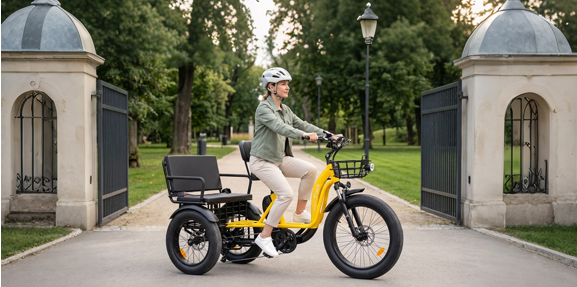
Image alt text: Step-through electric tricycle for adults with passenger seat parked on a park path, showing the padded rear bench and backrest







Comment